
In This Article
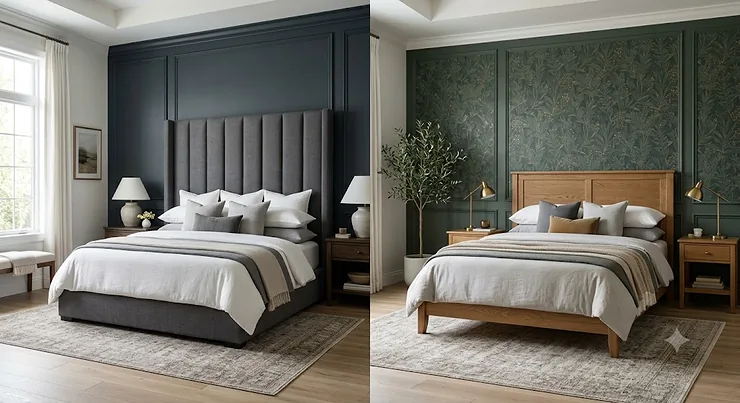
Here’s the thing nobody tells you before you start scrolling bed frame listings at midnight: the headboard is doing more work than you think. It’s not just the thing you lean on while you scroll your phone before sleep — it’s the single largest piece of “art” most bedrooms ever hang. So the tall headboard vs standard headboard for statement walls debate isn’t really about inches. It’s about whether your bedroom has a moment or just a b

A tall headboard, generally anything from about 48 to 60+ inches above the mattress, is built to dominate a wall the way a piece of gallery art would — stretching upward to fill vertical space and pull the eye toward the bed as the room’s obvious focal point. A standard headboard, typically 30 to 46 inches, plays a quieter supporting role: present, comfortable, and proportionate, but not the star of the show. Neither is objectively “better.” One is a design statement; the other is a design foundation.
We spent time digging into real product specs, aggregated customer feedback, and interior design guidance to figure out when height actually earns its keep — and when a standard headboard is the smarter, more proportionate call. Below you’ll find seven real headboards spanning budget to premium, a breakdown of the proportion math designers actually use, and enough practical detail to make the decision without a decorator on retainer.
Quick Comparison: Tall vs Standard Headboards at a Glance
Before the deep dive, here’s the shape of the decision. Ceiling height sets the ceiling (pun intended) on how tall you can go — as one designer note puts it, taller ceilings can comfortably carry larger, more stately furniture, while lower ceilings look better with low-slung pieces, according to Havenly’s guide to scale.
| Factor | Tall Headboard | Standard Headboard | Best For |
|---|---|---|---|
| Typical height | 48″–60″+ | 30″–46″ | Tall = statement walls; Standard = versatility |
| Ceiling requirement | 9 ft+ ideal | Works with 8 ft standard | Match to your actual ceiling |
| Visual role | Focal point / art substitute | Supporting furniture piece | Tall = drama; Standard = balance |
| Price range | Mid to premium | Budget to mid | Standard = lower cost of entry |
| Small room impact | Can feel heavy if oversized | Keeps room feeling open | Standard for compact bedrooms |
The takeaway here is that this isn’t a “which is better” question so much as a “which matches your architecture” question. A LARMACE 54-inch wingback in a room with an 8-foot ceiling will look like it’s trying to escape through the crown molding, while that same headboard in a 9- or 10-foot room reads as intentional and grand. Meanwhile, a standard-height headboard like the Modway Clique works almost anywhere because it never asks the room to accommodate it — it just fits in.
📐 Not sure which height suits your room? Measure your ceiling first — it’ll save you a return shipping label.
Top 7 Tall and Standard Headboards: Expert Analysis
1. LARMACE 54.2″ Extra Tall Wingback Headboard — most dramatic statement-wall option
The LARMACE platform bed’s defining feature is right there in the name — at 54.2 inches, it’s built specifically to command an oversized headboard bedroom moment rather than just support a mattress. That height, combined with a wingback silhouette, means the piece reads more like upholstered architecture than furniture.
Under the lambswool-style upholstery sits a solid wood frame with reinforced slats, and the platform design skips the box spring entirely — a detail that matters if you’re already working with a lower ceiling and don’t want the mattress height eating into your headroom. Built-in charging ports on the frame are a genuinely useful touch for anyone who’s tired of trailing a phone cord across the comforter.
Based on the spec sheet, this is the pick for bedrooms with at least a 9-foot ceiling and a wall that currently feels a little empty and impersonal. Reviewers consistently report that the wingback shape looks noticeably more upscale in person than in photos, though several buyers note the extra-tall design means it needs two people for assembly since the panel itself is unwieldy at that height.
Pros:
- ✅ Genuinely statement-making scale for high-ceiling rooms
- ✅ Built-in charging ports save nightstand clutter
- ✅ No box spring needed, simplifying setup
Cons:
- ❌ Two-person assembly recommended at this height
- ❌ Overwhelms rooms with standard 8-foot ceilings
Expect to pay in the mid-$300s to low-$400s range, and given the assembly quality and included charging hardware, that’s a reasonable value for a genuine focal-point piece — check current price before buying since availability and bundled deals shift often.
2. WATHPUR 54.8″ Tall Headboard with 3-Tier Storage — best for small bedrooms that still want height
The WATHPUR solves a real problem: how do you get statement-wall height without sacrificing the storage a smaller bedroom desperately needs? Its three-tier shelving built into the headboard itself gives you display and storage space that a flat panel headboard simply can’t offer.
At 54.8 inches, the linen-upholstered face still delivers plenty of vertical drama, while the shelving cuts down on how “heavy” that height feels visually — the negative space created by the shelves keeps the eye from reading the whole thing as one dense block. USB and USB-C ports are integrated directly into the frame, plus an LED light strip for reading or ambient nighttime glow.
What most buyers overlook about a shelved headboard like this is that it effectively replaces a nightstand-adjacent bookshelf, which is a real space-saver in apartments or guest rooms doing double duty. Aggregated review sentiment points to strong satisfaction with the LED lighting feature specifically, with a common complaint centering on the assembly instructions being harder to follow than the hardware itself warrants.
Pros:
- ✅ Storage shelving offsets the visual weight of extra height
- ✅ Integrated USB, USB-C, and LED lighting
- ✅ Doubles as bookshelf, cutting need for extra furniture
Cons:
- ❌ Assembly instructions reportedly unclear for some buyers
- ❌ Linen upholstery shows marks more than darker fabrics
Priced in the $200-$300 range at the time of research, it’s one of the stronger value plays among tall options if storage matters as much as the statement-wall look.
3. Garvee 50.6″ Tall Wingback Headboard — best budget entry into tall headboards
The Garvee wingback proves you don’t need a premium price tag to get real height. At 50.6 inches, it clears the 46-inch line most designers use to separate “standard” from “tall,” while staying priced closer to entry-level furniture.
Corduroy upholstery over high-density sponge padding gives it a textured, tactile presence that reads more expensive than the price point suggests, and the sturdy wood frame underneath keeps it from feeling flimsy despite the accessible cost. On paper, this is what a budget-conscious statement wall looks like: enough height to matter, enough texture to feel intentional, without the premium finish costs of wingback pieces from higher-end brands.
Here’s what the spec sheet won’t tell you, but reviewers note: corduroy is forgiving of dust and pet hair compared to velvet, which matters more than people expect once the headboard’s actually living in a real bedroom. A common thread in customer feedback is praise for the assembly speed, with the main complaint being limited color options compared to competitors.
Pros:
- ✅ Genuine tall-headboard height at a budget price
- ✅ Corduroy texture hides everyday wear well
- ✅ Fast, straightforward assembly per reviewer feedback
Cons:
- ❌ Limited color and fabric options
- ❌ Full-size only, limiting bed-size flexibility
Look for it in the under-$200 range, which makes it arguably the best value-for-height ratio on this entire list.
4. Prepac Sonoma 55.75″ Bookcase Headboard — best for function-first statement walls
The Prepac Sonoma takes a completely different approach to tall — instead of upholstered drama, it delivers height through a slant-back bookcase design that puts every one of those 55.75 inches to functional use. This is transformation-through-furniture: a headboard that behaves like built-in storage.
Constructed from engineered wood in an espresso or black finish, the bookcase back offers real shelving depth (10.25 inches) rather than the shallow display ledges some upholstered tall headboards include as an afterthought. For anyone who reads in bed, keeps a nightstand’s worth of books within arm’s reach, or just wants a non-fabric option that won’t show stains, this changes the calculation entirely.
Based on the spec comparison with upholstered tall options, the Sonoma sacrifices the “soft statement wall” look for genuine daily utility — a trade-off worth making if your bedroom doubles as a reading nook. Reviewers consistently note the shelving is sturdy enough for actual hardcover books rather than just decorative objects, though some mention the finish can show assembly-hardware marks if installed without care.
Pros:
- ✅ Real functional shelving at true tall-headboard height
- ✅ Non-fabric finish resists stains and wear
- ✅ Sturdy enough for actual books, not just décor
Cons:
- ❌ Assembly hardware marks can show on finish if rushed
- ❌ Lacks the soft, plush look some statement walls want
Expect a price in the $250-$350 range depending on finish, positioning it as a mid-range pick that prioritizes function over pure visual drama.
5. COCO DESIGN 80″ Wide Fluted Wingback Headboard — best oversized statement piece for wide walls
Where the LARMACE and WATHPUR win on vertical height, the COCO DESIGN wins on horizontal presence — an 80-inch-wide king headboard with fluted wood panel detailing that turns an entire wall section into a mid-century-meets-farmhouse focal point. This is the pick for anyone whose “statement wall” problem is width as much as height.
The walnut fluted panels bring texture and warmth without upholstery, wall-mounted for a floating, architectural look rather than a bulky furniture silhouette. Because it’s wall-mounted rather than resting on bed-frame legs, it visually reads even taller and more integrated into the wall itself than its actual dimensions suggest.
What most buyers overlook about fluted wood designs like this is how much they read as “built-in millinery” rather than “furniture you bought,” which is exactly the effect a statement-wall bed decor project is usually chasing. Aggregated reviews highlight the walnut finish’s richness in person, with the main criticism being that wall-mounting requires more precise stud-finding than bed-frame-mounted alternatives.
Pros:
- ✅ 80-inch width makes an unmissable focal point
- ✅ Wall-mounted design looks architecturally built-in
- ✅ Fluted walnut panels add texture without upholstery upkeep
Cons:
- ❌ Wall-mounting demands precise stud location
- ❌ King-size only, no smaller-bed option
Pricing typically falls in the $300-$450 range, which is reasonable for a piece doing double duty as both headboard and wall art.
6. Lucid Mid-Rise Upholstered Headboard — best standard-height headboard for maximum flexibility
Not every statement wall needs to shout, and the Lucid Mid-Rise is the clearest standard-height counterpoint on this list. Its adjustable range of 34 to 46 inches sits it firmly in “standard” territory by most designers’ definitions, and that’s precisely the point — this headboard is engineered to fit almost any bedroom without a proportion recalculation.
Diamond-tufted padded polyester upholstery gives it a classic, hotel-headboard look, and — critically — the adjustable height mounting means the same headboard can sit lower in an 8-foot-ceiling room or slightly higher in a room with more vertical space, without ever crossing into “too tall for this ceiling” territory.
Here’s the honest analysis: if your priority is genuinely proportion in interior design rather than drama, a headboard that adapts to your specific wall rather than forcing your wall to adapt to it is the smarter long-term investment. Reviewers consistently praise the adjustability as the standout feature, with the most common complaint being that the tufting can loosen slightly after a year or more of regular use.
Pros:
- ✅ Adjustable height fits almost any ceiling proportion
- ✅ Classic diamond tufting suits multiple decor styles
- ✅ Works as bed-frame mount or wall mount
Cons:
- ❌ Tufting may loosen with extended daily use
- ❌ Lacks the dramatic scale of true tall options
Priced in the $150-$250 range, it’s one of the more budget-friendly standard options with genuine styling flexibility.
7. Modway Clique Tufted Button Diamond Headboard — best classic standard headboard for budget statement walls
Closing the list is the Modway Clique, a linen-upholstered, button-tufted standard headboard that proves “standard” doesn’t have to mean “boring.” At a queen-size standard height, it delivers a diamond-pattern tufted texture that reads as considered and finished, without asking your ceiling or wall to accommodate anything unusual.
The linen fabric upholstery holds structure well over time compared to cheaper polyester blends, and the panel mounts directly to most standard bed frames without requiring special wall hardware — a meaningful advantage for renters who can’t drill into walls for a floating wingback design.
Based on the spec comparison against the taller pieces on this list, the Clique’s real strength is universality: it works in a studio apartment, a guest room, or a primary bedroom with equal ease, because it was never designed to be the loudest thing in the room. A common theme in aggregated customer feedback is appreciation for how the tufting holds its shape, with occasional notes that the linen can wrinkle slightly during shipping and needs a day to relax back into place.
Pros:
- ✅ Classic tufted texture upgrades a plain bed frame
- ✅ Mounts to standard frames without wall hardware
- ✅ Linen fabric holds shape better than cheaper blends
Cons:
- ❌ Fabric can arrive wrinkled and needs settling time
- ❌ Lacks the oversized headboard bedroom “wow factor”
Expect pricing in the $80-$150 range, making it the most accessible entry point on this list for anyone testing whether a statement wall is even the right move for their space.
💬 Which height won you over — the drama of tall, or the ease of standard? Save this comparison so you’re not guessing at the store.
Practical Usage Guide: Setting Up Your Statement-Wall Headboard
Getting a tall headboard home is only step one — installation and first-month care determine whether it actually looks like the photos. Start by measuring your ceiling height and the distance from your bed frame’s intended position to the ceiling; leave at least 6-8 inches of breathing room above the tallest point of a wingback or bookcase design so it doesn’t visually collide with crown molding or a ceiling fan.
For wall-mounted options like the COCO DESIGN fluted panel, locate wall studs before drilling — a stud finder is worth the $15, since drywall anchors alone often aren’t rated for the sustained weight of a wide upholstered or wood panel. Bed-frame-mounted tall headboards like the LARMACE or Garvee need a second set of hands during assembly; the panel’s height makes it top-heavy and awkward for one person to hold steady while securing brackets.
In the first 30 days, resist the urge to over-accessorize the wall around a tall headboard — the common mistake is layering art, sconces, and shelving onto a wall that’s already doing its job as the focal point. Let the headboard breathe for a few weeks before deciding what (if anything) needs to go beside it. For maintenance, vacuum upholstered panels monthly with a soft brush attachment, and check bracket hardware every six months, since headboards mounted higher on the wall experience more leverage-based stress on their fasteners than low-profile designs.
Real-World Scenarios: Matching Headboard Height to Your Life
Not every bedroom situation calls for the same decision, so here’s how three common buyer profiles actually shake out. If you’re a first-time homeowner with a 9-foot ceiling and an empty primary bedroom wall, a tall wingback like the LARMACE or WATHPUR solves two problems simultaneously — it fills vertical space that would otherwise feel unfinished, and it removes the need to buy separate wall art for that same spot.
If you’re renting a studio apartment with standard 8-foot ceilings and a lease that prohibits wall drilling, the Modway Clique or Lucid Mid-Rise make far more sense: both mount to the bed frame itself, both work at heights that won’t crowd a lower ceiling, and neither requires landlord approval for wall modifications. If you’re furnishing a guest room or a small home office that occasionally becomes a bedroom, the WATHPUR‘s built-in shelving earns its keep by replacing a nightstand and a small bookshelf in one footprint — genuinely useful in rooms where every square foot is doing multiple jobs.
A fourth, often-overlooked case: households with young children in the home should also weigh wall-mounted tall headboards against the practical anti-tip guidance that the U.S. Consumer Product Safety Commission publishes for securing furniture to walls, since a taller, top-heavy panel benefits from the same anchoring logic as a dresser or bookshelf.
Problem → Solution: Fixing the Most Common Statement-Wall Headboard Mistakes
Problem one: the headboard looks too small against a large wall. Solution — measure the actual wall width and aim for a headboard that spans at least 75-80% of the bed’s width at minimum, or consider a wider option like the COCO DESIGN if the wall itself is unusually large. Problem two: a tall headboard makes a low-ceiling room feel cramped instead of grand. Solution — swap to a standard-height option like the Modway Clique, which won’t compete with a lower ceiling line.
Problem three: an oversized headboard bedroom that used to feel cozy now feels sparse and cold. Solution — the height itself isn’t the issue; it’s usually a lack of layered texture elsewhere in the room, so add a textured throw, layered pillows, or a rug to rebalance the visual weight the headboard introduced. Problem four: assembly instructions for tall wingback designs are confusing multiple owners in reviews. Solution — watch the manufacturer’s install video before starting, and recruit a second person specifically for the panel-lifting step, not just general assembly. Problem five: a wall-mounted design won’t stay level over time. Solution — re-check and re-tighten mounting brackets every six months, since taller panels place more torque on hardware than low-profile designs.
How to Choose Between a Tall Headboard and a Standard Headboard
What is a tall headboard vs standard headboard? A tall headboard generally rises 48 to 60+ inches above the mattress and is designed to function as a statement wall focal point, while a standard headboard sits around 30 to 46 inches and prioritizes proportion and versatility over visual drama.
Here’s how to actually decide, step by step:
- Measure your ceiling height first. Rooms under 8.5 feet generally look better with standard headboards; 9 feet and above can comfortably support tall options.
- Check your wall’s actual width, not just the bed’s width — a too-narrow headboard on a wide wall looks stranded regardless of height.
- Decide if the headboard needs to replace wall art. If the wall is otherwise bare, tall headboards do double duty as both furniture and focal point.
- Consider your lease or ownership status. Wall-mounted tall designs need drilling rights; bed-frame-mounted standard options don’t.
- Factor in storage needs. A bookcase-style tall headboard like the Prepac Sonoma can replace a nightstand shelf; a flat standard panel can’t.
- Weigh maintenance tolerance. Taller upholstered panels show more surface area for dust and wear, requiring more frequent care.
- Set a realistic budget band, since tall statement pieces generally command a premium over standard designs of comparable materials.
✨ Ready to shop your pick? The right height is only half the equation — fabric and finish matter just as much.
Tall Headboard vs Standard Headboard: The Real Difference for Statement Walls
The core distinction isn’t really about inches — it’s about what job the headboard is being asked to do. A tall headboard is being asked to perform as art: it needs to visually justify the wall space it occupies the same way a large canvas would, which is exactly why interior designers apply similar proportional logic to headboards as they do to hanging wall art above furniture, generally aiming for the piece to feel intentionally scaled to what’s below and around it, per design guidance on proportional relationships between furniture and adjacent elements.
A standard headboard, by contrast, is being asked to perform as furniture — comfortable, functional, unobtrusive. Neither role is wrong, but conflating them is where statement walls go sideways. A room with an 8-foot ceiling and heavy crown molding will make even a beautifully built tall headboard look like it’s fighting the architecture, while a soaring 10-foot loft bedroom with a standard-height headboard can end up feeling under-furnished, like the wall never got finished. The honest analysis: match the headboard’s role to what your specific wall actually needs, not to what looks best in a showroom photo taken in a different room entirely.
High-Ceiling Bedroom Design: When Height Becomes Essential
High-ceiling bedroom design changes the entire proportion equation, and it’s the single biggest variable in whether a tall headboard reads as intentional or oversized. In rooms with 9-to-12-foot ceilings, low-profile standard headboards can actually look under-scaled, leaving a visual gap between the top of the bed and the ceiling line that reads as unfinished rather than airy.
This is where a tall wingback like the LARMACE or a wide statement piece like the COCO DESIGN genuinely earns its premium price — it fills that vertical gap the way a large art installation would, anchoring the eye to the bed instead of letting it drift upward into empty wall space. What most buyers overlook in high-ceiling rooms specifically is that height alone isn’t enough; a tall headboard paired with low, sparse surrounding furniture can still look lonely. Pair height with layered bedding, substantial nightstands, and at minimum one additional vertical element (a floor mirror or tall plant) to keep the whole composition, not just the headboard, in proportion with the ceiling.
Oversized Headboard Bedroom Ideas for a Genuine Focal Point
An oversized headboard bedroom doesn’t have to mean matchy-matchy hotel decor — the most successful statement walls treat the headboard as one bold element balanced by restraint everywhere else in the room. Keep wall art off the headboard wall entirely and let the piece stand alone; competing focal points is the fastest way to undercut the drama you paid for.
Color contrast does a lot of the work here: a cream or walnut oversized headboard against a deeper accent wall color reads dramatically differently than the same piece against a plain white wall, even though the headboard itself hasn’t changed. For focal point decor that still feels warm rather than showroom-sterile, layer in asymmetric lighting — a single oversized sconce or pendant to one side of the headboard rather than a matched pair on both — since perfectly symmetrical setups can flatten the visual interest an oversized piece is supposed to create. The WATHPUR‘s built-in shelving is a natural fit here too, since it gives you a place to style small objects (a plant, a framed photo, a candle) without needing separate floating shelves elsewhere on the statement wall.
Common Mistakes When Buying a Statement Wall Headboard
The most common and expensive mistake is buying based on room photos rather than actual ceiling measurements — a headboard that looks perfectly scaled in a marketing photo shot in a 10-foot-ceiling studio can look absurd in an 8-foot suburban bedroom. A close second is ignoring bed size compatibility; a stunning king-size wingback doesn’t simply “adjust” to a queen frame, and mismatched mounting hardware is one of the most frequent return reasons cited in aggregated review data.
Buyers also frequently underestimate delivery footprint — a 54-inch-tall, fully assembled headboard box is large, and apartment buildings with narrow stairwells or small elevators can turn delivery day into a genuine logistical problem. Another overlooked issue is fabric durability versus household reality: plush velvet or boucle looks luxurious in photos but shows pet hair and spills far more visibly than a corduroy or linen blend, something worth weighing honestly before committing to a light-colored oversized piece. Finally, shoppers regularly skip verifying whether a headboard is wall-mount only, frame-mount only, or both — a detail that determines whether you’ll need a stud finder and drill or just a set of Allen keys.
Long-Term Cost & Maintenance for Tall vs Standard Headboards
Sticker price is only part of the ownership cost. Tall, wide, or wall-mounted headboards generally carry higher long-term maintenance simply because there’s more surface area to clean and more hardware under sustained structural stress. A 54-inch wingback panel has considerably more upholstered fabric exposed to dust, sunlight fading, and general wear than a 36-inch standard panel, which means more frequent vacuuming and, eventually, a shorter useful lifespan for lighter fabrics.
On the value side, though, a genuinely well-built tall statement piece can function as both furniture and decor, effectively replacing what would otherwise be a separate wall-art purchase — meaning the true cost-per-use math often favors the tall option once you factor in what you’re not buying separately. Standard headboards win on replacement cost and flexibility: because they’re less architecturally tied to a specific ceiling height, a standard piece can move with you to a new home more easily, while a tall statement headboard bought for a 10-foot loft may need replacing entirely if you move into a standard 8-foot-ceiling home. Budget-conscious buyers should weigh whether they’re likely to relocate in the next few years before investing heavily in height.
Features That Actually Matter (And Those That Don’t)
Height and proportion to your ceiling actually matter — everything else in this category is secondary to getting that relationship right. Mounting type (wall versus bed-frame) actually matters, since it determines both installation difficulty and whether you can take the piece with you when you move. Fabric durability actually matters more than fabric name-brand status; a well-constructed corduroy or linen blend will often outlast a premium-sounding velvet in daily household conditions.
What doesn’t matter nearly as much as marketing suggests: built-in LED lighting, while a nice bonus, rarely factors into long-term satisfaction according to aggregated review patterns, and several buyers report disabling it after the novelty wears off. Charging ports and USB hardware are genuinely convenient but shouldn’t be a deciding factor over height and proportion, since a simple power strip solves the same problem for a fraction of the cost. Tufting pattern (diamond versus channel versus plain) is almost entirely a style preference with no meaningful durability difference between them, so choose based on what matches your existing decor rather than assuming one pattern is objectively higher quality.
Safety and Wall-Mounting Guide for Tall Statement Headboards
Wall-mounted tall headboards carry real weight — often 40 to 80 pounds for a large upholstered or wood-panel design — and that weight matters most in households with children who might climb or lean on furniture. The safety logic here mirrors general furniture anti-tip guidance more than people expect: identify wall studs before mounting rather than relying on drywall anchors alone, use metal brackets rather than plastic ones where possible, and re-check hardware tension periodically, following the same general anchoring principles outlined by the CPSC’s furniture safety program for other tall, top-heavy furniture pieces.
For bed-frame-mounted tall headboards, the primary safety consideration is simply structural — confirm the frame’s weight rating accommodates the panel’s height and material before assembly, since a frame under-built for a 55-inch upholstered panel can develop wobble over time. Renters should also confirm with landlords before any wall-drilling installation, both for lease compliance and because larger anchor holes are more noticeable (and costly) to patch than standard picture-hanging holes at move-out.
Frequently Asked Questions
❓ What height counts as a tall headboard?
❓ Does a tall headboard work with an 8-foot ceiling?
❓ Are wall-mounted headboards safer than bed-frame-mounted ones?
❓ Do tall headboards cost significantly more than standard ones?
❓ Can a standard headboard still create a statement wall look?
Conclusion
The tall headboard vs standard headboard for statement walls decision really comes down to one honest question: does your room’s architecture want drama, or does it want balance? High ceilings, empty walls, and a taste for bold design tend to reward height — pieces like the LARMACE, WATHPUR, and COCO DESIGN all deliver genuine visual weight for rooms built to carry it. Lower ceilings, rental restrictions, or a preference for understated comfort tend to reward proportion instead, which is exactly where options like the Modway Clique and Lucid Mid-Rise consistently perform well.
There’s no universally “correct” answer here, only a correct answer for your specific wall, your ceiling height, and how much drama you actually want to wake up to every morning. Measure first, choose second, and let the room’s actual proportions — not the showroom photo — make the final call.
Recommended for You
- Headboard for a Room-Divider Look Behind a Sofa: 7 Picks (2026)
- 7 Best Headboards With Built-In Storage Shelves in 2026
- Headboard for Adjustable Bed Frame Attachment: 7 Best Kits 2026
Disclaimer: This article contains affiliate links. As an Amazon Associate, I earn from qualifying purchases. If you purchase products through these links, we may earn a small commission at no additional cost to you.
✨ Found this helpful? Share it with your friends! 💬🤗
