
In This Article
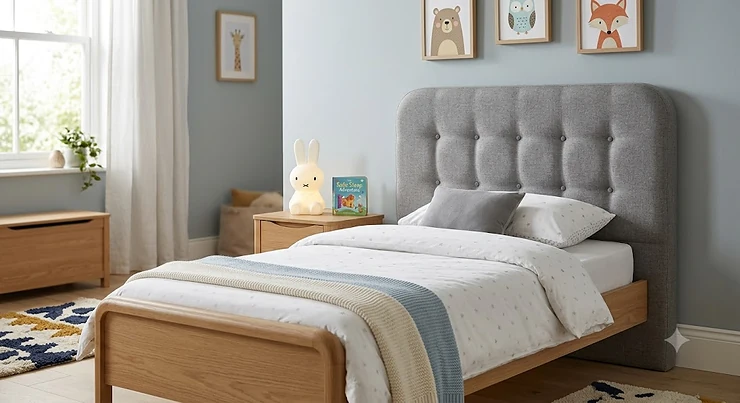
Somewhere between the third 2 a.m. thud and the fourth Band-Aid, most parents start Googling the exact phrase that brought you here. A headboard for kids bedroom safety isn’t a luxury upgrade — it’s the difference between a kid who bonks a soft, rounded edge and giggles, and one who catches a sharp MDF corner mid-somersault. So let’s define it plainly: a kid-safe headboard is bedroom furniture built with softened or rounded edges, non-toxic finishes, and secure anchoring hardware, engineered specifically to reduce injury risk for children who treat every piece of furniture like gymnastics equipment.
Furniture-related child injuries are a documented federal safety concern, not internet paranoia — CPSC data has linked hundreds of child fatalities to unstable, unanchored furniture, which is exactly why edge design and anchoring hardware deserve as much attention as color and style. Here’s the thing nobody tells you at the furniture store: most headboards aren’t designed with kids in mind at all. They’re scaled-down adult furniture — same sharp corners, same glossy solvent-based lacquers, same missing anti-tip brackets — just smaller. That gap is exactly why this guide exists. We dug through real product specs, aggregated review sentiment, and federal safety standards to build a shortlist that actually accounts for how kids sleep, climb, and occasionally use their bed as a launchpad.
Below, you’ll find seven real, currently available options spanning budget wood toddler beds to premium upholstered designs, plus the safety science behind rounded edges, non-toxic finishes, and anti-tip hardware — because a rounded edge headboard for children only protects your kid if the whole frame is anchored and finished correctly, too.
Quick Comparison Table: Headboard for Kids Bedroom Safety at a Glance
Before the deep dive, here’s the 30-second version for parents skimming this on a phone in the car line.
| Product | Edge Profile | Finish/Certification | Price Range | Best For |
|---|---|---|---|---|
| Delta Children Upholstered Twin Bed with Round Headboard | Fully padded, rounded | GREENGUARD Gold | $200-$300 range | Toddlers transitioning to a big-kid bed |
| Max & Lily Twin Low Bed with Panel Headboard | Rounded solid-wood edges | Low-VOC water-based finish | $250-$400 range | Families wanting solid wood durability |
| Graco Wood Toddler Bed | Smooth, low-profile rails | JPMA certified, non-toxic paint | Under $150 | Budget-conscious first toddler bed |
| Storkcraft Caribou Toddler Bed | Rounded guardrail edges | Non-toxic, low-VOC finish | Under $150 | Small rooms, tight budgets |
| Dream On Me Bailey Toddler Bed | Curved corner posts | Non-toxic paint | Under $150 | Nursery-to-toddler continuity |
| BarnFurin Boucle Upholstered Bed Frame | Cloud-soft rounded corners | OEKO-TEX-style fabric certification (verify listing) | $200-$350 range | Older kids and tweens who still headbutt walls |
| Little Seeds Monarch Hill Poppy Upholstered Twin Bed | Rounded arched headboard | Low-VOC engineered wood | $200-$300 range | Design-conscious parents, small guest rooms |
Looking at the table, the split is clear: the Graco Wood Toddler Bed, Storkcraft Caribou Toddler Bed, and Dream On Me Bailey Toddler Bed compete on price and are aimed at kids still transitioning from a crib, while the Delta Children Upholstered Twin Bed with Round Headboard, BarnFurin Boucle Upholstered Bed Frame, and Little Seeds Monarch Hill Poppy Upholstered Twin Bed trade a higher price for softer, fully-padded impact zones better suited to older, more active kids. The Max & Lily Twin Low Bed with Panel Headboard sits in the middle, pairing solid-wood longevity with a rounded profile that splits the difference between the two camps.
💬 Found a favorite already? Bookmark this page — you’ll want to compare specs again before you check out.
Top 7 Headboards for Kids Bedroom Safety: Expert Analysis
We picked these seven after cross-referencing real product listings, aggregated buyer sentiment, and certification data. Each one gets the full treatment: specs translated into real life, an honest take on who it fits, and a straight look at the tradeoffs.
1. Delta Children Upholstered Twin Bed with Round Headboard — deepest padding for active toddlers
The curved, channel-tufted headboard on this one isn’t just a design flourish — it’s genuinely the softest impact surface in this lineup. The bed’s low platform profile sits close to the floor, which matters more than people expect: a shorter drop means fewer serious falls when a toddler inevitably rolls out mid-nap. Built on a slatted wood frame, it skips the box spring entirely, and the whole unit carries GREENGUARD Gold certification, meaning it’s been tested for low chemical emissions in an enclosed space — a real distinction, not marketing fluff.
Based on the spec comparison, this bed is the strongest fit for households moving a toddler out of a crib for the first time, since the padded curve mimics the softness of a crib bumper without the suffocation risk bumpers carry. Reviewers consistently report that the tufted fabric holds up to leaning and climbing better than expected, though a few aggregated reviews note the fabric shows wear faster under rough-and-tumble siblings sharing a room.
Pros:
- ✅ Fully padded rounded headboard reduces bump severity
- ✅ GREENGUARD Gold certified for low emissions
- ✅ Low platform height limits fall distance
Cons:
- ❌ Upholstery fabric shows wear with heavy roughhousing
- ❌ No built-in anti-tip anchor points, so wall-anchoring is a DIY add-on
In the $200-$300 range, it’s a strong value if padding is your top priority; check current price and availability before buying, since inventory on kid-specific upholstered frames tends to shift seasonally.
2. Max & Lily Twin Low Bed with Panel Headboard — solid wood built to survive years of headbutts
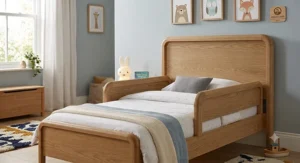
Solid, knot-free pine is the headline spec here, and what most buyers overlook is what that actually buys you: unlike engineered wood, solid pine doesn’t chip or splinter at the corners the way particleboard does after a few years of impact. The panel headboard is rounded at every visible edge, and the frame sits low enough that a school-age kid can climb in and out without a step stool.
What the spec sheet won’t tell you, but reviewer patterns suggest, is that this bed’s finish resists the kind of dents and scuffs that upholstered frames simply can’t shrug off — a meaningful factor if you’re outfitting a shared kids’ room where two siblings treat the bed frame like a jungle gym. The manufacturer states a low-VOC, water-based finish, which lines up with what non-toxic finishes should look like on paper: no strong odor out of the box and no off-gassing warning on the label.
Pros:
- ✅ Solid pine resists chipping better than engineered wood
- ✅ Rounded panel headboard softens every visible edge
- ✅ High weight capacity supports use well into the teen years
Cons:
- ❌ Heavier frame makes reconfiguring the room a two-person job
- ❌ No padding, so bumps are softened by shape alone, not cushioning
Priced in the $250-$400 range depending on finish color, this is the pick for parents who’d rather pay once for solid wood than replace a worn upholstered frame in three years.
3. Graco Wood Toddler Bed — the budget entry point that still checks the safety boxes
Here’s what a sub-$150 price tag usually sacrifices: rounded edges, safety certification, or both. The Graco Wood Toddler Bed doesn’t. It’s JPMA certified, meaning it passed the Juvenile Products Manufacturers Association’s independent safety testing, and the low-to-the-ground frame keeps the whole structure within easy reach of a toddler who’s used to a crib mattress height.
Based on the spec comparison, this is the bed to buy when your primary goal is simply “get my toddler safely out of the crib” without overthinking design. Reviewers consistently note the assembly is fast — under 30 minutes for most buyers — and the finish holds up fine to typical daytime use, though a handful of aggregated reviews mention the side rails feel less sturdy than pricier competitors when a toddler uses them to pull up to standing.
Pros:
- ✅ JPMA certified for independent safety compliance
- ✅ Very low profile matches crib-to-bed transition height
- ✅ Budget-friendly without skipping rounded edges
Cons:
- ❌ Side rails flex more than premium alternatives
- ❌ Limited color and style options compared to upholstered picks
At under $150, it’s tough to beat as a first toddler bed, especially if you’re not sure yet whether your child will even stay in a “big kid” bed consistently.
4. Storkcraft Caribou Toddler Bed — compact footprint for small shared rooms
The standout here is size efficiency: this bed’s footprint is noticeably smaller than most twin-scale toddler beds, which matters enormously if two kids are sharing a room and floor space is the real constraint, not style. The guardrails carry rounded edges front and back, and the frame’s low-VOC finish keeps it in line with non-toxic finishes buyers should be screening for anyway.
What most buyers overlook about compact toddler beds is that a smaller frame often means a shorter usable lifespan — this one is genuinely sized for the 15-month-to-early-elementary window rather than something that grows with a child into the tween years. Aggregated review sentiment describes the assembly as beginner-friendly, with a common complaint centered on the included hardware bag occasionally missing a bolt or two, which is worth checking the moment the box arrives.
Pros:
- ✅ Compact footprint suits small or shared bedrooms
- ✅ Rounded guardrails on both sides of the frame
- ✅ Low-VOC finish keeps chemical exposure minimal
Cons:
- ❌ Shorter usable lifespan than full twin-size beds
- ❌ Occasional hardware shortages reported in reviews — count parts before assembling
Staying under $150, this is the smartest pick for cramped nurseries-turned-bedrooms where every square foot counts.
5. Dream On Me Bailey Toddler Bed — curved corner posts for nursery continuity
If your nursery furniture already leans traditional, the curved corner posts on this bed carry over that look while still delivering the rounded-edge safety profile you’re shopping for. The frame uses non-toxic paint throughout, and the low bed height keeps the fall distance minimal — a genuinely important spec, since most toddler bed injuries reported to CPSC stem from falls rather than structural failure.
Based on the spec comparison, this bed earns its spot for parents who want visual continuity between the crib and the first “big kid” bed, since the curved post styling mirrors classic crib silhouettes. Reviewers consistently report solid stability once assembled, with a recurring theme in aggregated feedback pointing to the assembly instructions being less detailed than competitors — budget extra time on setup day.
Pros:
- ✅ Curved corner posts mirror traditional crib styling
- ✅ Non-toxic paint finish throughout
- ✅ Low bed height minimizes fall distance
Cons:
- ❌ Assembly instructions are thinner than competitors
- ❌ Style options are more limited than upholstered alternatives
In the under-$150 bracket, it’s a strong value pick if design continuity from nursery to bedroom matters to you.
6. BarnFurin Boucle Upholstered Bed Frame — cloud-soft rounded corners for tweens who still headbutt walls
Don’t assume rounded-edge safety furniture is only a toddler category — plenty of eight- and nine-year-olds still catch a corner mid-pillow-fight. This frame’s boucle upholstery wraps every corner in a soft, cloud-like silhouette, genuinely softening collisions in a way rigid wood simply can’t. The low-profile design skips the box spring, and the manufacturer notes a non-slip, noise-free base, which quietly solves the 2 a.m. bed-frame-squeak problem parents rarely mention until they’re living it.
What the spec sheet won’t tell you, but the design implies, is that fully-wrapped upholstery like this tends to show fabric matting faster than woven alternatives — something to weigh if your kid is rough on furniture. Reviewers consistently praise the aesthetic and the ease of two-person assembly, while a recurring theme in aggregated feedback flags that the padding, while soft, compresses over a few years of daily use.
Pros:
- ✅ Cloud-like rounded corners soften every collision
- ✅ Non-slip, noise-free base for smoother nights
- ✅ Works for both twin- and full-size upgrades as kids grow
Cons:
- ❌ Padding compresses somewhat over several years of use
- ❌ Requires two people for efficient assembly
In the $200-$350 range, this is the pick for older kids who’ve outgrown toddler beds but still need genuinely soft edges.
7. Little Seeds Monarch Hill Poppy Upholstered Twin Bed — arched design for small, design-conscious rooms
The arched, rounded headboard on this bed does double duty: it’s a design statement and a genuinely softened impact zone, built from engineered wood with a low-VOC finish rather than solid upholstery all the way through. That construction keeps the price approachable while still avoiding the sharp 90-degree corners common on basic dorm-style frames.
Based on the spec comparison, this bed suits parents furnishing a smaller bedroom or a shared guest/kid room where the frame needs to look intentional, not purely functional. Aggregated review sentiment describes the assembly as manageable solo, with a common complaint noting the headboard padding is thinner than fully-upholstered competitors like the BarnFurin Boucle Upholstered Bed Frame — a fair tradeoff at this price point, but worth knowing going in.
Pros:
- ✅ Arched rounded headboard softens the primary impact zone
- ✅ Low-VOC engineered wood construction
- ✅ Compact enough for smaller bedrooms
Cons:
- ❌ Headboard padding is thinner than fully-upholstered competitors
- ❌ Engineered wood is less impact-resistant long-term than solid pine
In the $200-$300 range, it’s the strongest pick when floor space and style both matter as much as the safety profile.
Setting Up and Anchoring Your Kid’s Headboard: A Practical Guide
Buying a rounded-edge, non-toxic bed is step one. Step two — the one people skip — is making sure the whole frame can’t tip. Anti-tip hardware isn’t just for dressers; any tall or heavy headboard benefits from being secured to the wall stud, not just the drywall.
On assembly day, locate the wall studs behind the intended bed position before you place the frame, and use the anti-tip bracket or strap included with the bed (or a hardware-store equivalent rated for at least 50 pounds of pull force) to anchor the headboard directly into a stud. Skip the temptation to anchor into drywall alone — it will not hold in a real tip-over scenario. Once anchored, run your hand along every edge and joint monthly for the first year, checking for loosening screws, which is common as kids climb and lean on furniture daily.
For maintenance, wipe upholstered headboards with a mild, unscented cleaner rather than harsh solvents, since aggressive chemicals can degrade both the fabric and the non-toxic finish underneath it. Wood frames benefit from a quick tightening pass on all hardware every three to four months — kids’ furniture takes far more repetitive stress than adult furniture ever does.
✨ Ready to compare current listings side by side? Check today’s availability on the models above before prices shift.
Real-World Scenarios: Which Headboard Fits Your Kid?
Picture three different households, because “best” genuinely depends on the kid.
The toddler fresh out of a crib, still testing boundaries at climbing out of bed: the Graco Wood Toddler Bed or Storkcraft Caribou Toddler Bed make sense here, since both keep the frame low to the ground and the price low enough that outgrowing it in two years doesn’t sting.
The rambunctious six-to-nine-year-old sharing a room with a sibling, using the headboard as a trampoline launch point more nights than not: the fully-padded Delta Children Upholstered Twin Bed with Round Headboard or the BarnFurin Boucle Upholstered Bed Frame absorb impact in a way rigid wood can’t, even though they cost more upfront.
The design-conscious family furnishing a small guest room that doubles as a kid’s room: the Little Seeds Monarch Hill Poppy Upholstered Twin Bed balances a soft arched profile with a footprint that won’t overwhelm a compact space, while the Max & Lily Twin Low Bed with Panel Headboard offers the solid-wood alternative for families who prioritize longevity over plush padding.
Buyer’s Decision Framework
If your child is under three and still transitioning off a crib mattress, choose a low-profile toddler bed like the Graco Wood Toddler Bed because the shorter fall distance matters more than padding at that age. If your child is an aggressive sleeper or shares a room, choose a fully-upholstered rounded headboard like the Delta Children Upholstered Twin Bed with Round Headboard because cushioning reduces injury severity on repeated impacts. If budget is tight but safety certification is non-negotiable, prioritize JPMA-certified or GREENGUARD Gold-certified options over uncertified budget alternatives — certification, not price, is the real safety signal. If your kid is past age eight and outgrowing toddler-scaled furniture, look at twin-size upholstered frames like the BarnFurin Boucle Upholstered Bed Frame rather than sticking with a bed sized for younger children.
What Does “Kid-Safe” Actually Mean for a Headboard?
A kid-safe headboard combines three things at once: rounded or padded edges to reduce impact injury, a certified non-toxic finish to limit chemical exposure in an enclosed bedroom, and secure anti-tip anchoring to prevent the whole unit from toppling under a climbing child’s weight. Missing any one of the three leaves a real gap — a rounded edge on an unanchored frame still tips, and a well-anchored frame with a sharp corner still cuts.
It’s worth being honest here: “kid-safe” isn’t a single regulated label you can search for on Amazon. It’s a bundle of separate certifications and design choices — JPMA certification, GREENGUARD Gold, ASTM compliance, low-VOC labeling — that buyers have to verify individually, since no single sticker guarantees all three at once.
Rounded Edge Headboard for Children: Why Corners Matter More Than You Think
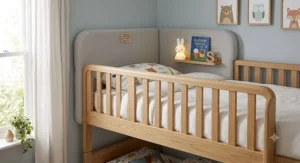
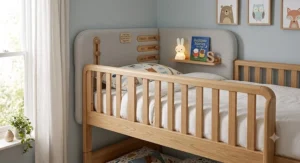
A rounded edge headboard for children isn’t just softer to the touch — it changes the physics of an impact. A sharp 90-degree corner concentrates force into a small contact point, which is exactly what causes cuts and bruising on a child’s forehead during a fall or a rowdy pillow fight. A rounded or chamfered edge spreads that same force across a wider surface area, which is why pediatric safety guidance consistently favors curved furniture profiles in children’s rooms.
What most buyers overlook is that “rounded” comes in degrees. A gently beveled wood edge, like the panel headboard on the Max & Lily Twin Low Bed with Panel Headboard, softens impact less than a fully-padded curve like the one on the Delta Children Upholstered Twin Bed with Round Headboard. Neither is wrong — but if your child is an especially active sleeper, the fully-upholstered route buys more real protection than a merely rounded wood corner.
How to Choose a Headboard for Kids Bedroom Safety
- Start with edge profile. Prioritize fully-padded or heavily rounded corners over lightly beveled ones if your child is an active climber or a rough sleeper.
- Verify a real certification. Look for GREENGUARD Gold, JPMA, or a stated low-VOC/water-based finish rather than trusting vague “eco-friendly” marketing language.
- Check the fall height. Lower platform beds reduce injury severity when a child inevitably rolls out during sleep.
- Confirm anti-tip hardware is included or easily added. A bracket or strap rated for at least 50 pounds of pull force should anchor any tall headboard to a wall stud.
- Match the frame to your child’s stage, not just their current size. A toddler-scaled bed will be outgrown faster than a twin frame built to last into the tween years.
- Weigh upholstery against solid wood. Padding softens impact better; solid wood resists long-term wear and chipping better — pick based on your child’s temperament.
- Read aggregated review themes, not star ratings alone. Recurring complaints about loose hardware or thin padding tell you more than an average rating does.
Common Mistakes When Buying a Kid-Safe Headboard
The single biggest mistake is buying based on style photos alone and skipping the certification check entirely — a beautiful curved headboard with no GREENGUARD or JPMA backing might still off-gas or lack tested stability. A close second: skipping the anti-tip anchor step because “it’s just a headboard, not a dresser.” Any furniture piece a child can climb, lean on, or pull against needs to be secured to a wall stud, headboards included.
Parents also frequently underestimate growth — buying a toddler-scaled bed for a child already approaching kindergarten age, which leads to an unnecessary second purchase within a year. And a subtler mistake: assuming “non-toxic” printed on a listing is a regulated claim. It often isn’t. Cross-check for an actual certification mark like GREENGUARD Gold rather than taking marketing copy at face value.
Upholstered vs Wood Headboards: Which Is Safer?
Upholstered headboards win on impact absorption — foam and fabric genuinely cushion a collision in a way rigid wood cannot, which is why models like the Delta Children Upholstered Twin Bed with Round Headboard and BarnFurin Boucle Upholstered Bed Frame top this list for active kids. But wood headboards, like the one on the Max & Lily Twin Low Bed with Panel Headboard, win on longevity and hygiene — solid wood doesn’t trap allergens or compress over time the way foam padding eventually does, and a well-rounded wood edge still meaningfully reduces injury versus a sharp corner.
The honest answer: there isn’t a universal winner. A household with a rough, active sleeper benefits more from upholstery’s cushioning. A household prioritizing a decade-long furniture investment, or managing allergies, often does better with a solid, rounded wood frame and a washable mattress protector instead.
Non-Toxic Finishes Explained: What VOCs, GREENGUARD, and CertiPUR Actually Mean
Non-toxic finishes matter because kids spend eight-plus hours a night, every night, breathing the air right next to their furniture. Volatile organic compounds, or VOCs, off-gas from certain paints, adhesives, and foams — meaning they release chemical vapor into the room’s air over time, sometimes for months after purchase. A GREENGUARD Gold certification specifically tests for low chemical emissions in an enclosed space, which is exactly the scenario a bedroom represents.
Here’s what most buyers overlook: “non-toxic” as a marketing phrase on a product listing carries no legal weight on its own. What actually matters is a verifiable third-party certification — GREENGUARD Gold for the frame and finish, or CertiPUR-US for any foam padding inside an upholstered headboard. Several beds on this list, including the Delta Children Upholstered Twin Bed with Round Headboard, carry GREENGUARD Gold certification specifically; for others, check the current listing before buying, since certifications can change between product runs.
Child Furniture Safety Standards You Should Know
Child furniture safety standards in the U.S. run through a mix of voluntary industry standards and federal rules. JPMA certification means a product has passed independent testing against ASTM safety standards specific to juvenile products. Separately, furniture tip-over prevention now falls under a federal mandatory standard: the CPSC adopted ASTM F2057-23 as a mandatory safety standard specifically to reduce child injuries and deaths from furniture tipping over, following years of advocacy after Consumer Product Safety Commission data linked hundreds of fatalities to unanchored furniture.
That standard technically targets clothing storage units like dressers rather than beds directly, but the underlying principle — that any furniture piece within a child’s reach should be stable and, where appropriate, anchored — applies just as much to a tall upholstered headboard a toddler might climb. Anti-tip hardware for beds and headboards should meet or exceed the pull-force testing used in that broader furniture-safety framework, and it’s worth noting that tip-over injuries have driven real federal enforcement action, including recalls of defective anchor hardware that failed under normal use.
Long-Term Cost & Maintenance
Here’s the ROI math nobody puts on the product page: a $120 toddler bed that gets outgrown in eighteen months costs roughly $80 a year of use, while a $350 twin-size upholstered frame that lasts through age eleven works out closer to $45 a year — genuinely cheaper over time despite the higher sticker price. Solid wood frames like the Max & Lily Twin Low Bed with Panel Headboard carry the best long-term value on paper, since they resist the wear and compression that eventually flattens upholstered padding.
Maintenance costs stay low across this whole list — occasional hardware tightening, a mild-cleaner wipe-down for upholstered frames, and a periodic anchor-strap inspection are the only real recurring tasks. The main hidden cost to budget for is replacement padding or reupholstering if a fabric headboard takes years of daily abuse; factor that into your total cost of ownership if you’re choosing between the BarnFurin Boucle Upholstered Bed Frame and a comparable wood alternative.
For anyone anchoring furniture themselves, it’s worth checking free wall-anchoring guidance and hardware resources before assembly day, since proper stud placement makes the difference between hardware that actually holds and hardware that only looks secure.
Frequently Asked Questions
❓ Is a headboard necessary for a kid's bed?
❓ What age is a toddler bed safe to switch to?
❓ Do headboards need to be anchored to the wall?
❓ What does GREENGUARD Gold certification mean?
❓ Are upholstered headboards safer than wood ones for kids?
Conclusion
A headboard for kids bedroom safety comes down to three non-negotiables: rounded or padded edges, a verifiable non-toxic finish, and solid anti-tip anchoring — everything else is style preference. Among the seven picks here, the Delta Children Upholstered Twin Bed with Round Headboard leads for active toddlers who need real cushioning, the Max & Lily Twin Low Bed with Panel Headboard wins on long-term durability, and budget-conscious families land well with the Graco Wood Toddler Bed or Storkcraft Caribou Toddler Bed.
Whichever you choose, don’t skip the anchoring step, and don’t take “non-toxic” at face value without checking for a real certification mark. The right bed isn’t the prettiest one in the catalog photo — it’s the one still standing sturdy, unmarked by chemical odor, and firmly anchored to the wall a year from now.
✨ Don’t Miss These Exclusive Deals!
🔍 Give your kid’s room the safety upgrade it deserves. Click on any highlighted pick above to check current pricing and availability before it changes. A rounded, non-toxic, properly anchored bed is one home upgrade you won’t regret.
Recommended for You
- Tall Headboard vs Standard Headboard: 7 Statement Wall Picks (2026)
- Headboard for a Room-Divider Look Behind a Sofa: 7 Picks (2026)
- 7 Best Headboards With Built-In Storage Shelves in 2026
Disclaimer: This article contains affiliate links. As an Amazon Associate, I earn from qualifying purchases. If you purchase products through these links, we may earn a small commission at no additional cost to you.
✨ Found this helpful? Share it with your friends! 💬🤗
