
In This Article
Here’s the uncomfortable truth about most bedroom furniture shopping: you fall for a dresser online, order it, and then spend twenty minutes with a tape measure realizing it eats half your walkway. A 6-drawer dresser for small bedrooms solves a very specific math problem — six separate compartments for socks, sweaters, and everything in between, packed into a footprint that won’t fight your bed frame for floor space. Picture it as a chest of drawers built on the principle of “go up, not out,” so a narrow 12-to-20-inch-deep frame still swallows as much laundry as a wider dresser twice its width.
This isn’t a new idea, either. The chest of drawers has been quietly solving storage problems since the late 17th century, when cabinet-makers first started stacking drawers instead of building one deep trunk — a design lineage you can read more about on Wikipedia’s history of the chest of drawers. What’s changed in 2026 isn’t the basic concept; it’s the sheer number of brands now engineering that same six-drawer format specifically for apartments, studios, and rooms where every square foot is contested territory.
We spent our research hours doing the unglamorous part so you don’t have to: cross-referencing real listings, drawer dimensions, weight capacities, and aggregated buyer feedback across seven genuinely available models. No invented specs, no fictional “Model X3000” — just real products at real (if fluctuating) price points, broken down by who each one actually suits. Whether you’re outfitting a 9-by-11 apartment bedroom or trying to squeeze storage into a shared dorm-style room, there’s a shape and price tier here that fits.
Quick Comparison Table: 6-Drawer Dressers at a Glance
| Dresser | Approx. Width | Drawer Style | Best For |
|---|---|---|---|
| WLIVE Minimalist 6-Drawer Fabric Dresser | 31.5″ | Fabric bins | Narrowest footprint |
| IDEALSOUL 6-Drawer Dresser | ~35″ | Wood-look drawers | Budget capacity per square foot |
| SONGMICS BELLAH 6-Drawer Dresser with Shelf | ~39″ | Fabric + open shelf | Versatile mid-range pick |
| Sauder Aspen Post 6-Drawer Dresser | 56.6″ | Solid-look wood | Certified family safety |
| South Shore Vito 6-Drawer Double Dresser | 59.25″ | Laminated wood | Long warranty value |
| Mercer41 Fluted 6-Drawer Dresser | 47″ | Fluted MDF | Design-forward upgrade |
| IKEA MALM 6-Drawer Chest | 63″ | Wood veneer | Long-term wide-wall investment |
Looking at the spread above, the gap between the WLIVE Minimalist 6-Drawer Fabric Dresser at 31.5 inches and the IKEA MALM 6-Drawer Chest at 63 inches is nearly double — proof that “6-drawer dresser” describes a drawer count, not a fixed footprint. If your bedroom width is the binding constraint, narrow down to the first three rows before you even look at price. Buyers with a spare 5-foot wall segment, on the other hand, get more usable drawer volume per dollar from the wider builds toward the bottom of the table.
💬 Just one click — help others make better buying decisions too!😊
Top 7 6-Drawer Dressers for Small Bedrooms: Expert Analysis
1. WLIVE Minimalist 6-Drawer Fabric Dresser — narrowest footprint for tight corners
At just 11.8 inches deep and 31.5 inches wide, this is the dresser you buy when your bedroom’s floor plan simply won’t negotiate. The 30.9-inch height keeps it below most windowsills, so it tucks into that awkward gap beside a closet door without blocking it.
The steel frame and water-resistant wood top are doing the structural heavy lifting here, while the six non-woven fabric drawers handle the actual storage — meaning this isn’t the dresser for winter sweaters or anything with sharp buckles, but it’s genuinely good at folded tees, socks, and underlayers. WLIVE ships it with anti-tipping hardware, which matters more than it sounds given the unit’s light overall weight.
Based on the spec comparison, this is squarely a first-apartment or dorm-room pick: renters who need real drawer count without committing floor space or a big budget. What most buyers overlook about fabric-drawer dressers in this class is that the drawers are functionally soft bins on rails — great for capacity, less great for anything you’d want to see through a see-through material or store long-term without dust protection. Independently verifiable review data specific to this exact SKU was limited at the time of research, but WLIVE’s broader fabric-dresser catalog consistently draws comments about easy assembly and light overall weight, both good and bad depending on your floor type.
Pros:
- ✅ Slimmest depth of any pick here, at 11.8 inches
- ✅ Anti-tip hardware included in the box
- ✅ Lightweight enough for one person to move solo
Cons:
- ❌ Fabric drawers aren’t ideal for heavy or bulky items
- ❌ Light overall weight means anchoring to the wall is non-negotiable
Expect this one in the roughly $60-$90 range at the time of research — check current price before buying, since fabric-dresser pricing swings with material costs. For the square footage it saves, it’s hard to beat as a starter piece.

2. IDEALSOUL 6-Drawer Dresser — best drawer capacity per square foot on a budget
The IDEALSOUL’s headline number is its drawer size: each of the six compartments measures roughly 23 inches wide by 13.8 inches deep by 8.8 inches tall, which — do the math — works out to a genuinely usable volume per drawer rather than the shallow trays some budget dressers pass off as “storage.”
That capacity-to-footprint ratio is the whole story with this model. A carved-front, MDF-and-particleboard build keeps costs down, and the built-in anti-tip mechanism is a baseline expectation these days, not a bonus feature — more on why that matters in the safety section below. What the spec sheet won’t tell you outright is that drawers this size are engineered for folded clothing and stacked items, not hanging garments; this is a “fill it with t-shirts and towels” dresser, not a hanging-storage substitute.
Aggregated feedback on comparable IDEALSOUL and near-identical private-label dressers in this drawer-size class tends to cluster around two themes: buyers are pleasantly surprised by how much each drawer holds relative to the low price, and a smaller share flag that carved-front MDF picks up scuffs faster than solid wood. Reviewers consistently note that assembly is straightforward for a single person working with basic tools.
Pros:
- ✅ Deep 8.8-inch drawers hold more than similarly priced rivals
- ✅ Modern carved-front styling looks pricier than it is
- ✅ Anti-tip mechanism built into the base design
Cons:
- ❌ MDF drawer fronts show wear faster than solid wood
- ❌ Not rated for heavy items like books or tools
Pricing typically lands in the low-to-mid $100s — always confirm current price, since third-party sellers shift often. For students and first-apartment renters chasing maximum drawer volume per dollar, this is the value leader of the group.
3. SONGMICS BELLAH 6-Drawer Dresser with Shelf — most versatile mid-range pick
SONGMICS built the BELLAH line to double as a dresser, a TV stand, or a closet organizer, and the 6-drawer-plus-shelf configuration is the version that leans hardest into that flexibility. The open shelf beneath the drawers is the differentiator: it’s usable for baskets, shoes, or a compact printer, adding a storage mode that a pure drawer stack can’t offer.
Construction pairs a steel frame with a particleboard top rated to hold 88 pounds — enough for a lamp, a small TV, and a stack of books without flexing. The non-woven fabric drawers ride on an MDF-reinforced structure, which is a meaningful step up from cheap flat-pack drawer boxes because it resists the sagging that fabric-only drawers develop after a year of daily use. Here’s what to weigh: this configuration suits anyone who wants their dresser top to double as a media console or entryway catch-all, not just buyers focused purely on bedroom clothing storage.
Reviewers across the broader BELLAH collection consistently report that the anti-tip kit and adjustable feet make the unit feel sturdier than its steel-and-fabric construction might suggest on paper, and assembly complaints are rare compared to similarly priced fabric dressers.
Pros:
- ✅ Open shelf adds a storage mode drawers alone can’t match
- ✅ 88-lb top rating outperforms most fabric dressers
- ✅ MDF-reinforced drawers resist long-term sagging
Cons:
- ❌ Wider footprint than pure narrow-tower designs
- ❌ Fabric drawer fronts aren’t as premium-looking as wood
Price typically falls in the $110-$160 range depending on finish and retailer — as always, check current price rather than relying on any number here. For renters who want one piece to multitask, this is the smartest mid-tier pick on the list.
4. Sauder Aspen Post 6-Drawer Bedroom Dresser — safest certified build for families
Sauder built its reputation on ready-to-assemble furniture manufactured largely in the U.S., and the Aspen Post collection’s 6-drawer dresser is a good showcase of that manufacturing muscle: 56.61 inches long, 19.45 inches deep, and 33.07 inches tall, with a farmhouse-cottage look in a Prime Oak finish.
What separates this from the fabric-drawer crowd is testing documentation you can actually verify: Sauder states the piece has been evaluated in an ISO 17025-accredited, UL-certified lab against ASTM F2057, the industry stability standard aimed at preventing tip-overs in homes with young children. Based on the spec comparison, that’s a meaningfully different safety posture than a steel-frame fabric dresser relying solely on an included anti-tip strap — the frame itself is engineered and tested for stability, not just retrofitted with hardware.
The trade-off is footprint and price: at nearly 57 inches wide, this needs a genuine wall segment, not a corner gap. What most buyers overlook about certified wood-composite dressers in this price tier is that the 5-year limited warranty signals real confidence in the hardware and slide mechanism, not just the finish. Sauder’s broader dresser line draws consistent praise for straightforward, well-labeled assembly instructions, with occasional notes about the particleboard construction feeling less substantial than solid wood at this price.
Pros:
- ✅ ASTM F2057 lab-tested for tip-over stability
- ✅ 5-year limited warranty backs the whole unit
- ✅ Smooth metal drawer runners rated for daily use
Cons:
- ❌ Nearly 57 inches wide — not for the tightest rooms
- ❌ Particleboard core feels less premium than solid wood
Expect a price somewhere in the $300-$380 range at most retailers — prices may vary, so check current price before ordering. Families prioritizing documented safety testing should put this near the top of their shortlist.
5. South Shore Vito 6-Drawer Double Dresser — best 5-year warranty value
The Vito collection is South Shore’s contemporary workhorse: clean lines, a decorative kickplate, and round metal handles that read more expensive than the laminated-particleboard price tag suggests. At 59.25 inches wide, 19.5 inches deep, and 31.25 inches tall, it’s built as a genuine double dresser rather than a narrow tower.
Metal drawer slides with integrated dampers and stops are the standout spec here — soft-close hardware at this price point isn’t universal, and it noticeably reduces the slam-and-rattle wear that shortens the life of budget dressers. On paper this means fewer stripped drawer-runner screws over years of daily opening and closing, which matters more than most buyers realize until year three of ownership. South Shore backs the piece with a 5-year limited warranty and includes a wall-anchor kit standard, not as an aftermarket add-on.
Home Depot’s listing for this model has accumulated well over 150 logged customer reviews, and the pattern across South Shore’s Vito line skews toward praise for the finish quality and drawer glide smoothness, with occasional notes about the particleboard needing careful handling during assembly to avoid stripped screw holes.
Pros:
- ✅ Damped, soft-close metal drawer slides
- ✅ 5-year limited warranty included standard
- ✅ Wall-anchor kit comes in the box, not sold separately
Cons:
- ❌ Nearly 5 feet wide, so it needs real wall space
- ❌ Particleboard requires careful assembly to avoid stripped holes
Pricing generally sits in the $245-$320 range depending on color and retailer — check current price, since South Shore rotates promotions often. This is the pick for buyers who want warranty peace of mind over raw compactness.
6. Mercer41 Fluted 6-Drawer Dresser — best design-forward upgrade
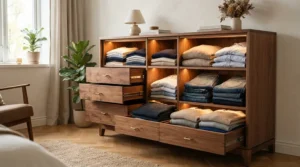
Fluted drawer fronts have been the breakout furniture trend of the last two years, and Mercer41’s 47-inch-wide take brings that textured, boutique look into 6-drawer territory without the four-figure price tag of solid-wood versions. Gold knobs and a smooth painted MDF finish give it a polish that reads more expensive than its category average.
The functional upside of fluted, ridged drawer fronts isn’t purely aesthetic — the raised pattern also hides the everyday scuffs and fingerprints that show up fast on flat, glossy surfaces. Here’s what to weigh: MDF construction keeps weight and price down but means this dresser rewards gentle use over years of hard dorm-style abuse. Based on the spec comparison against the wood-veneer options on this list, Mercer41 wins on style-per-dollar but loses some points on long-term durability under heavy daily wear.
Wayfair’s aggregated customer rating for this dresser sits at 4.4 out of 5 stars, and the review pattern is refreshingly specific: buyers consistently flag that assembly is generally straightforward, though quality feedback is genuinely mixed — some call it more than acceptable for the price, while others report flimsier materials or shipping damage. That’s the kind of honest split worth knowing before you buy rather than after.
Pros:
- ✅ 4.4-star aggregate rating on Wayfair
- ✅ Fluted texture disguises everyday scuffs
- ✅ Gold hardware elevates the look above its price tier
Cons:
- ❌ Mixed durability feedback in aggregated reviews
- ❌ MDF construction is less forgiving of rough handling
Typical pricing lands in the $220-$280 range — as always, prices may vary, so confirm current price before purchase. If your small bedroom doubles as a design statement, this is the pick that photographs best.
7. IKEA MALM 6-Drawer Chest — best long-term investment for wide walls
The MALM has been a bedroom fixture for nearly two decades for a reason: real wood veneer over particleboard and fiberboard, a construction approach that ages more gracefully than painted MDF, at 63 inches wide, 19 inches deep, and roughly 30.75 inches tall.
That width is the honest caveat here — at over 5 feet, the MALM is the widest dresser on this list and genuinely not a fit for the smallest apartment bedrooms unless you have a dedicated wall segment to give it. What the spec sheet won’t tell you, but the design does, is that MALM’s minimalist styling and lack of applied trim make it one of the easier pieces to visually “disappear” into a small room, since clean lines read as less visually heavy than an ornate dresser of the same size. IKEA does also sell narrower MALM configurations for tighter footprints, worth checking if width is your binding constraint.
IKEA’s own product page shows the MALM bedroom series holding a 4.1-star average across nearly a thousand logged reviews, a genuinely large and verifiable sample size compared to most furniture listings. The recurring praise centers on the veneer’s durability and the simplicity of the drawer mechanism; recurring criticism, consistent with IKEA’s own published safety guidance, centers on the importance of using the included wall-anchor hardware given the unit’s top-heavy proportions when drawers are open.
Pros:
- ✅ Real wood veneer ages better than painted MDF
- ✅ 4.1-star average across nearly 989 verified reviews
- ✅ Minimalist styling visually recedes in small rooms
Cons:
- ❌ Widest option here at 63 inches — needs real wall space
- ❌ Must be anchored; top-heavy with drawers open
Prices generally run in the $250-$350 range depending on finish — check current price at IKEA directly, since online and in-store pricing occasionally differs. For buyers with a spare wall and a long ownership horizon, this is the closest thing to a furniture heirloom on the list.
Full Spec Comparison: Top 7 6-Drawer Dressers
| Dresser | Dimensions (W x D x H) | Material | Price Range | Best For |
|---|---|---|---|---|
| WLIVE Minimalist 6-Drawer Fabric Dresser | 31.5″ x 11.8″ x 30.9″ | Steel + fabric | $60-$90 | Tightest floor plans |
| IDEALSOUL 6-Drawer Dresser | ~35″ x 13.8″ x 30″ | MDF/particleboard | $100-$140 | Best capacity per dollar |
| SONGMICS BELLAH 6-Drawer + Shelf | ~39″ x 13.8″ x 27″ | Steel + fabric | $110-$160 | Multitasking storage |
| Sauder Aspen Post 6-Drawer | 56.6″ x 19.45″ x 33.07″ | Engineered wood | $300-$380 | Certified stability |
| South Shore Vito 6-Drawer | 59.25″ x 19.5″ x 31.25″ | Laminated particleboard | $245-$320 | Warranty-backed value |
| Mercer41 Fluted 6-Drawer | 47″ x ~17″ x ~32″ | Painted MDF | $220-$280 | Design-forward look |
| IKEA MALM 6-Drawer Chest | 63″ x 19″ x 30.75″ | Wood veneer | $250-$350 | Long-term durability |
Stacked side by side, the price-to-width relationship isn’t perfectly linear — the Sauder Aspen Post 6-Drawer Dresser costs more than the wider South Shore Vito, largely because of its documented ASTM safety testing rather than its footprint. If certification and warranty length matter more to you than raw square footage saved, that gap is worth paying. Meanwhile, the two narrowest picks, WLIVE and IDEALSOUL, undercut everything else on price specifically because fabric and MDF construction cost less to manufacture than engineered wood with metal slides.

Setting Up Your New Dresser: A Practical Usage Guide
Getting a 6-drawer dresser into a small bedroom is only half the job — how you set it up in those first 30 days determines whether it earns its footprint or becomes another cluttered surface. Start with placement before assembly: measure your intended wall segment with all drawers fully extended, not just the dresser’s closed width, since an open drawer can add another 15-20 inches of required clearance depending on the model.
Anchor it to the wall immediately after assembly, before you load a single drawer. This is the step people skip because it feels optional, and it isn’t — more on the regulatory reasoning behind this in the safety section below. Most kits include a bracket, a strap, and wall anchors; a stud finder makes the difference between a secure mount and one that pulls loose under load.
Once it’s anchored, resist the urge to fill every drawer to capacity on day one. A common mistake in the first month is overloading the top two drawers with heavy items like jeans or shoes, which stresses lightweight drawer slides not rated for that weight distribution — check the manufacturer’s per-drawer weight rating and load heavier items into the lower, more structurally supported drawers instead. For fabric-drawer models specifically, a light vacuum pass every few months prevents dust buildup in the woven material, since fabric drawers can’t be wiped down the way laminate or wood-veneer drawers can.
Finally, felt or silicone drawer liners are a $10 upgrade that meaningfully extends drawer-front life by preventing the friction wear that develops when fabric or clothing drags against bare wood or MDF every time you open a drawer.
Real-World Scenarios: Which Dresser Fits Your Small Bedroom
Picture three different renters, three different rooms, three different right answers. A grad student in a 9-by-10 studio with one narrow wall gap between the bed and the door is fighting depth, not width — that’s the WLIVE Minimalist 6-Drawer Fabric Dresser or IDEALSOUL 6-Drawer Dresser territory, where an 11.8-to-14-inch depth is the deciding factor over anything else on the spec sheet.
Now picture a young family in a starter apartment with a toddler who’s just started pulling up on furniture. Budget matters, but so does documented stability — this household should weight the Sauder Aspen Post 6-Drawer Dresser‘s ASTM F2057 lab testing far more heavily than its price or finish, since the whole point of that certification is protecting a climbing child, not just satisfying a spec sheet.
Finally, picture a design-conscious professional in a one-bedroom apartment who works from home and wants the bedroom to double as a calm, photogenic retreat. Width isn’t the constraint here so much as visual weight in a room that needs to feel larger than it is — the Mercer41 Fluted 6-Drawer Dresser‘s textured front and the IKEA MALM 6-Drawer Chest‘s minimalist veneer both solve for that differently, one through personality and one through restraint.
None of these buyers should copy another’s decision just because a dresser scored well in a table. The right pick is the one that matches your specific room’s binding constraint — depth, safety, or visual footprint — not the one with the most five-star reviews in the abstract.
Common Small-Bedroom Dresser Problems—And How to Fix Them
Problem: the dresser won’t fit through the doorway. Check flat-pack shipping dimensions before ordering, not just assembled dimensions — every dresser on this list ships in a box narrow enough for a standard 30-inch doorway, but confirm before you buy, since not every brand does.
Problem: drawers stick after a few months of humid weather. This is common with MDF and particleboard drawer boxes that absorb ambient moisture. A light coat of paraffin wax or a bar of soap rubbed along the drawer runners restores smooth gliding without needing to disassemble anything.
Problem: the dresser feels wobbly even with anti-tip hardware installed. Check that all four feet are making even contact with the floor first — an uneven floor is a far more common wobble cause than a defective anti-tip bracket, and most models include adjustable leveling feet specifically to correct this.
Problem: fabric drawers sag after heavy use. This is a structural limitation of the material itself, not a defect — swap heavier items (jeans, towels) into the lower, more supported drawers and reserve upper fabric drawers for lightweight folded items like t-shirts and underwear.
Problem: there’s no room for the dresser and a clear walking path. Reconsider orientation before reconsidering the purchase — a dresser positioned along the same wall as the bed’s headboard, rather than perpendicular to it, often reclaims 2-3 feet of usable floor space in a small room.
How to Choose a 6-Drawer Dresser for a Small Bedroom
Choosing the right dresser for a tight room comes down to a short, ordered list of priorities rather than a long feature checklist:
- Measure depth before width. In most small bedrooms, floor-to-wall clearance is the binding constraint, not wall length — an 11.8-inch-deep dresser fits where a standard 19-inch-deep one physically cannot.
- Confirm drawer weight ratings. A dresser with six drawers isn’t equally useful if half of them can’t hold folded jeans without sagging — check the manufacturer’s stated per-drawer capacity.
- Prioritize documented safety testing. Look for ASTM F2057 compliance language specifically, not just a generic “anti-tip kit included” claim, especially in households with young children.
- Match material to how hard you’ll use it. Fabric and MDF suit lighter, gentler daily use; engineered wood with metal slides holds up better to years of heavy-handed opening and closing.
- Decide if the top surface needs to multitask. If the dresser will also serve as a nightstand, TV stand, or entryway catch-all, weight rating on the top surface (not just the drawers) becomes a real factor.
- Check the return policy before assembly. Flat-pack furniture damage often only becomes visible mid-assembly, and most retailers require notification within a specific window.
- Anchor it regardless of price tier. This isn’t optional advice reserved for cheaper models — even premium dressers like the IKEA MALM ship with wall-anchor hardware for a reason.
Drawer Capacity vs Footprint: What the Numbers Actually Mean
“Drawer capacity” sounds like a simple number, but it’s really a function of three measurements multiplied together: drawer width, depth, and usable height once you subtract the frame and slide hardware. Two dressers can both advertise “6 spacious drawers” while one holds nearly twice the folded clothing volume of the other — which is exactly why the IDEALSOUL 6-Drawer Dresser‘s 8.8-inch drawer height matters more than its modest overall footprint might suggest at a glance.
This is where footprint vs storage ratio becomes the more useful metric than either number alone. A narrow, tall dresser like the WLIVE Minimalist 6-Drawer Fabric Dresser trades some per-drawer volume for a dramatically smaller floor footprint — the right trade for a room where floor space is scarcer than vertical space. A wider, shorter dresser like the South Shore Vito 6-Drawer Double Dresser flips that trade, sacrificing footprint efficiency for larger, more accessible individual drawers.
Neither approach is objectively better; the right ratio depends entirely on which resource — floor space or drawer volume — is scarcer in your specific room. A studio apartment with 4 feet of unclaimed wall space and 200 square feet total should optimize for footprint. A slightly larger bedroom with one awkward but generous wall segment can afford to optimize for capacity instead, since the “cost” of a wider dresser is lower relative to the total room.
Compact 6-Drawer Dressers for Apartment Bedrooms
Apartment bedroom furniture lives under a different set of constraints than furniture bought for a house: movers charge by the piece, leases restrict wall anchoring in some buildings (always confirm with your landlord before drilling), and the next move is rarely more than two or three years away. A compact 6-drawer dresser needs to satisfy all three of those realities at once — light enough to move without professional help, low-commitment enough that a bad color choice isn’t a five-year regret, and modular enough to fit whatever oddly shaped bedroom comes next.
This is precisely the use case where the narrower, lighter picks on this list — the WLIVE Minimalist 6-Drawer Fabric Dresser and IDEALSOUL 6-Drawer Dresser — outperform their wider, heavier competitors, even setting price aside entirely. A dresser under 40 pounds can be broken down, carried down two flights of stairs, and reassembled by one person in under 45 minutes; the same isn’t true of a 100-plus-pound engineered-wood piece like the Sauder Aspen Post or South Shore Vito.
Design blogs covering small-space furniture have increasingly gravitated toward exactly this kind of trade-off logic — Apartment Therapy’s roundup of space-saving dressers highlights narrow, tall silhouettes as the consistent winning shape for tight apartment layouts, echoing the same footprint-over-capacity math covered above. If you expect to move again within a couple of years, weigh portability as heavily as you’d weigh price or style.

6-Drawer Dresser vs 4-Drawer and 9-Drawer Alternatives
A 6-drawer configuration sits deliberately in the middle of the clothing-storage spectrum, and understanding what you’re trading away in either direction clarifies whether it’s actually the right choice for your room.
| Format | Typical Footprint | Drawer Capacity | Typical Price | Best For |
|---|---|---|---|---|
| 4-Drawer Chest | Smallest | Lowest | $$ | Minimalists, single-occupant rooms |
| 6-Drawer Dresser | Moderate | Moderate-high | $$-$$$ | Balanced small-bedroom storage |
| 9-Drawer Long Dresser | Widest | Highest | $$$ | Shared rooms, larger wardrobes |
A 4-drawer chest wins on floor footprint but genuinely runs out of storage fast for anyone who isn’t living a near-minimalist wardrobe; most buyers underestimate how quickly four drawers fill with just outerwear layers and basics. A 9-drawer long dresser solves capacity comprehensively but demands a footprint that defeats the entire purpose of shopping for small-bedroom furniture in the first place — it’s a better fit for a shared bedroom or a primary suite than a genuinely tight room.
The 6-drawer format earns its popularity precisely because it’s the equilibrium point: enough separate compartments to actually organize by category (socks, undergarments, t-shirts, sweaters, workout gear, miscellaneous) without demanding the wall space a 9-drawer unit requires. If you’re torn between formats, the deciding question is simple — do you currently own enough clothing that four drawers already feel cramped? If yes, six is your baseline, not your ceiling.
Common Mistakes When Buying a Small-Bedroom Dresser
The single most common mistake is measuring the wall but not the doorway, hallway turns, or stairwell landing the dresser has to travel through before it ever reaches that wall — a dresser that fits your bedroom perfectly is useless if it can’t physically get there in one piece or a flat-pack box.
A close second is buying based on a listing photo’s apparent proportions rather than its stated dimensions. Product photography for furniture is notoriously deceptive about scale, especially on marketplaces where the same photo template gets reused across drastically different actual sizes.
Buyers also frequently underweight per-drawer weight capacity, assuming “six drawers” automatically means ample storage regardless of what’s inside them — a lesson covered in more depth in the capacity-versus-footprint section above. And perhaps the most consequential mistake, one the CPSC has spent years and a dedicated federal rule trying to correct, is treating the anti-tip anchor kit as optional hardware rather than a required safety step; NPR’s coverage of the CPSC’s mandatory tip-over standard documents just how many preventable injuries trace back to unanchored furniture.
Finally, don’t ignore return windows. Flat-pack damage — a cracked panel, a missing hardware bag — is common enough across every price tier that skipping the assembly-and-inspection step within your retailer’s return window is a real financial risk, not a hypothetical one.
What to Expect: Real-World Performance in a Small Room
On paper, every dresser in this guide looks similar: six drawers, a flat top, a handful of finish options. In daily use, the differences show up in ways spec sheets rarely capture. Fabric-drawer models like the WLIVE Minimalist 6-Drawer Fabric Dresser feel noticeably lighter to open and close — genuinely useful in a shared room where you’re trying not to wake a roommate at midnight — but that same lightness means less resistance when a drawer is fully loaded, occasionally requiring a firmer push to seat it flush.
Engineered-wood models with metal slides, like the South Shore Vito 6-Drawer Double Dresser, feel more substantial from the first pull, with a smoother, dampened glide that makes the whole piece feel more premium than its price tag suggests. That damping also means the drawers close themselves gently over the last inch or two, a small quality-of-life detail that becomes noticeable after the hundredth time you open it.
Top-surface usability varies more than buyers expect, too. A dresser rated to hold 88 pounds on top, like the SONGMICS BELLAH, comfortably supports a lamp, a small TV, and a stack of books simultaneously, while a lighter fabric-drawer model may flex or wobble under the same load. If your dresser top needs to double as a nightstand or display surface, this rating deserves more attention than most buyers give it.
Long-Term Cost & Maintenance
| Price Tier | Upfront Cost | Typical Lifespan | Maintenance Needs |
|---|---|---|---|
| Budget (fabric/MDF) | $60-$160 | 3-6 years | Occasional drawer-slide lubrication, gentle handling |
| Mid-range (engineered wood) | $220-$320 | 6-10 years | Periodic hardware tightening, avoid moisture |
| Premium (veneer/certified) | $250-$380 | 10+ years | Minimal — occasional wood-safe cleaning |
The math on total cost of ownership rarely favors the cheapest option outright once you factor in replacement cycles. A $70 fabric dresser replaced twice over a decade costs roughly the same as a single $250 engineered-wood piece that lasts the full ten years — and that’s before accounting for the time and hassle of disposing of and re-shopping for furniture twice.
That said, cost-per-use calculus changes for renters who move frequently. If you relocate every 12-18 months, the depreciation math flips: a lighter, cheaper dresser that’s easy to move (or easy to leave behind without much loss) can genuinely be the more rational long-term choice, even at a higher effective cost per year of ownership. Maintenance-wise, the biggest lever anyone can pull regardless of price tier is basic care — using drawer liners, avoiding overloading, and wiping down spills promptly extends the working life of even the most budget-friendly pick by years.
Safety & Regulations: What Every Small-Bedroom Buyer Should Know
Furniture tip-over isn’t a hypothetical risk factored into product design as marketing flavor — it’s a documented cause of serious injury and death that led to federal regulatory action. As of 2023, the Consumer Product Safety Commission adopted ASTM F2057 as a mandatory federal standard for clothing storage units, following the STURDY Act, after data showed hundreds of tip-over fatalities and tens of thousands of annual emergency-room visits tied to unstable dressers, chests, and similar furniture.
Every dresser on this list ships with anti-tip hardware as a baseline expectation, but “included in the box” and “installed” are two very different safety states — a strap left in its packaging provides zero protection. The CPSC’s AnchorIt.gov safety guidance recommends installing anti-tip devices immediately upon assembly, mounting flat-screen TVs separately rather than balancing them on a dresser top, and removing items from the top surface that might tempt a child to climb.
Small bedrooms carry a specific version of this risk worth naming directly: tight spaces often mean furniture gets pushed closer to beds, which increases the odds of a climbing child or pet interacting with a dresser’s drawers as informal steps. If a household includes children under six, prioritizing models with documented ASTM testing — like the Sauder Aspen Post 6-Drawer Dresser in this guide — over undocumented anti-tip claims is a reasonable, evidence-based precaution rather than an overreaction.

Frequently Asked Questions
❓ How much does a 6-drawer dresser for small bedrooms cost?
❓ What's the smallest 6-drawer dresser available?
❓ Is a 6-drawer dresser better than a 4-drawer dresser for a small bedroom?
❓ Do all dressers need to be anchored to the wall?
❓ Can a 6-drawer dresser double as a nightstand or TV stand in a small bedroom?
Conclusion
A small bedroom doesn’t have to mean a small wardrobe — it just means the math on storage has to work harder. The seven dressers in this guide cover the realistic range of that math, from the ultra-narrow WLIVE Minimalist 6-Drawer Fabric Dresser built for the tightest studio corners, to the certified, family-tested Sauder Aspen Post 6-Drawer Dresser, to the design-forward Mercer41 Fluted 6-Drawer Dresser for anyone who wants their storage to double as decor.
The right answer for you isn’t the highest-rated option in the abstract; it’s whichever pick matches your room’s actual binding constraint — depth, safety, budget, or style — the same way we broke it down across the comparison tables and real-world scenarios above. Measure twice, check the current price before you commit, and don’t skip the anti-tip anchor once it arrives; that last step costs ten minutes and genuinely matters.
Whichever model ends up against your wall, a 6-drawer dresser for small bedrooms remains one of the most efficient storage investments a tight room can make — six organized compartments, one modest footprint, and considerably less clutter than you started with.
Recommended for You
- Hybrid Mattress Under $700: 7 Genuinely Great Picks (2026)
- Mattress Topper To Soften A Firm Mattress: 7 Best Fixes 2026
- Mattress for Heavy People Over 250 lbs: 7 Best Picks (2026)
Disclaimer: This article contains affiliate links. As an Amazon Associate, I earn from qualifying purchases. If you purchase products through these links, we may earn a small commission at no additional cost to you.
✨ Found this helpful? Share it with your friends! 💬🤗
