
In This Article
Every bedroom has one. It’s the corner where the door swings too wide, or the wall juts out like a shy elbow, or the ceiling slopes just enough to make a normal wardrobe look like a bad joke. You’ve probably stacked a laundry basket there. Maybe a houseplant that’s quietly given up.
A corner armoire for awkward bedroom layouts turns that dead zone into your most useful square footage. Instead of fighting the geometry, it moves in and takes over. Designers have long argued that tight gaps and odd angles often reward a tailor-made solution rather than forcing standard furniture into the space. A freestanding corner armoire is the off-the-shelf version of that idea.
Here’s what this guide covers. I compared seven real corner units on dimensions, construction, storage layout and price tier. I also read what shoppers say in aggregated reviews, and I flag where that evidence is thin. Everything below is research and spec analysis, not hands-on testing. I haven’t used these pieces, so expect honest reasoning rather than invented anecdotes.
By the end you’ll know which footprint suits a small bedroom, when an angled design beats a square one, and which mistakes make a corner armoire useless. You’ll also see why anchoring it to the wall isn’t optional.
Quick Comparison: Corner Armoire Picks at a Glance
| Product | Shape | Listed Footprint & Height | Price Tier | Best For |
|---|---|---|---|---|
| FUFU&GAGA Corner Armoire | L-shaped, frosted doors | ~35.4″ W × 19.8″ D × 70.9″ H | $215–$325 range | Budget-minded renters |
| PAPROOS Corner Armoire Wardrobe | Polygonal, two-tier | 43.3″ wide, two hanging rods | Budget tier, check current price | Maximum hanging space |
| Gyfimoie Corner Armoire | 90° triangular | 71″ tall | Check current price | Farmhouse-style rooms |
| AIEGLE Corner Armoire | Square corner + drawers | 35.4″ × 35.4″ × 74.2″ | Check current price | Replacing a dresser |
| MOUMON Tall Corner Wardrobe | L-shaped, frosted doors | 35.4″ × 35.4″ × 86.6″ | Check current price | Taller ceilings |
| Atlin Designs 32″ Corner Storage Unit | Modular corner module | 32.3″ × 32.3″ × 83.7″ | Around $600 | Build-as-you-go systems |
| Manhattan Comfort Mulberry Corner Wardrobe | Sectional corner | ~36″ W × 21.65″ D × 81.3″ H | Around $800 | Long-term modular setups |
Dimensions come from retailer listings and can differ by variant. Confirm them on the current product page.
Looking at the table, the FUFU&GAGA is the cheapest way into the category. The Atlin Designs and Manhattan Comfort units cost more because they’re systems you can expand rather than single cabinets. Note that several tier cells say “check current price” because I couldn’t verify a stable price range for those listings. Prices move fast in furniture, so treat every figure here as a snapshot.
💬 Just one click — help others make better buying decisions too!😊
What Is a Corner Armoire for Awkward Bedroom Layouts?
A corner armoire is a freestanding, enclosed storage cabinet built to sit in the junction of two walls. Its L-shaped, triangular or diagonal-front design uses space a standard wardrobe can’t reach. In an awkward bedroom, such as one with a door near a corner, a sloped ceiling or a jutting wall, it turns unusable space into hanging and shelf storage.
The format has real variety. One corner wardrobe design roundup describes two-way, sloping, sliding, mirrored and L-shaped versions that all target the same problem: an unused corner. Freestanding versions matter most for renters, because you can take them with you and they don’t need a contractor.
Top 7 Corner Armoires: Expert Analysis
Each pick below follows the same logic. First what the spec means in practice, then who it suits, then what reviewers say, where that evidence exists.
1. FUFU&GAGA Corner Armoire — best budget L-shaped pick
The headline feature is the L-shaped body with frosted glass doors, which hide a messy rail while keeping the piece visually light. Listings at Home Depot and Walmart give roughly 35.4 inches wide, about 19.8 inches deep and 70.9 inches tall. Variants include two drawers and a hanging bar, built from particle board and MDF with a surface described as water-resistant.
In practice, that roughly 20-inch depth clears the width of a standard hanger, and the 71-inch height tucks neatly under most ceilings. The two drawers mean you may skip a separate dresser. It suits someone with a modest, edited wardrobe rather than a collector of floor-length coats.
On reviews, I couldn’t verify a consistent star rating for this exact listing. Similar L-shaped frosted-glass corner armoires on Wayfair show a 4.2 average across roughly 394 reviews, which suggests the format satisfies buyers. Check this model’s own review page before ordering.
Pros:
- ✅ L-shaped body hugs the corner cleanly
- ✅ Frosted doors hide a cluttered rail
- ✅ Drawers add dresser-style storage
Cons:
- ❌ Particle board and MDF won’t survive rough moves
- ❌ Moderate height leaves dead space above
Pricing runs about $215–$325 depending on finish and retailer, which is strong value for a first corner armoire.
2. PAPROOS Corner Armoire Wardrobe — widest polygonal body with two rods
The standout is a 43.3-inch-wide polygonal wood unit with two hanging rods in a two-tier tower. Two rods mean you can hang shirts and jackets on both levels, so the capacity is closer to a small reach-in closet than a cabinet.
Here’s the geometry the listing won’t spell out. If 43.3 inches is the diagonal front face, the unit reaches roughly 30 inches along each wall (43.3 divided by the square root of two). In a small room that’s a real wall sacrifice, so check the dimension diagram before you buy.
I couldn’t verify written reviews for this listing. Similar polygon-style corner wardrobes list 55-pound limits for both shelves and rail, and one such listing shows a 4.2 rating from 119 ratings with zero written reviews. Ratings without text are thin evidence, so confirm PAPROOS’s own weight limits.
Pros:
- ✅ Two hanging rods double rail capacity
- ✅ Diagonal front opens a tight corner
- ✅ Light white finish suits small rooms
Cons:
- ❌ Wide face eats more wall than L-shapes
- ❌ Weight limits likely modest
It sits in the budget tier, so check current price. For clothes-heavy small bedrooms, the value verdict is good if your walls can spare the width.
3. Gyfimoie Corner Armoire — farmhouse triangle for true 90° corners
This one is built around a 90° triangular structure, a 71-inch-tall white wooden cabinet with doors and a hanging rod. It appears in Amazon-sourced corner armoire roundups, which at least confirms it’s an active listing.
A triangular design works best when the corner is truly square and you want the doors facing into the room. The farmhouse styling is a deliberate choice. It will blend with shaker or cottage-style bedrooms and look out of place in a sleek modern one.
I couldn’t verify the exact footprint or a stable review average, so measure the diagonal on the listing before committing. Triangular units can look compact on screen and then swallow more floor than expected.
Pros:
- ✅ Triangular body sits flush in 90° corners
- ✅ Farmhouse finish adds visual warmth
- ✅ 71-inch height suits standard ceilings
Cons:
- ❌ Footprint details are hard to confirm
- ❌ Style clashes with minimalist rooms
Expect the budget-to-mid segment, but check current price. Value is solid when the style matches your room and the corner is truly square.
4. AIEGLE Corner Armoire — drawers plus hanging in a 35-inch square
The standout is the drawers: the listing shows a freestanding white corner wardrobe with doors, a hanging rod and drawers at 35.4 inches wide, 35.4 inches deep and 74.2 inches tall. That equal-sided footprint is the classic corner module, with each leg running about 35 inches along the wall.
A 74.2-inch height is just over six feet, so you’ll want a stool for the top shelf. The drawers are the practical story. In a small bedroom they can retire a dresser, which frees up floor area for walking space, and that matters more than any single storage figure.
I couldn’t verify review sentiment for this listing. Look for comments on drawer slide quality and door alignment, the two things that usually separate flat-pack wardrobes that last from ones that rattle.
Pros:
- ✅ Drawers can replace a separate dresser
- ✅ Square footprint fits standard corners
- ✅ Modern white finish blends easily
Cons:
- ❌ Doors need swing clearance
- ❌ Top shelf requires a stool
Check current price; this is typically mid-tier territory. Good value if the drawers let you skip a second furniture purchase.
5. MOUMON Tall Corner Wardrobe — L-shaped height for higher ceilings
The standout here is vertical reach. The listing describes an L-shaped wardrobe with frosted glass doors and a hanging rod, with wood-grain finish at 35.4 inches wide, 35.4 inches deep and 86.6 inches tall. A related white-and-gold four-door version stretches to 94.7 inches with top cube storage.
At 86.6 inches, you get about 7 feet 2 inches of storage height. That’s valuable in a small bedroom because it moves capacity upward, not outward. But a tall, narrow-footed cabinet has more leverage to tip, so wall anchoring matters more here than with shorter units.
I couldn’t verify a stable review average. When you read reviews, look for comments on door alignment and whether the top compartments are reachable without a ladder.
Pros:
- ✅ Extra height adds capacity without extra floor area
- ✅ Frosted doors soften visual clutter
- ✅ Same compact footprint as shorter models
Cons:
- ❌ Tall frame demands firm wall anchoring
- ❌ Upper shelves need a stool
Check current price. Value is strongest in rooms with eight-foot ceilings or higher, where vertical space is otherwise wasted.
6. Atlin Designs 32″ Corner Storage Unit — modular corner you can grow
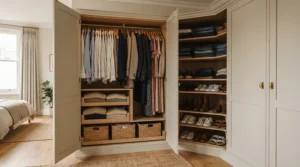
The standout is the system it belongs to. The corner unit measures 32.3 by 32.3 inches and stands 83.7 inches tall, with one fixed shelf and two hanging poles. It pairs with 36-inch and 25-inch units and a cubby, and a four-piece kit spans roughly 82 by 68 inches.
Two poles in one corner module mean stacked hanging, which is a smart way to use height. Because it’s modular, you can start with just the corner and add side units when budget allows. That makes it a good choice for awkward layouts, since you can shape the run around a window or a door.
I found no verifiable customer reviews for the corner unit. One more flag: the listing shows conflicting weight figures (126.5 versus 217 pounds), so confirm shipping weight before you plan for moving it upstairs.
Pros:
- ✅ Modular system grows with your needs
- ✅ Two poles stack hanging space
- ✅ Compact 32-inch corner module
Cons:
- ❌ Corner unit alone has no drawers
- ❌ Listing details show inconsistencies
The corner unit runs around $600, while the four-piece kit lands in the low-$2,000s. It’s strong value only if you actually build out the system.
7. Manhattan Comfort Mulberry Corner Wardrobe — sectional design for the long haul
The standout is expandability. Listings show a sectional corner wardrobe at roughly 36 inches wide, 21.65 inches deep and 81.3 inches tall, designed to pair with additional Mulberry sections. The line also includes 2-piece and 3-piece sets, some with doors.
That 21.65-inch depth gives hangers real breathing room, which matters if you own thick winter coats. The Mulberry 2.0 line is also described as having a finished back, which is helpful when part of the unit stays visible, as it often does in odd rooms.
On reviews, one shopper commented that assembling the corner section alone is a lot of work, so budget a helper and an afternoon. Other review counts on Walmart are small, so I wouldn’t call a rating verified.
Pros:
- ✅ Deeper cabinet suits bulky coats
- ✅ Expandable with extra sections
- ✅ Taller than most budget options
Cons:
- ❌ Assembly is demanding and slow
- ❌ Higher price than single-unit rivals
A single corner listing sits around $800, with sets from roughly $1,480 up into the $2,000s. This is the premium choice for people who plan to keep the wardrobe for years.
Top 7 Comparison: Specs and Value
| Product | Doors / Storage | Hanging Setup | Price Tier | Best For |
|---|---|---|---|---|
| FUFU&GAGA | Frosted doors, 2 drawers | 1 bar | $215–$325 range | First-time renters |
| PAPROOS | Two-tier tower | 2 rods | Budget tier | Hanging-heavy wardrobes |
| Gyfimoie | Doors | 1 rod | Check current price | Farmhouse rooms |
| AIEGLE | Doors + drawers | 1 rod | Check current price | Dresser replacement |
| MOUMON | Frosted doors | 1 rod | Check current price | High ceilings |
| Atlin Designs | Open modular shelf | 2 poles | Around $600 | Modular builds |
| Manhattan Comfort | Sectional, doors in sets | Hanging bays | Around $800 | Long-term systems |
For a single-person bedroom, the FUFU&GAGA and AIEGLE deliver the best storage per dollar. If hanging capacity is the priority, the PAPROOS and Atlin Designs unit with its two rods are the better bets. I didn’t include star ratings in this table because I couldn’t verify consistent figures across listings, and a fabricated average would be worse than a blank cell.
How to Choose a Corner Armoire for Awkward Bedroom Layouts
- Measure both walls and the diagonal. One corner wardrobe buying guide warns that if either wall is under about 120 cm (roughly 47 inches), you’ll get short wings and little storage for the money.
- Check door swing first. If your bedroom door opens into the corner, rethink the plan before ordering. Choose the opposite corner or a sliding-door design.
- Match footprint to leg length. A 35-inch square module uses about three feet of each wall, which is a lot in a 10-by-10 room.
- Decide what you hang. Count your long coats and dresses, then pick a rod height to match, or choose two rods if you mostly hang shirts.
- Look at the build. Particle board and MDF are common at this price. Prefer units with metal hardware and clear weight limits.
- Plan for anchoring. Confirm anti-tip hardware is included and that your wall can take it.
- Think modular or fixed. If your layout may change, a sectional system saves you from buying twice.
Corner Wardrobe Small Bedroom: What Actually Fits
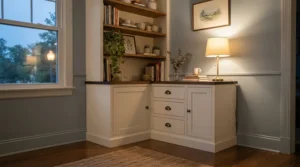
A corner wardrobe small bedroom setup works only when you respect the room’s walking space. In a 10-by-10 bedroom, a 35-inch square corner module takes roughly a third of each wall it touches. That’s fine if the other two walls hold the bed and a nightstand, and painful if you’re also squeezing in a desk.
Here’s the trick small-room dwellers overlook. A corner wardrobe small bedroom unit gains efficiency from depth rather than width. A diagonal-front or L-shaped design tucks its bulk into the corner, which means the visible wall run stays short even when the interior is generous.
The ideal corner wardrobe small bedroom candidates are the AIEGLE, FUFU&GAGA and Atlin Designs corner module, all with modest legs. Skip the widest polygon units in tiny rooms unless you’ve confirmed the wall run. For design inspiration, HomeLane’s roundup of corner wardrobe styles shows how mirrors and light finishes keep these units from feeling heavy.
Angled Armoire for Tight Corners: When the Walls Won’t Cooperate
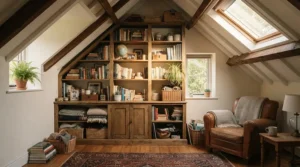
An angled armoire for tight corners earns its keep where a square cabinet simply can’t turn. That includes sloped ceilings, bay-window recesses and walls that meet at something other than 90 degrees. Attic rooms are the classic case. A fitted angled wardrobe can sit flush to the slope, which is why loft specialists promote them.
If you’re working with a slope, one practical method that DIYers suggest is simple. Measure the tallest height the wardrobe can reach at the lowest point. Then measure how far out from the wall the ceiling reaches that height. Those two numbers define the cut line.
Freestanding versions are less precise but more flexible. An angled armoire for tight corners that’s about 70 inches tall will clear most slopes if you push it to the high side. Interior designers also suggest low-profile furniture, since it makes the gap between floor and slope feel larger, and mirrors on the doors help brighten tight spots.
Be honest about the trade-off, though. Triangular and diagonal units waste some internal volume in their points, so you’re buying fit, not maximum capacity.
Corner Armoire vs Traditional Wardrobe
| Feature | Corner Armoire | Standard Two-Door Armoire | Best For |
|---|---|---|---|
| Wall use | Uses two walls, saves floor | Uses one wall run | Corner: small, odd rooms |
| Dead-space recovery | Excellent | None | Corner: awkward layouts |
| Hanging depth | Often generous | Often 20–24″ | Standard: deep coats |
| Door swing | Can collide with beds | Predictable | Standard: tight walkways |
| Assembly | Often longer, more parts | Simpler | Standard: quick builds |
Here’s the interpretation. A standard armoire is easier to place and assemble, but it sacrifices a corner that otherwise goes unused. A corner armoire wins whenever floor area is scarce, and loses when your wall layout already works. If your room is a clean rectangle, the traditional option is probably smarter.
Corner Furniture Design: Features That Actually Matter (And Those That Don’t)
Good corner furniture design is quieter than the marketing suggests. These features earn their place:
- Leg length and depth. A 35-inch square module with a roughly 20-inch interior depth is a sweet spot for hangers.
- Rod placement. Two rods help if you hang short items. A single high rod is better for dresses.
- Anti-tip hardware. Several listings I reviewed mention wall anchoring, and it should be non-negotiable.
- Door type. Frosted glass hides clutter. Solid doors hide more but look heavier.
These matter less than ads suggest: LED strips, mirrored panels you could add cheaper elsewhere, and decorative gold handles. Treat extras as bonuses, never as reasons to buy. In corner furniture design, the geometry and build quality do the heavy lifting, and everything else is garnish.
What to Expect: Real-World Performance
On paper, specs describe capacity. In practice, composite wardrobes behave like composite wardrobes. Expect a cabinet that’s sturdy when empty and slightly flexible when loaded, which is why weight limits matter. For reference, one corner cabinet listing states 40 to 80 pounds per shelf and 100 pounds overall.
Expect assembly to take longer than the box suggests. In reviews of a comparable corner wardrobe sold in Ireland, one buyer reported that the stated two-person, 2.5-hour assembly took three people about five hours. Another noted instructions were short on detail. Plan accordingly.
Expect door clearance to shape daily life. Frosted-glass doors are lighter, but swinging doors still need floor space. Finally, expect the first week to reveal cam-lock looseness, so re-tighten hardware after initial loading.
Awkward Room Layout Solutions: Three Real-World Scenarios
Good awkward room layout solutions start with the room, not the product. Here are three profiles and matching picks.
Scenario 1: The renter with a swinging door. An 11-by-10 rental bedroom, with a door that opens into one corner. Budget under about $350. Use the opposite corner and choose the FUFU&GAGA, whose roughly 70.9-inch height clears typical ceilings. You can disassemble it when you move.
Scenario 2: The attic sleeper. A sloped-ceiling loft bedroom, used nightly. Pick a low-profile solution, such as the Atlin Designs corner module paired with lower side units, so the tallest piece sits where the ceiling is highest.
Scenario 3: The long-haul couple. A shared bedroom with a window-side corner, daily heavy use, and a budget around $800 and up. The Manhattan Comfort sectional gives deeper hanging space and room to add modules later.
The pattern in these awkward room layout solutions is consistent: map the constraint first, then choose the footprint, and only then think about style.
Practical Setup Guide: Your First 30 Days
- Pre-measure the path. Tape the footprint on the floor, then check door swing and the route to the room.
- Assemble on a rug. Work with a helper, since several reviewers report longer-than-stated builds.
- Anchor before loading. Secure the top to the wall studs before any clothes go in.
- Load low and heavy. Put dense items on lower shelves and lighter pieces up top.
- Re-tighten hardware after week one. Cam locks and screws settle under weight.
- Check rod sag at day 30. If it bows, add a center support.
Common first-month mistakes include overloading the rod, skipping anchoring and blocking the doors with a laundry basket.
Problem → Solution: Common Corner Armoire Headaches
- The door hits the bed. Swap swinging doors for sliding ones or shift the bed six inches.
- The shelves sag. Lower the load, add supports, or choose a unit with stated weight limits.
- You can’t reach the back. Use the deep corner for off-season storage and keep daily items near the doors.
- Dead space above. Use storage boxes on top, or choose a taller unit like the MOUMON in a room with high ceilings.
- The unit feels bulky. Pick a light finish and frosted doors, as on the FUFU&GAGA.
Safety First: Anchoring Your Corner Armoire
Tall cabinets are tip-over risks, and the data is sobering. The CPSC’s Anchor It! campaign marked its 10th anniversary and credits itself with contributing to a nearly 50 percent decline in tip-over injuries and deaths. The agency also points to a federal mandatory standard directed by the STURDY Act.
Anchoring is the simple fix. Fasten the top of the cabinet to a wall stud with the supplied bracket, or buy an inexpensive kit. Do it even if no children live with you, because guests, nieces and nephews do visit. Tall units like the MOUMON and Atlin Designs corner module deserve extra care. Never assume a freestanding piece is stable just because it sits in a corner.
Long-Term Cost and Space-Efficient Storage
Space-efficient storage isn’t just about square footage. It’s also about cost per year of use. A corner unit that replaces a dresser and a rack saves both money and floor area.
| Tier | Typical Range | What You Get | Best For |
|---|---|---|---|
| Budget | Under about $350 | FUFU&GAGA-style L-shaped units | Renters, short-term setups |
| Mid-range | Roughly $350–$700 | Taller or drawer-equipped units, Atlin Designs corner module | Daily-use bedrooms |
| Premium | $800 and up | Manhattan Comfort sectional, multi-piece systems | Long-term homes |
Premium pricing pays off only if you’ll keep the piece for years and expand it. Otherwise, a budget unit replaced in three or four years still costs less. When comparing space-efficient storage options, also factor in anchoring supplies and the cost of an extra helper for assembly.
Frequently Asked Questions
❓ How much does a corner armoire cost?
❓ Does a corner armoire fit a 10-by-10 bedroom?
❓ Do I need to anchor a corner armoire to the wall?
❓ Is an L-shaped or triangular corner wardrobe better?
❓ Can I use a corner wardrobe under a sloped ceiling?
Conclusion
A corner armoire for awkward bedroom layouts is one of the few furniture purchases that adds storage without stealing walking space. The right pick depends on your constraints more than your taste. Choose the FUFU&GAGA for a budget rental, the AIEGLE when drawers should replace a dresser, and the PAPROOS if hanging capacity is king. Go to the MOUMON when ceilings are high, the Atlin Designs unit when you want to grow a system, and the Manhattan Comfort sectional when this is a keeper. The Gyfimoie suits farmhouse rooms with true 90-degree corners.
Whatever you choose, measure twice, check door swing, and anchor to the wall before the first hanger goes in. For more on why that last step matters, see the Anchor It! campaign from the CPSC.
✨ Ready to Reclaim That Corner?
🔍 Take your bedroom to the next level with these carefully selected corner units. Click on any highlighted product to check current pricing and availability. A little planning now means more floor, more storage and a room that finally feels like it fits you!
Recommended for You
- Clothing Armoire Vs Closet Organizer For Small Bedrooms: 7 Picks 2026
- TV Armoire For Hiding A Flat Screen In the Bedroom: 7 Best Picks 2026
- Nightstand For Storage In Studio Apartments: 7 Proven Picks (2026)
Disclaimer: This article contains affiliate links. As an Amazon Associate, I earn from qualifying purchases. If you purchase products through these links, we may earn a small commission at no additional cost to you.
✨ Found this helpful? Share it with your friends! 💬🤗
