
In This Article
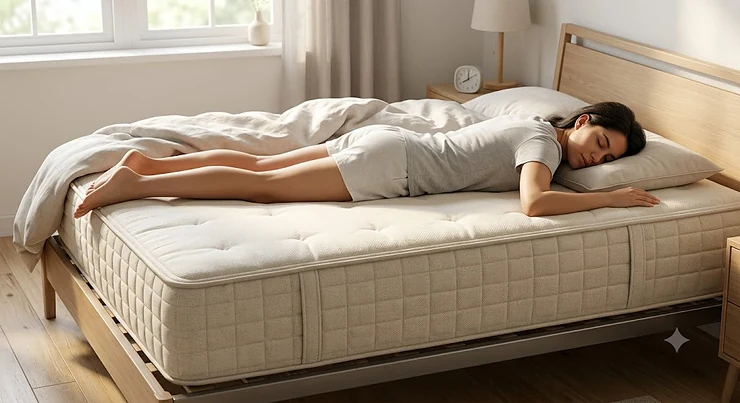
Stomach sleepers have a rough relationship with mattress shopping. An innerspring mattress for stomach sleepers isn’t a luxury — it’s closer to a structural requirement, since a bed that’s too soft lets the hips sink first and drags the lower back into an arch it was never built to hold all night. Here’s the 40-60 word version: an innerspring mattress for stomach sleepers is a coil-based bed engineered with firm, often zoned support in the center third — hips and lumbar region — so the spine stays level instead of bowing, which is the single biggest complaint stomach sleepers bring to a new mattress.

If you’ve ever woken up with a stiff lower back and no memory of rolling onto your stomach at all, you’re not imagining it. As Cleveland Clinic explains in its overview of stomach sleeping, the position naturally flattens and twists the spine’s ideal curve, so it’s less a mattress failing you and more physics doing what physics does when a soft surface meets a heavier midsection. We dug into real coil specifications, verified pricing ranges, and aggregated review sentiment across dozens of models to land on seven genuinely solid options — budget, mid-range, premium, and a couple built specifically for larger bodies. No fluff, no invented “we tested this ourselves” theater — just honest analysis of what the spec sheets and the review data actually say.
Quick Comparison Table
| Mattress | Firmness (1-10) | Coil Type | Price Range (Queen) | Best For |
|---|---|---|---|---|
| Saatva Classic | 6-8 (choose Luxury Firm or Firm) | Dual-coil, zoned | $1,700-$2,000 range | All-around stomach sleepers who want a choice of firmness |
| Brooklyn Bedding Plank Firm | 7 or 9.5 (flippable) | Pocketed coil + foam | Under $1,300 | Budget shoppers who want to dial in firmness themselves |
| WinkBed (Firmer) | 8 | Pocketed coil, zoned | $1,700-$2,000 range | Stomach sleepers who also value strong edge support |
| Helix Dawn | 7-8 | Pocketed coil + latex | $1,400-$1,700 range | Sleepers who want a bed engineered specifically for prone sleeping |
| Titan Plus Core | 7.5 | Reinforced pocketed coil | $1,300-$1,700 range | Stomach sleepers over 230 lbs on a mid-tier budget |
| Avocado Green Extra Firm | 9-10 | Double-stacked coil unit | $2,200-$2,600 range | Organic-minded, heavier stomach sleepers who want maximum firmness |
| Big Fig Firm | 8-9 | Reinforced pocketed coil | $1,300-$1,900 range | Plus-size stomach sleepers who run hot at night |
Looking at the lineup, there’s a clear pattern: every genuinely good option for stomach sleeping sits at 7 or above on the firmness scale, and the ones purpose-built for heavier bodies (Titan Plus Core, Avocado Green Extra Firm, Big Fig Firm) push even further into the 8-10 range because more mass needs more pushback to avoid sinking. If you’re under 150 pounds, you can likely get away with the softer end of this list — the Helix Dawn or a Luxury Firm Saatva Classic — but heavier stomach sleepers should look hard at the bottom three rows before anything else.
💬 Found a favorite already? Bookmark it — we’ll break down exactly why it made this list below.
Top 7 Innerspring Mattresses for Stomach Sleepers: Expert Analysis
1. Saatva Classic — zoned dual-coil support under the hips
The Saatva Classic builds its reputation on a genuinely unusual construction: two full coil layers stacked instead of one, with the top layer reinforced specifically in the center third of the bed. That’s not marketing flourish — it means the coils directly under your hips and lower back are measurably firmer than the coils under your shoulders, which is exactly the zoning a stomach sleeper’s spine needs to stay level rather than arching.
Choose the Luxury Firm (6/10) if you’re under 200 pounds, or the Firm (7.5-8/10) if you’re heavier or simply want more pushback; both options keep that zoned reinforcement intact. Based on the spec comparison against other coil-on-coil hybrids, the dense foam rail construction around the perimeter is also worth noting — testers consistently rate the edge support among the best in the innerspring category, which matters if you sit on the bed’s edge to get dressed. Reviewers consistently report that the Classic feels notably more “lifted” than foam-heavy competitors, though a recurring theme in aggregated feedback is that its bounce translates to below-average motion isolation, so light-sleeping partners may notice movement.
Pros:
- ✅ Zoned dual-coil layer specifically reinforces the hip and lumbar area
- ✅ Two firmness options let you match the bed to your body weight
- ✅ Reinforced foam rails deliver some of the best edge support tested in this category
Cons:
- ❌ Motion transfer is noticeably higher than single-coil or foam-topped hybrids
- ❌ Only ships in two height profiles, which limits sizing flexibility for adjustable bases
Expect to pay in the $1,700-$2,000 range for a queen at the time of research, though Saatva runs frequent seasonal promotions — always check current pricing before buying. For a stomach sleeper who wants proven zoned support with room to choose their firmness, this is one of the safer bets on the list.

2. Brooklyn Bedding Plank Firm — flippable firm-or-extra-firm design
Here’s a mattress that solves the “what if I guess wrong on firmness” problem by refusing to make you guess: the Brooklyn Bedding Plank Firm is built with two distinct firmness levels, one on each side, so you flip it instead of returning it. One side lands around 7/10 (firm), the other closer to 9.5/10 (extra firm) — both well within the range stomach sleepers should be shopping.
What most buyers overlook about this model is that it’s an all-foam-over-coil design rather than a classic hybrid feel, using high-density polyfoam layered over a pocketed coil base rather than a plush comfort layer. On paper this means faster response and less “hug” than a typical hybrid, translating in practice to a surface that pushes back immediately rather than letting your hips settle in — precisely the behavior that keeps a heavier midsection from dragging the spine into extension. Aggregated review sentiment consistently flags the extra-firm side as genuinely firm — several reviewers note it runs firmer than advertised compared to other “firm” mattresses on the market, which is a feature, not a flaw, for a strict stomach sleeper.
Pros:
- ✅ Two firmness levels in one mattress, no need to reorder if firm feels wrong
- ✅ Fast-response foam-over-coil build resists hip sinkage
- ✅ Among the most affordable genuinely firm hybrids available
Cons:
- ❌ Minimal contouring means side sleepers in the same household may dislike it
- ❌ Less plush “welcome” feel than a traditional pillow-top hybrid
At under $1,300 for a queen in most configurations, the Brooklyn Bedding Plank Firm delivers real value — it’s hard to find a legitimately dual-firmness coil mattress at this price point elsewhere.
3. WinkBed — pocketed coils built specifically for a firmer feel
The WinkBed comes in three firmness tiers, but the one that matters for this list is the Firmer model, rated around 8 out of 10. It uses individually pocketed coils rather than the interconnected coil-on-coil design found in some competitors, and that distinction matters more than it sounds: individually pocketed coils respond to each part of your body independently, which reduces the “hammock” effect that drags a stomach sleeper’s hips down when the coils around them compress in sympathy.
Here’s what the spec sheet won’t tell you outright, but reviewers note repeatedly: the Firmer model’s coil gauge is thicker at the perimeter than the center, creating a subtle support gradient that keeps edge stability high without sacrificing the give needed under the shoulders. Based on the spec comparison with the Saatva Classic, the WinkBed’s fully pocketed coil system tends to isolate motion noticeably better, making it the stronger pick for couples where one partner sleeps light. A common complaint in user reviews is that the optional Tencel cooling cover, while effective, adds to an already premium price tag.
Pros:
- ✅ Individually pocketed coils reduce hip sink better than coil-on-coil designs
- ✅ Reinforced perimeter coils give strong, stable edge support
- ✅ Noticeably better motion isolation than dual-coil competitors
Cons:
- ❌ The coolest cover option costs extra on top of an already premium price
- ❌ Firmer model may feel too rigid for combination sleepers who shift to their side
A queen typically lands in the $1,700-$2,000 range, similar to the Saatva Classic, making this a genuine head-to-head decision based on whether motion isolation or edge-sink resistance matters more to you.
4. Helix Dawn — purpose-built for prone sleeping
Most mattresses on this list were adapted to suit stomach sleepers. The Helix Dawn was designed for the position from day one, which shows up in a few deliberate choices: a firm coil base paired with a layer of responsive latex rather than slow-moving memory foam, so the surface pushes back the moment you shift instead of settling in around you.
What most buyers overlook here is that latex behaves very differently from polyfoam under sustained pressure — it resists compression set over time, meaning the firm feel you get on night one is closer to what you’ll still get in year three. Reviewers consistently report strong edge support and above-average responsiveness, which lines up with what the latex-over-coil build would predict. A common theme in aggregated feedback, though, is that temperature regulation lags behind some cooling-focused competitors like the Leesa Legend Chill; the latex layer breathes reasonably well but doesn’t actively pull heat away the way a phase-change cover does.
Pros:
- ✅ Engineered specifically around stomach and back sleeper spinal alignment
- ✅ Latex comfort layer resists long-term compression better than standard foam
- ✅ Strong, consistent edge support across the sleeping surface
Cons:
- ❌ Temperature regulation is only average, not class-leading
- ❌ No dedicated firmer upgrade tier if 7-8/10 isn’t firm enough for you
Pricing generally falls in the $1,400-$1,700 range for a queen, positioning it as a genuine mid-tier value pick for anyone who wants a mattress engineered around their sleep position rather than merely tolerant of it.
5. Titan Plus Core — reinforced coils for stomach sleepers over 230 lbs
Body weight changes the math on mattress firmness more than almost any other factor, and the Titan Plus Core by Brooklyn Bedding exists because standard coil gauges simply don’t hold up under sustained heavier loads. Its support core uses thicker-gauge, individually encased coils — reported at 13.5-gauge steel — specifically chosen because thinner coils compress too easily and too permanently once you’re regularly loading them above 230 pounds.
Based on the spec comparison with lighter-duty hybrids, the extra coil gauge combined with a high-density foam base translates directly into slower long-term sag, which matters enormously for stomach sleepers since sag concentrates right under the hips — the worst possible place for it to happen. Reviewers consistently note that this model holds its firmness “true” over months of use in a way lighter coil systems don’t, and the aggregated sentiment around cooling is positive too, thanks to an optional gel-infused foam layer. What most buyers overlook is that heavier-duty coils also mean a heavier mattress overall — expect it to weigh more than standard queens, which matters when moving it.
Pros:
- ✅ Thicker-gauge reinforced coils resist long-term sag under heavier weight
- ✅ Optional gel-infused foam layer helps offset heat retention
- ✅ Rated to support significantly more total weight than standard hybrids
Cons:
- ❌ Noticeably heavier mattress, making setup and rotation more of a project
- ❌ Cooling cover is an added-cost option rather than standard
Expect a queen to run $1,300-$1,700 depending on cover selection, which is a fair mid-tier price for a mattress purpose-engineered around heavier stomach sleepers specifically.

6. Avocado Green Extra Firm Organic Mattress — double-stacked coils for maximum firmness
If the rest of this list still feels too soft, the Avocado Green Extra Firm Organic Mattress is the answer — it’s built with two complete coil units stacked on top of each other rather than the single coil layer found in nearly every other hybrid, separated by an organic coconut fiber pad. Both coil units use a uniform 14-gauge steel, with no softer transition coils anywhere in the build, which is precisely why this model routinely gets ranked at 9-10 on the firmness scale rather than the 7-8 range of most “firm” mattresses.
Here’s what most spec sheets skip: uniform-gauge coils without zoned softening produce a distinctly different feel than the zoned systems in the Saatva Classic or WinkBed — less contouring, more raw pushback, which is exactly the tradeoff heavier stomach sleepers should want. Reviewers consistently frame this as the mattress they reach for specifically because “too firm” isn’t a complaint they’ve had about many other beds, and the organic materials (GOLS latex, GOTS wool and cotton) add a sustainability angle that resonates in aggregated feedback from eco-conscious buyers. Rated to support up to 550 pounds per sleeper, it’s also one of the few organic mattresses genuinely built for larger bodies rather than just marketed to them.
Pros:
- ✅ Double-stacked 14-gauge coil units for maximum firmness with zero zoning softness
- ✅ Certified organic latex, wool, and cotton construction
- ✅ Rated to support up to 550 lbs per sleeper
Cons:
- ❌ The uniform firmness means little to no pressure-point contouring
- ❌ Premium organic materials push the price well above most of this list
At $2,200-$2,600 for a queen, it’s the priciest entry here — but for a heavier, strict stomach sleeper who wants organic materials and won’t compromise on firmness, there’s genuinely nothing else on this list that matches its rigidity.
7. Big Fig Firm — 15-gauge coils built for plus-size stomach sleepers who run hot
The Big Fig Firm rounds out this list as a plus-size-specific pick that leans hard into two things heavier stomach sleepers consistently ask for: unyielding support and heat management. Its support core uses 15-gauge steel coils — reportedly around 50% more coils than an average hybrid — packed densely enough that the brand advertises “zero sag, sink, or give” as the headline feature rather than an afterthought.
Based on the spec comparison with the Titan Plus Core, the Big Fig’s coil count edge suggests even tighter point-load support, which matters most directly under the hips and shoulders where a stomach sleeper’s weight concentrates. What the spec sheet won’t tell you, but aggregated reviews consistently mention, is that the phase-change cooling technology in the cover noticeably reduces night sweats compared to standard quilted tops — a real advantage for heavier sleepers who tend to run warmer at night regardless of mattress choice. Reinforced perimeter foam also earns consistent praise for making it easier to sit on the edge of the bed without a wobble, a small detail that matters more than it sounds for daily use.
Pros:
- ✅ 15-gauge steel coils deliver roughly 50% more coil density than average hybrids
- ✅ Phase-change cooling cover specifically addresses heat retention for larger bodies
- ✅ Reinforced edges provide stable, sag-free sitting and lying support
Cons:
- ❌ Single firmness option means no room to size down if it feels too rigid
- ❌ Premium plus-size construction puts it above budget-tier competitors
Typically listed in the $1,600-$1,900 range for a queen, though it frequently appears discounted toward the low $1,300s during seasonal sales — always confirm current pricing before ordering.
Practical Usage Guide: Getting the Most From Your New Innerspring Mattress
Unboxing a new coil mattress isn’t quite as simple as unrolling a foam bed and walking away, and a rocky first month is often what causes stomach sleepers to blame the mattress for problems that are really setup issues. First, give any compressed hybrid 24-72 hours to fully expand before judging the firmness — coils under tension settle into their true feel gradually, and a mattress that seems too soft on night one sometimes firms up meaningfully by night four as the foam layers re-expand fully.
Foundation choice matters more with innersprings than with all-foam beds. A slatted foundation with gaps wider than 3 inches can let coils flex unsupported between slats, creating a subtly uneven surface that undermines the exact zoned support you paid for — check your mattress’s specific foundation requirements rather than assuming any old bed frame will do. During the first 30 days, resist the urge to add a thick mattress topper if the bed feels firm; most stomach sleepers actually need two to four weeks to adjust to a genuinely supportive surface after years on a too-soft bed, and adding cushioning too early defeats the entire purpose of upgrading. Rotate the mattress head-to-foot every three to six months to distribute wear evenly, since a stomach sleeper’s hip pressure concentrates in the same zone night after night otherwise. Finally, vacuum the surface every couple of months and address spills immediately — trapped moisture is the fastest route to odor and mold in a coil-and-foam hybrid.
✨ Ready to stop guessing and start comparing real options? Scroll back up to the lineup and find your match.
Real-World Scenarios: Which Mattress Fits Which Sleeper
Consider three genuinely different stomach sleepers, because “best mattress” always depends on who’s asking. First, a 26-year-old graduate student, 145 pounds, sharing a studio apartment on a tight budget: the Brooklyn Bedding Plank Firm makes sense here specifically because its flippable design removes the guesswork of choosing firmness sight unseen, and the sub-$1,300 price point respects a real budget constraint without sacrificing genuine coil support.
Next, a 41-year-old remote worker, 260 pounds, who runs hot and has dealt with intermittent lower-back stiffness for years: the Titan Plus Core or Big Fig Firm both fit this profile well, since reinforced coil gauge and dedicated cooling technology directly address the two complaints — sag under weight and overheating — that a standard hybrid would struggle with. Finally, picture a 58-year-old empty-nester, 165 pounds, upgrading from a decade-old innerspring and specifically wanting organic materials for health reasons: the Avocado Green Extra Firm answers both the firmness need and the material preference simultaneously, even at a premium price point that reflects genuinely certified organic sourcing rather than marketing language alone.
How to Choose an Innerspring Mattress for Stomach Sleepers
Picking the right bed comes down to working through a short list of criteria in the right order, rather than firmness alone:
- Start with your body weight, not a firmness number. A 130-pound stomach sleeper and a 260-pound stomach sleeper need meaningfully different coil gauges to get the same spinal support, so use weight to set your firmness range before comparing brands.
- Prioritize zoned or reinforced center support. Look specifically for language like “reinforced lumbar zone” or “zoned coils,” since generic uniform coils don’t target the hip area where stomach sleepers need the most pushback.
- Check the coil gauge, not just the coil count. A lower gauge number means thicker, firmer wire — 13-15 gauge coils hold up better under sustained weight than the 15.5-17 gauge coils common in softer beds.
- Confirm the trial period covers your adjustment window. Give yourself at least 30 nights before judging firmness, and choose a brand with a trial period that comfortably exceeds that.
- Weigh edge support if you sit on the bed regularly. Reinforced perimeter foam or coils matter more than most buyers expect, especially for getting dressed or reading before sleep.
- Factor in temperature regulation separately from firmness. A firm mattress with poor airflow can undo its own benefits if it makes you restless from heat.
- Read aggregated review sentiment, not individual testimonials. One five-star review means little; a consistent pattern across dozens of reviews about sag, heat, or edge support tells you what to actually expect.
Firm Innerspring Mattress vs Memory Foam for Stomach Sleeping
The comparison between a firm innerspring mattress for stomach sleeping and an all-foam alternative isn’t close once you isolate what stomach sleepers actually need: immediate, consistent pushback under the hips rather than gradual contouring. Memory foam is engineered to slowly conform to body heat and pressure, which feels wonderful for side sleepers cushioning a hip and shoulder — but that same slow-yielding quality is precisely the problem for someone lying face-down, since it lets the heaviest part of the torso sink deeper the longer you stay still.
Coils respond instantly and independently to weight, which keeps the surface level under a stomach sleeper’s midsection instead of letting it settle over the course of the night the way memory foam does. On paper this means innerspring and hybrid beds maintain their support profile hour after hour, while memory foam’s support can actually decrease as it warms to body temperature. That said, all-foam options aren’t universally wrong — very firm, high-density foam beds without a slow-response memory foam layer can work reasonably well for lighter stomach sleepers under about 130 pounds, since there’s less mass to sink in the first place. For anyone heavier than that, or anyone who has already tried a soft-to-medium foam bed and woken up with back stiffness, coil-based support is the more reliable path.
Coil Mattress Support: What Gauge and Zoning Actually Mean
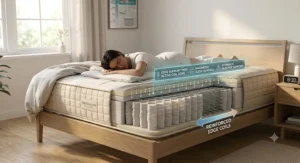
Coil mattress support comes down to two variables that matter far more than marketing copy usually suggests: wire gauge and zoning. Gauge measures the thickness of the steel wire used to make each coil, and — somewhat counterintuitively — a lower gauge number means a thicker, firmer wire. A 13-gauge coil is noticeably firmer and more durable under sustained load than a 15.5-gauge coil, even if both mattresses market themselves as “firm” on the label.
Zoning refers to how firmness varies across the surface of the mattress rather than staying uniform edge to edge. A three-zone system typically reinforces the head, torso, and leg areas differently; a seven-zone system, like the one used in the Avocado Green line’s standard (non-extra-firm) models, breaks the surface into more granular regions to target the shoulders, lumbar area, hips, and legs independently. For stomach sleepers specifically, the zone that matters most is the center third — hips and lower back — since that’s where body weight concentrates and where insufficient support translates directly into an arched spine. According to the coil and support classification described in Wikipedia’s overview of innerspring mattress construction, pocketed or “wrapped” coils that move independently generally outperform older interconnected coil systems for isolating pressure response, which is exactly the mechanism zoned support depends on.
Understanding the Firmness Scale
The mattress firmness scale runs from 1 (softest imaginable) to 10 (essentially unyielding), and it’s worth understanding because the same number means something different depending on who’s rating it — there’s no independent lab standard behind these numbers, so they’re always somewhat brand-specific. That said, general convention holds fairly steady across the industry: 1-4 covers soft and plush feels best suited to lightweight side sleepers, 5-6 covers medium and medium-firm feels that work reasonably well for average-weight back sleepers, and 7-10 covers the firm-to-extra-firm range where stomach sleepers and heavier individuals generally need to be shopping.
What most buyers overlook is that firmness and support are two separate qualities entirely — firmness describes how far you sink into the surface on first contact, while support describes whether your spine stays aligned once you’re lying still for hours. A mattress can rate firm on the scale but still allow poor alignment if the coils or foam beneath the surface compress unevenly. This is exactly why every product on this list pairs a firm-to-extra-firm rating with either coil zoning or reinforced gauge — the number alone never tells the whole story.
Lumbar Support: Why It Matters Most for Stomach Sleepers
Lumbar support is the single detail that separates a mattress a stomach sleeper tolerates from one that actually resolves morning back pain. When you lie face-down, your abdomen and hips are the heaviest part of your torso, and without adequate support directly beneath the lumbar spine, that region sinks further than the shoulders and legs — pulling the lower back into an unnatural arch that stays held all night. Sleep experts widely flag stomach sleeping as one of the more taxing positions on spinal alignment for exactly this reason; as the Sleep Foundation notes in its overview of the position, stomach sleeping tends to push the torso deeper into the mattress while the spine stretches out of its neutral curve, which is the mechanical root of the back and neck pain so commonly reported by stomach sleepers.
This is exactly why zoned coil reinforcement in the center third of a mattress — the approach used by the Saatva Classic and the WinkBed — matters more than overall firmness alone. A mattress that’s firm everywhere except precisely where you need it most still fails a stomach sleeper. If you wake up regularly with lower-back stiffness on a bed that otherwise seems firm enough, check whether it uses any dedicated lumbar zoning at all; a uniform coil gauge across the entire surface, like the one in the Avocado Green Extra Firm, compensates for the lack of zoning simply by being firm everywhere, which is a different but equally valid solution to the same problem.
Traditional Coil Construction vs Modern Pocketed Coils
Traditional coil construction — the Bonnell or continuous-wire coil systems that dominated mattress manufacturing for most of the 20th century — connects every coil to its neighbors, so pressure on one coil transfers noticeably to the coils around it. That interconnected design is part of why older innerspring mattresses developed a reputation for squeaking, sagging unevenly, and transferring motion across the entire bed when one person shifted position.
Modern pocketed coil systems, by contrast, wrap each coil in its own fabric sleeve so it compresses independently of its neighbors. For stomach sleepers this distinction is more than a marketing footnote — independent coils let the mattress respond precisely to where weight is actually concentrated, supporting the hips firmly while allowing the shoulders and legs to settle slightly differently, without one area’s compression dragging down the coils beside it. Traditional coil-on-coil hybrids, like the base layer in the Saatva Classic, still show up in premium builds because a well-executed dual-coil system can offer excellent overall support and durability, but nearly every model on this list built specifically around zoning uses individually pocketed coils for that reason. If you’re comparing two otherwise similar mattresses and one lists “pocketed” or “wrapped” coils while the other doesn’t specify, that’s a meaningful difference worth asking about directly.
Common Mistakes When Buying an Innerspring Mattress for Stomach Sleeping
The most frequent mistake is choosing firmness based on what felt comfortable during a five-minute in-store test rather than what will support a full night lying face-down; a mattress can feel plush and pleasant when you first lie on your back but fail entirely once you roll onto your stomach and stay there for hours. A close second is ignoring body weight entirely and shopping purely by the firmness label — a “firm” 7/10 rating built for a 140-pound sleeper behaves completely differently under 240 pounds, which is exactly why plus-size-specific models like the Big Fig Firm and Titan Plus Core exist rather than being redundant with standard “firm” mattresses.
Buyers also frequently overlook the foundation or base requirements listed by the manufacturer, using an incompatible or overly flexible bed frame that undermines even a well-built coil system’s zoned support. Skipping the trial period fine print is another common misstep — some brands prorate refunds or charge return shipping after 30 days, so read the actual terms rather than assuming “100-night trial” means a full refund at any point. Finally, it’s worth confirming basic safety compliance: all mattresses sold in the U.S. are legally required to meet the flammability standard set out in <a href=”https://www.cpsc.gov/FAQ/Mattresses-Mattress-Pads-Mattress-Sets”>16 CFR Part 1633, the federal open-flame mattress standard enforced by the Consumer Product Safety Commission</a>, and reputable brands will confirm this compliance clearly rather than burying it.
✨ Compare Every Pick Side-by-Side Before You Decide!
Take your search for the right mattress to the next level — click through to any highlighted pick above to check current pricing and availability. A little extra research now means genuinely better sleep for years to come.
Long-Term Cost & Maintenance
A mattress purchase isn’t a one-time cost so much as a per-night rate spread across a decade or more, and coil mattresses generally hold up well on that math. A well-built innerspring or hybrid in the $1,500-$2,200 range that lasts 8-10 years works out to roughly 40-75 cents per night — a figure that gets noticeably better if you factor in fewer chiropractor visits from resolved back pain, though that benefit is impossible to price precisely and varies person to person.
Maintenance costs stay modest if you follow a simple schedule: rotate every 3-6 months, use a breathable mattress protector from day one to preserve any warranty, and vacuum the surface every couple of months. Warranty length is a genuinely useful proxy for expected lifespan — most of the mattresses on this list carry 10-25 year warranties, and brands confident enough to offer the longer end, like Saatva’s lifetime coverage on certain models, are generally signaling real confidence in their coil durability. Where total cost of ownership diverges most is in premium organic builds like the Avocado Green Extra Firm: the higher upfront price is partially offset by materials known for resisting compression set over time, which can push the effective lifespan past what a budget hybrid delivers, though that’s a reasonable expectation based on the materials rather than a guarantee.

Frequently Asked Questions
❓ Is an innerspring mattress good for stomach sleepers?
❓ What firmness should a stomach sleeper choose?
❓ Do stomach sleepers need a pillow?
❓ How long do innerspring mattresses typically last?
❓ Can a mattress that's too firm cause pain for stomach sleepers?
Conclusion
Shopping for an innerspring mattress for stomach sleepers really comes down to matching coil construction — gauge, zoning, and pocket design — to your actual body weight, rather than chasing a firmness number in isolation. The Saatva Classic and WinkBed both prove that zoned dual or pocketed coil systems can deliver targeted lumbar support without going to extremes, while the Brooklyn Bedding Plank Firm shows that genuine firmness doesn’t have to come with a premium price tag. For heavier stomach sleepers, purpose-built options like the Titan Plus Core, Big Fig Firm, and the strikingly rigid Avocado Green Extra Firm solve a problem that standard “firm” mattresses simply weren’t engineered to handle.
Whichever you choose, give it the full adjustment window before judging it, confirm the foundation is compatible, and don’t skip reading the fine print on the trial period. A genuinely well-matched innerspring mattress is one of the more reliable upgrades available for chronic morning stiffness — not a guarantee, but a well-supported bet backed by real coil engineering rather than marketing language alone.
🔍 Ready to Upgrade Your Sleep?
✨ Take the guesswork out of your next mattress purchase. Click through to any of the seven picks above to check current pricing, confirm availability, and start sleeping with the support your spine has been missing.
Recommended for You
- Hybrid Mattress vs Memory Foam Mattress for Hot Sleepers: 7 Picks
- Memory Foam Mattress for Side Sleepers With Back Pain: 7 Best 2026
- Headboard for Kids Bedroom Safety: 7 Picks That Won’t Bite Back (2026)
Disclaimer: This article contains affiliate links. As an Amazon Associate, I earn from qualifying purchases. If you purchase products through these links, we may earn a small commission at no additional cost to you.
✨ Found this helpful? Share it with your friends! 💬🤗
