
In This Article
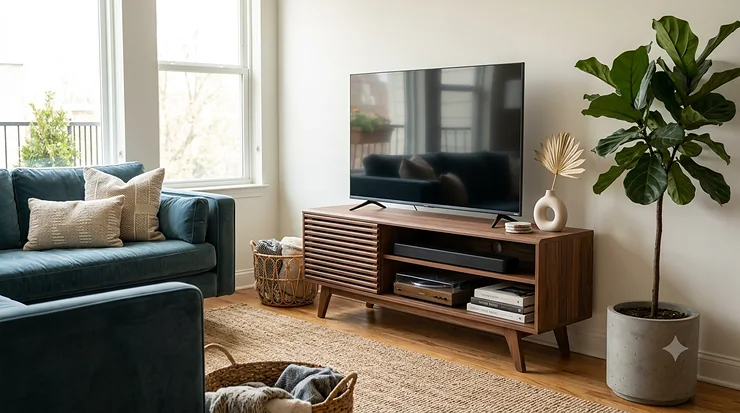
A mid century modern tv stand is a low-profile media console built around the mid-century modern design movement of the 1950s and 60s: clean lines, warm wood tones, and slim tapered legs that lift the piece off the floor. If you’ve spent any time scrolling furniture listings, you already know the style is everywhere right now — but not every “mid-century” stand is built the same way underneath the marketing photos.
I’ve spent the last few weeks digging through real listings, reading spec sheets line by line, and comparing what’s actually inside the box versus what the product photos suggest. Some stands lean on solid wood that’ll outlast your next three TVs. Others use particleboard dressed up with a wood-grain laminate, which is fine for a guest room but not what you want anchoring your main living space for a decade.
What surprised me most? Price doesn’t always track with quality the way you’d expect. A few budget options punch well above their price tag because the brand nailed the leg construction and storage layout, while a couple of pricier picks are really paying for brand name and finish, not raw durability.
This guide walks through seven real, currently available stands — budget, mid-range, and investment-grade — plus the practical stuff nobody tells you: how to actually size one for your TV, what tends to go wrong after the honeymoon period, and which features are worth paying extra for versus which ones are just nice photos.
Quick Comparison Table: Mid Century Modern TV Stand Options at a Glance
| Stand | Best For | Material | Max TV Size | Price Range |
|---|---|---|---|---|
| LCRBOL TV Stand | First apartments / tight budgets | Particleboard, walnut finish | 65″ | Budget |
| Walker Edison 3-Drawer | Drawer storage on a budget | Solid pine wood | 65″ | Budget-Mid |
| Walker Edison Saxon | Large TVs, airy look | MDF with metal legs | 80″ | Mid |
| Crosley Liam | Small-to-mid rooms, US brand support | Engineered wood veneer | 65″ | Mid |
| Modway Render | Textured look on a budget | MDF/particleboard | 64″ | Budget-Mid |
| POVISON LED Console | Big screens, zero assembly | Solid ash wood | 75″+ | Premium |
| SIMPLIHOME Draper | Long-term, heirloom-quality piece | Solid hardwood | 65″ | Premium |
Looking at the spread above, the real dividing line isn’t price so much as construction: the LCRBOL, Saxon, Liam, and Render options all use engineered wood (particleboard or MDF) with a veneer finish, which keeps costs down but means less tolerance for moving or heavy use over the years. The Walker Edison 3-Drawer, POVISON, and SIMPLIHOME Draper all step up to solid wood cores, which is where you start paying for longevity rather than just looks.
💬 Just one click — help others make better buying decisions too!😊
Top 7 Mid Century Modern TV Stands: Expert Analysis
I sorted these from budget to premium so you can jump straight to your price range, but I’d read at least the “best for” line on each one — the cheapest stand isn’t always the worst choice, and the priciest isn’t automatically the best fit for your room.
| Stand | Construction | Storage | Standout Feature | Rating Pattern |
|---|---|---|---|---|
| LCRBOL | Particleboard | Shelf + 2 cabinets | Adjustable feet for uneven floors | Praised for value |
| Walker Edison 3-Drawer | Solid pine | 3 drawers + 2 shelves | Cutout drawer handles | Liked for sturdiness |
| Walker Edison Saxon | MDF + metal legs | 2 cabinets + glass shelf | Supports up to 80″ TVs | Liked for size capacity |
| Crosley Liam | Engineered wood | 2 cabinets + open shelf | Low-profile US-made design | Liked for finish quality |
| Modway Render | MDF/particleboard | Sliding doors + drawer | Slatted door texture | Mixed on long-term wear |
| POVISON LED | Solid ash wood | Multiple compartments | Built-in adjustable LED | Liked for assembly ease |
| SIMPLIHOME Draper | Solid hardwood | Sliding doors + open shelves | Hand-finished brass pulls | Liked for craftsmanship |
A pattern shows up fast in this table: stands using metal-reinforced legs (Saxon) or solid wood cores (3-Drawer, POVISON, Draper) consistently get fewer complaints about wobbling after assembly. If stability with kids or pets in the house is your top priority, that’s the column to scan first rather than the price column.
1. LCRBOL TV Stand for Living Room
The LCRBOL TV Stand stands out for its wave-shaped fluted cabinet doors — a detail that instantly reads “mid-century” even from across the room. It’s built on six wooden legs, including two adjustable middle feet, which matters more than it sounds: most budget stands skip the middle-foot adjustment entirely, so this one won’t rock on a slightly uneven floor the way cheaper competitors do.
The desktop measures roughly 54 inches wide, comfortably handling TVs up to 65 inches with room left over for a soundbar. Storage comes from a middle shelf plus two enclosed cabinets, with two rear cord holes for cable management.
In my experience, this is the stand for someone furnishing a first apartment or a secondary room who wants the look without the investment. Buyer feedback consistently calls out the easy assembly and the visual impact of the fluted doors relative to the price.
✅ Pros: Very budget-friendly; adjustable feet handle uneven floors; generous enclosed storage
❌ Cons: Particleboard core won’t take heavy abuse like solid wood; ships flat-packed, requiring full assembly
Price & Verdict: Typically in the lower end of the market range — a strong pick if budget matters more than long-term durability.
2. Walker Edison 3-Drawer Mid Century Modern Wood TV Stand
What most buyers overlook about this model is that it’s built from solid pine, not the particleboard you’ll find in most stands at this price. That single material choice changes how the piece ages — solid wood can be sanded and refinished if it gets scratched, while veneer just shows the damage underneath.
The 58-inch frame sits on slightly tapered legs and includes three drawers with cutout handles plus two open shelves above, all rated for TVs up to 65 inches. The drawers are the real differentiator here — most stands in this price bracket only offer cabinets, and drawers are genuinely better for organizing remotes, cables, and small media accessories you want to grab quickly.
✅ Pros: Solid pine construction outlasts particleboard rivals; three drawers beat cabinet-only storage for daily use; classic tapered-leg silhouette
❌ Cons: Stained finish can show wear faster than a lacquered topcoat; full assembly required
Price & Verdict: Sits just above entry-level pricing — the better choice over the LCRBOL if you specifically want drawer storage and solid wood.
3. Walker Edison Saxon Mid Century Modern Glass Shelf TV Stand
The Saxon is the stand to consider if your TV is genuinely large — it’s rated for screens up to 80 inches, which most mid-century stands simply can’t support. The 70-inch frame uses metal tapered legs rather than wood, and in my experience metal legs hold their alignment better over years of vacuuming bumps and furniture-sliding than thinner wooden ones.
The center glass shelf is the signature touch, breaking up what would otherwise be a solid wood block and making the whole piece feel lighter in a room. Two side cabinets handle closed storage, while the open glass shelf is ideal for a soundbar or streaming box you want visible.
The frame itself is MDF, not solid wood, so this is a style-and-capacity play rather than a heirloom-furniture play.
✅ Pros: Supports unusually large TVs up to 80″; metal legs add stability; glass shelf creates visual lightness
❌ Cons: MDF core means less durability than solid wood; glass shelf shows fingerprints and dust quickly
Price & Verdict: Mid-range pricing that’s justified mainly by the large-TV capacity — skip it if your screen is under 55 inches, since you’re paying for size you don’t need.
4. Crosley Furniture Liam Mid-Century TV Stand
Crosley has been making furniture for over a century, and the Liam reflects that legacy with a low-profile silhouette and noticeably clean tapered legs. What I like about this one is the proportions — at a sub-30-inch height, it sits low enough that it won’t compete visually with a wall-mounted TV, which is a common styling mistake with bulkier stands.
Storage includes two cabinet doors with adjustable shelves plus an open shelf, and the rear panel includes built-in cable management. It’s rated for TVs up to 65 inches.
This is best suited to smaller-to-midsize living rooms where you want the mid-century look without an oversized footprint, and where US-based customer support and warranty backing matter to you.
✅ Pros: Established US brand with dedicated support; low-profile design fits compact rooms; built-in cable management
❌ Cons: Interior cabinet space is on the smaller side for big media collections; finish is veneer over engineered wood, not solid wood
Price & Verdict: Mid-range, and the brand backing is genuinely worth something if you’ve been burned by unresponsive sellers before.
5. Modway Render Mid-Century Modern Low Profile TV Stand
The Render leans on slatted sliding doors for texture — a detail that photographs better than flat panel doors and adds a subtle mid-century rhythm to the front of the piece. At 59 inches wide, it supports TVs up to 64 inches, with adjustable shelves behind each sliding door and a center glide-out drawer for loose accessories.
The frame combines particleboard and MDF with a wood-grain laminate, which keeps the price down but is the trade-off to know about going in. Reviewer sentiment is genuinely mixed on long-term wear — fine for moderate use, less ideal if you’re moving the stand often or living with rambunctious kids.
✅ Pros: Good value at this price point; slatted doors add texture other budget stands lack; center drawer adds useful extra storage
❌ Cons: Engineered wood frame is less durable long-term; capped at a lower max TV size (64″) than most competitors
Price & Verdict: A solid budget-to-mid pick if you want more visual texture than a flat-panel stand without stepping up to solid wood pricing.
6. POVISON Fully-Assembled Mid Century Modern TV Stand with LED Light
If you’ve ever sworn at a hex key while assembling furniture, the POVISON console solves that problem outright — it arrives fully assembled, which is rare for a piece this large. Built from multi-layered solid ash wood rather than particleboard, the 78.74-inch frame is sized for genuinely large TVs, 75 inches and up.
The built-in adjustable LED lighting is the standout feature here, casting a warm glow along the slatted swing doors that most competitors simply don’t offer. Multiple open and closed compartments give you flexibility for gaming consoles, a soundbar, and decor without crowding any single section.
In my experience, this is the pick for home-theater-leaning households with a big screen who want the unboxing experience to be “set it against the wall and plug it in,” not a weekend project.
✅ Pros: Arrives fully assembled, saving real setup time; integrated adjustable LED lighting; built for very large TVs (75″+)
❌ Cons: Sits at the higher end of the price spectrum; large footprint needs a correspondingly large room
Price & Verdict: Premium pricing, but the combination of solid wood, LED lighting, and zero assembly genuinely justifies it for a large-screen setup.
7. SIMPLIHOME Draper TV Stand
The Draper is the closest thing on this list to investment furniture. It’s hand-finished from solid hardwood in a rich teak brown stain with a protective lacquer, and it’s the one stand here you could realistically refinish in twenty years instead of replacing. The 60-inch frame sits at a balanced 30-inch height, with two sliding doors revealing adjustable-shelf storage and an open center section with two more shelves and rear cord cutouts.
The detail that signals genuine mid-century craftsmanship is the antique brass recessed door pulls — small, but it’s the kind of hardware choice that separates a piece built to look mid-century from one actually built using mid-century joinery principles.
This is the stand for buyers who’ve already replaced two or three cheaper consoles and are done doing that. The trade-off is weight: two-person assembly is genuinely recommended, not just a suggestion on the box.
✅ Pros: True solid wood construction that can be refinished; hand-finished craftsmanship with brass hardware; balanced height keeps everything at a comfortable reach
❌ Cons: Priced noticeably above the MDF/particleboard competitors; heavy enough that solo assembly is a struggle
Price & Verdict: Premium pricing, and worth it specifically if you want a stand that outlasts the TV sitting on it.
✨ Don’t Miss These Exclusive Deals!
🔍 Take your living room to the next level with these carefully selected mid century modern tv stand picks. Click on any highlighted item to check current pricing and availability. These stands will help you build a home your family will actually want to hang out in!
Practical Usage Guide: Setup, Maintenance & Styling
Getting a mid century modern tv stand into your room is only step one — how you set it up determines whether it looks intentional or just “furniture that arrived in a box.”
During the first 30 days:
- Let particleboard or MDF stands sit for a few hours after assembly before loading them with weight; cam-lock fasteners settle and tighten slightly as the joints seat.
- Use felt pads under any glass shelf inserts to prevent micro-scratching when you set down remotes or decor.
- Tighten leg bolts again after the first week — most wobble complaints trace back to fasteners that loosened slightly during the first round of use, not a manufacturing defect.
Ongoing maintenance:
- Dust solid wood pieces (like the Draper or POVISON) with a slightly damp microfiber cloth, then dry immediately — standing water is what eventually clouds a lacquer finish.
- For particleboard/MDF stands, avoid wet cleaning altogether; a dry cloth or vacuum attachment is safer for the laminate edges.
- Check adjustable middle feet every few months if your floor isn’t perfectly level — it’s a thirty-second fix that prevents long-term frame stress.
Optimization tricks: Run cables through the rear cutouts before mounting your TV, not after — it’s far easier to thread cords through an empty cavity than around a TV that’s already in place.
Real-World Scenarios: Matching a Stand to Your Life
The first-apartment renter: Budget matters most, and you’re not staying five years. The LCRBOL or Modway Render both deliver the mid-century look without overcommitting financially — pick the LCRBOL if floor leveling is a concern, the Render if you want a textured door front.
The growing family with a big-screen TV: Durability and capacity matter more than price sensitivity. The Walker Edison Saxon (up to 80″) or the POVISON LED console (75″+, fully assembled) both solve the “will this actually hold my TV” question while standing up to daily traffic.
The long-term homeowner ready to stop replacing furniture: If you’ve already cycled through a couple of cheaper stands, the SIMPLIHOME Draper’s solid hardwood construction is built to be refinished rather than replaced — the higher upfront cost is really a one-time decision instead of a recurring one.
Problem → Solution: Fixing Common TV Stand Headaches
Problem: Stand wobbles on hardwood or uneven flooring. Solution: Look for adjustable feet specifically — the LCRBOL’s two adjustable middle feet solve this directly, and most stands’ rear feet can be shimmed with felt pads as a quick fix.
Problem: Cords turn into a visible tangle behind the TV. Solution: Every stand on this list includes some form of cable cutout — route cords through them before final TV placement, and consider a velcro cable sleeve for anything still visible.
Problem: Cabinet doors won’t stay aligned after a few months. Solution: This is almost always a hinge-screw issue, not a structural one. A quarter-turn tightening on visible hinge screws resolves the vast majority of misaligned-door complaints.
Problem: TV looks oversized or undersized on the stand. Solution: Match stand width to TV width plus 10–15 inches of overhang on each side — the comparison table above lists max TV sizes for exactly this reason.
✨ Don’t Miss These Exclusive Deals!
🔍 Whichever budget you’re working with, there’s a mid century modern tv stand above sized for your space. Tap through to compare current availability before your favorite size sells out!
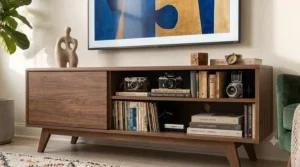
How to Choose a Mid Century Modern TV Stand
- Measure your TV first, not your wall. Add 10–15 inches of total width beyond your TV’s edges so the stand doesn’t look undersized once the screen is in place.
- Decide solid wood versus engineered wood early. Solid wood (Draper, POVISON, 3-Drawer) costs more but can be refinished; engineered wood (Saxon, Liam, Render, LCRBOL) costs less but shows wear permanently.
- Check the height range for your seating. Aim for 20–26 inches off the floor so you’re not craning your neck from a standard sofa.
- Confirm at least one closed-storage section. Open cubbies look great in photos but collect clutter fast — every stand here includes at least one cabinet or drawer for this reason.
- Look for cable management cutouts. Stands without them turn into a wire nest within weeks.
- Verify the weight rating if you’re wall-mounting instead. Some “TV stands” double as sideboards and aren’t rated to support a mounted TV’s bracket hardware. If you have young kids or pets in the house, it’s also worth anchoring the stand itself to the wall — the CPSC’s Anchor It! campaign has straightforward guidance on securing furniture and TVs to prevent tip-overs.
- Match leg material to your traffic level. Metal legs (Saxon) generally outlast thin wooden legs in high-traffic households with kids or pets.
Common Mistakes When Buying a Mid Century Modern TV Stand
The most common mistake is buying a stand that’s narrower than the TV itself — it makes the whole setup look top-heavy and unstable even when it’s perfectly secure. A close second is skipping closed storage entirely; open shelving looks clean in a showroom photo but becomes a cable-and-remote graveyard within a month of real use.
Buyers also frequently underestimate weight capacity. If a listing doesn’t clearly state a load rating of at least 75–100 pounds, treat the piece as decorative rather than a true equipment stand. Finally, ignoring floor levelness is an easy miss — a stand that looked stable in the store can wobble noticeably once it’s on your actual (often not-quite-level) living room floor, which is exactly why adjustable feet matter more than they get credit for.
Mid Century Modern TV Stand vs Traditional Entertainment Centers
| Feature | Mid Century Modern TV Stand | Traditional Entertainment Center |
|---|---|---|
| Footprint | Low-profile, elevated on legs | Often floor-to-near-ceiling, bulky |
| Style flexibility | Pairs with most modern decor | Tends to lock you into one aesthetic |
| Storage style | Mix of open shelving + closed cabinets | Mostly closed cabinets |
| Airflow under electronics | Open leg design improves ventilation | Enclosed base can trap heat |
| Best For | Open-concept, modern living rooms | Dedicated media rooms with heavy AV gear |
The biggest practical difference is ventilation and visual weight: a mid century modern tv stand’s open-leg design lets air circulate around streaming boxes and consoles, while boxier traditional units can trap heat around electronics. If your living room is open-concept, the lighter footprint of a mid-century stand also tends to make the whole space feel less cluttered than a wall-spanning traditional unit.
What to Expect: Real-World Performance
Spec sheets rarely tell you how a stand actually behaves day to day. In practice, solid wood stands like the Draper feel noticeably more solid when you set something down on top — less surface vibration, less hollow sound. Engineered wood stands like the Render or LCRBOL are perfectly stable for normal use but will show a small “give” if you lean on the edge, which is just the nature of particleboard versus solid lumber.
Sliding and fluted doors (LCRBOL, POVISON) tend to operate more smoothly over time than swing-hinge cabinet doors, since there’s no hinge alignment to drift. Glass-shelf designs like the Saxon look striking initially but require more frequent dusting than fully enclosed cabinets — something worth knowing if you’re not the type to wipe down furniture weekly.
Features That Actually Matter (And Those That Don’t)
Actually matters: Solid wood versus engineered wood (durability), adjustable feet (stability on real floors), and confirmed max TV weight/size rating. Worth knowing: any particleboard or MDF sold in the U.S. has to meet EPA formaldehyde emission standards for composite wood products, so material safety isn’t really a differentiator between budget and premium picks — durability still is.
Doesn’t matter as much as marketing suggests: The exact number of “mid-century inspired” decorative grooves on a door front, or whether handles are brass versus brushed nickel — both are purely aesthetic and have zero impact on how the stand performs.
Genuinely underrated: Rear cord cutout placement. A stand with cutouts positioned awkwardly behind a cabinet wall is technically “cable management” on paper but useless in practice if you can’t reach the opening with your TV mounted close to the wall.
Long-Term Cost & Maintenance
A budget particleboard stand costing less upfront may need replacing within 5–7 years of regular use, especially if moved more than once or twice. A solid wood stand costing more upfront — like the Draper or the Walker Edison 3-Drawer — can realistically last 15–20+ years with occasional refinishing, which works out to a lower cost per year of ownership despite the higher initial price.
Maintenance costs are minimal either way: a refinishing kit for solid wood runs a fraction of the price of a replacement stand, while engineered wood stands have no realistic refinishing option once the laminate is damaged — at that point, replacement is the only path forward.
Frequently Asked Questions
❓ What is a mid century modern tv stand?
❓ How wide should my mid century modern tv stand be?
❓ Can a mid century modern tv stand hold a 75-inch TV?
❓ Is solid wood worth the extra cost for a tv stand?
❓ Do mid century modern tv stands need to be wall-mounted secure?
Conclusion
There’s no single “best” mid century modern tv stand — there’s a best one for your TV size, your room, and how long you want it to last. If you’re outfitting a first apartment or a guest room, the LCRBOL or Modway Render get you the look without a big commitment. If your TV is genuinely oversized, the Walker Edison Saxon or POVISON LED console are built to actually support that scale. And if you’re done replacing furniture every few years, the SIMPLIHOME Draper or Walker Edison 3-Drawer give you real solid wood that can be refinished instead of discarded.
Whichever direction you go, the same checklist applies: measure your TV first, confirm the weight rating, and don’t skip closed storage just because open shelving photographs better. A stand that handles your actual living room — uneven floor, cable mess, and all — will always beat one that just looked good in a showroom.
✨ Don’t Miss These Exclusive Deals!
🔍 Ready to upgrade your living room? Compare current pricing on these mid century modern tv stand picks and grab the one that fits your space before availability changes.
Recommended for You
- Fireplace TV Stand: 7 Best Picks for 2026 (Real Specs)
- TV Stand for 65 Inch TV: 7 Best Picks Ranked for 2026
- Behind Sofa Table: 7 Real Picks That Won’t Wobble in 2026
Disclaimer: This article contains affiliate links. As an Amazon Associate, I earn from qualifying purchases. If you purchase products through these links, we may earn a small commission at no additional cost to you.
✨ Found this helpful? Share it with your friends! 💬🤗
