
In This Article
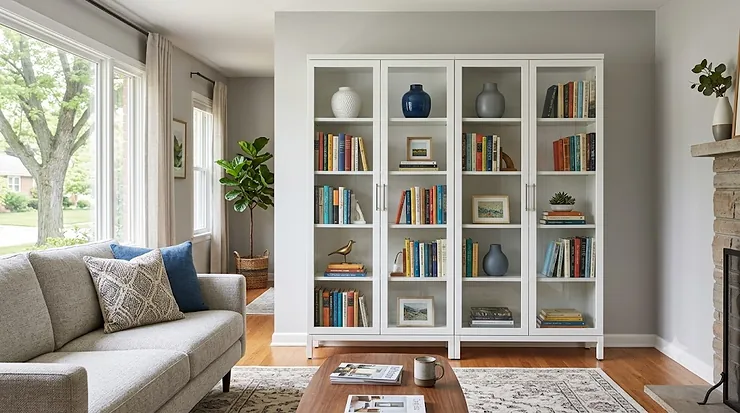
Here’s a confession every book lover eventually makes: the shelves aren’t the problem. It’s what’s sitting in front of the shelves — the phone chargers, the half-finished puzzle box, the mystery cables nobody claims — that turns a nice room into visual noise. A bookcase with doors solves that specific, annoying problem. It’s a piece of furniture that lets you keep the books you’re proud of on open display while quietly locking the chaos behind a panel, a pane of glass, or a louvered slat nobody can see through.
A bookcase with doors is a vertical storage unit combining open or adjustable shelving with one or more hinged, sliding, or glass-fronted doors that conceal part of the interior. Unlike a fully open bookshelf, it gives you a “public” shelf for display and a “private” cabinet for everything else — making it as much a decor decision as a storage one, according to reviewers who note the enclosed cabinet sections keep everyday essentials tucked away and out of sight.
This guide skips the fluff you’d get from an Amazon listing. Instead, you’re getting honest analysis built from real product specs, genuine aggregated review patterns, and side-by-side comparisons that actually explain why one option beats another for your specific room, budget, and mess-hiding needs. We researched seven real units — spanning entry-level metal-and-MDF builds up through solid wood, lockable, and glass-front designs — and broke down exactly who each one is for. For a broader sense of how this furniture category has evolved, Wikipedia’s overview of bookcases traces the form back centuries, which helps explain why the “shelf plus door” format has stuck around this long: it simply works.
By the end, you’ll know whether you need a glass door bookcase for showing off a curated collection, an enclosed bookcase for hiding the mess entirely, or something in between.
Quick Comparison: 7 Bookcases With Doors at a Glance
| Product | Style | Door Type | Best For |
|---|---|---|---|
| IRONCK Industrial Bookshelf with Two Louvered Doors | Compact industrial | Louvered wood | Small rooms, starter budgets |
| Sauder Palladia Bookcase with Doors | Traditional | Framed panel | Home offices, classic decor |
| Shintenchi Industrial Bookshelf with Doors | Farmhouse industrial | Solid panel | Mixed open/hidden storage |
| VINGLI Lockable Display Cabinet with Glass Doors | Modern metal | Tempered glass, locking | Valuables, collectibles |
| IKEA BILLY / OXBERG Bookcase with Glass Doors | Scandinavian modular | Glass | Growing collections, modularity |
| HOOBRO 4-Tier Bookshelf with Doors | Budget industrial | Solid panel | Renters, tight budgets |
| Mansfieler Solid Wood Dust-Resistant Bookshelf | Premium solid wood | Magnetic solid wood | Long-term investment pieces |
Looking at this lineup, the split isn’t really about price — it’s about what you’re protecting from what. If dust and clutter are your enemy, the solid-panel options (Shintenchi, HOOBRO, Mansfieler) win outright. If you want people to see what’s behind the door, the glass options (VINGLI, IKEA BILLY/OXBERG) do that job while a solid door never could. And if security matters — think rare books, breakables, or things you’d rather your toddler not reach — the lockable VINGLI cabinet is in a category by itself.
💬 Already have a favorite from this table? Scroll down for the full breakdown — or jump straight to checking today’s availability.
Just one click — help others make better buying decisions too!😊
Top 7 Bookcases With Doors: Expert Analysis
1. IRONCK Industrial Bookshelf with Two Louvered Doors — best compact starter for small rooms
The IRONCK Industrial Bookshelf with Two Louvered Doors solves a very specific problem: most “starter” bookcases are either too flimsy to trust or too bulky for a studio apartment. At 27.6 inches wide with four shelves split between open display and louvered concealment, it splits the difference nicely.
The louvered wood doors are the standout here — slatted rather than solid, they let a small amount of air circulate behind them, which matters if you’re storing anything even slightly humidity-sensitive. Two open shelves sit up top for books and decor, while the lower cabinet handles the stuff you don’t want on display, all built on a P2-grade MDF frame with a black metal accent frame for rigidity. In practice, that combination means IRONCK’s version won’t wobble the way some ultra-cheap particleboard units do, but it also won’t handle the load of a serious hardcover collection — this is a piece for paperbacks, binders, and knickknacks, not a home library’s heavy lifting.
Based on the spec sheet, this is squarely a first-apartment or dorm-adjacent pick: buyers furnishing a small home office or a bedroom corner get the most value here, since the compact footprint doesn’t demand a dedicated wall. Reviewers consistently describe the assembly as manageable solo, typically well under an hour, and note the anti-tip hardware included in the box as a genuine safety plus rather than an afterthought.
Pros:
- ✅ Compact 27.6-inch width fits small rooms easily
- ✅ Louvered doors allow slight airflow behind panels
- ✅ Anti-tip hardware included for safety
Cons:
- ❌ Lower weight tolerance than solid wood competitors
- ❌ Limited open display space with only two shelves
In the under-$150 range at the time of research, this is a smart low-risk entry point rather than a forever piece — check current price before deciding, since MDF-based units like this do see periodic promotional pricing.
2. Sauder Palladia Bookcase with Doors — best classic all-rounder for home offices
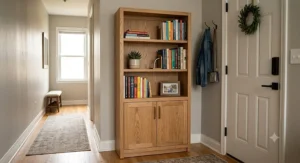
If the IRONCK pick is the “starter” option, the Sauder Palladia Bookcase with Doors is the one most people actually picture when they hear “bookcase with doors.” Finished in Vintage Oak with black hardware, it leans traditional rather than trendy — which, frankly, is exactly why it still sells well decades into Sauder’s furniture-building history.
What most buyers overlook about this model is the back-panel cord access built into the enclosed cabinet section — a small detail that turns the hidden storage area into a legitimate spot for a router, power strip, or printer, not just a junk drawer. Two adjustable shelves let you organize everything from books to kitchen essentials, and the framed double doors conceal that flexibility behind a finish that reads more “furniture” than “flat-pack.” Based on the spec comparison against the IRONCK and HOOBRO units, the Sauder Palladia trades some assembly simplicity for noticeably better fit-and-finish — Sauder’s patented slide-on moldings speed up construction, but the piece itself is heavier and less forgiving to reposition solo.
This is the pick for someone furnishing a home office who wants the bookcase to look intentional next to a matching desk, not like mismatched storage bolted on as an afterthought. Aggregated reviewer sentiment across Sauder’s Palladia line points to consistent praise for the finish quality and near-unanimous complaints about the multi-hour assembly time for first-timers — a fair trade for many buyers, a dealbreaker for others.
Pros:
- ✅ Furniture-grade finish matches desks and file cabinets
- ✅ Built-in cord access behind the enclosed doors
- ✅ Adjustable shelves in both open and hidden sections
Cons:
- ❌ Assembly commonly takes two to three hours
- ❌ Heavier build makes repositioning a two-person job
Priced in the low-to-mid hundreds range depending on finish, it’s a strong middle-of-the-road value pick — always check current price, since Sauder rotates finish availability seasonally.
3. Shintenchi Industrial Bookshelf with Doors — best mixed open-and-enclosed farmhouse tower
At 70.9 inches tall, the Shintenchi Industrial Bookshelf with Doors is built for people who’ve made peace with the fact that some things need to be seen and some things absolutely do not. Its four open shelves can display books and decor, while the two lower cabinet sections hold cables, office supplies, games, or paperwork — a layout that directly answers the “where do the ugly things go” question most open bookcases never solve.
Here’s what the spec sheet won’t tell you outright: the fixed-rod assembly and FSC-certified MDF construction give this a sturdier, more furniture-like feel than a bare metal utility shelf, but the black industrial farmhouse styling is a genuine style commitment — it reads bold, not neutral. If you’ve got a shared home office or a living room where books need to coexist with things better kept out of sight, this hits that use case directly. Compared with fully open units like a standard six-tier shelf, the tradeoff is straightforward: less total open display real estate in exchange for real concealed capacity.
Based on the materials used, buyers concerned about off-gassing or sourcing transparency should note the FSC certification — FSC-certified wood products generally indicate the composite board was manufactured to defined environmental and safety standards, which matters more than most shoppers realize when a piece will sit in a bedroom for a decade.
Pros:
- ✅ Combines four open shelves with two enclosed cabinets
- ✅ FSC-certified MDF construction for sourcing transparency
- ✅ Tall profile maximizes vertical storage in small footprints
Cons:
- ❌ Bold black finish can visually dominate small rooms
- ❌ Less open display space than a full open-shelf tower
Expect a mid-range price, roughly in the $150–$220 range at the time of research — always verify current pricing, since industrial-style units like this see frequent bundle deals.
4. VINGLI Lockable Display Cabinet with Glass Doors — best lockable glass display cabinet
Some collections aren’t meant to hide — they’re meant to be seen, just not touched. That’s the entire premise behind the VINGLI Lockable Display Cabinet with Glass Doors, a 71-inch metal-framed unit built around tempered glass doors, adjustable shelves, and a secure locking system rather than the wood-panel concealment most bookcases rely on.
The tempered glass is the standout feature worth expanding on: the sturdy cabinet paired with the locking system makes files and valuables more secure, and because tempered glass is heat-treated to be substantially stronger than standard annealed glass, it’s a meaningfully safer choice for a household with kids than an untreated glass front would be. Five adjustable shelves behind a three-point locking mechanism mean this doubles as a legitimate curio cabinet for anything from rare books to a wine collection to office files that need to stay confidential. On paper, this means it functions less like a traditional bookcase and more like a hybrid between a display case and a secure cabinet — which is precisely the niche it fills.
What most buyers overlook is the pre-drilled back panel designed for LED light installation — the lights aren’t included, so factor that into your total budget if ambient lighting is part of the plan. Reviewers of similar VINGLI display cabinets consistently note the all-steel frame feels noticeably more solid than MDF-based competitors, at the cost of a heavier overall unit.
Pros:
- ✅ Locking mechanism with two keys for real security
- ✅ Tempered glass doors resist impact better than standard glass
- ✅ Steel frame supports up to 120 pounds per shelf
Cons:
- ❌ LED lighting sold separately despite pre-drilled holes
- ❌ Heavier steel build makes it harder to relocate
At the time of research, pricing typically lands in the $200–$280 range — check current price and available sizes, since VINGLI offers this same design in multiple heights.
5. IKEA BILLY / OXBERG Bookcase with Glass Doors — best modular glass door system
No conversation about a glass door bookcase is complete without mentioning IKEA’s BILLY bookcase paired with OXBERG glass doors, a combination so common it’s practically become the generic term for the category. The appeal isn’t complicated: BILLY’s simple, adjustable shelving system is genuinely modular, and adding glass-fronted OXBERG doors turns an open bookshelf into something that reads as intentional rather than makeshift.
The honest analysis here is that this system rewards people who plan to expand. Because BILLY units connect side by side and stack with height extensions, buyers who start with a single unit can realistically add matching pieces later — something none of the fixed-width units in this list can do. Choosing a bookcase with glass doors in the open section lets you place things you want to both display and protect, whether that’s fine dinnerware, a book collection, or framed photos that would otherwise gather dust in the open.
Based on the spec comparison, the tradeoff against the VINGLI cabinet is security versus flexibility: BILLY/OXBERG doors don’t lock, but the modular sizing options and lower per-unit cost make it the more practical pick for a growing collection rather than a security-sensitive one. Aggregated customer sentiment across BILLY/OXBERG combinations skews positive, with common praise for value and modularity and recurring notes that the particleboard construction shows wear faster than solid wood alternatives under heavy daily use.
Pros:
- ✅ Modular design allows adding matching units later
- ✅ Glass doors protect displayed items from dust
- ✅ Widely available replacement parts and doors
Cons:
- ❌ Doors are not lockable
- ❌ Particleboard core shows wear faster than solid wood
Combination pricing runs roughly in the $190–$260 range depending on size and finish at the time of research — always confirm current availability, since IKEA rotates finish options by region.
6. HOOBRO 4-Tier Bookshelf with Doors — best budget pick with protective rails
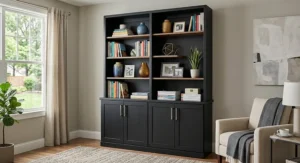
Budget bookcases usually cut corners in ways that show up fast — wobbly shelves, doors that don’t sit flush, hardware that strips on the first assembly attempt. The HOOBRO 4-Tier Bookshelf with Doors avoids most of that trap by keeping its footprint small (23.6″L x 9.4″W x 60.6″H) and adding a feature rarely seen at this price point: protective rails along the open shelves.
Those rails are the standout worth explaining — they’re a raised lip running along the front edge of the open shelves, and in practice they stop lightweight items like magazines or small decor from sliding forward and falling when the unit gets bumped. Paired with the industrial rustic brown-and-black finish, this reads more expensive than its price tag suggests, though the narrow 9.4-inch depth means it’s built for slim paperbacks and decor rather than oversized art books or binders. What most buyers overlook is that the compact width makes this an easy fit for narrow hallways or beside a doorway — spots where a 30-inch-wide unit simply wouldn’t clear.
Here’s what to weigh: this is a genuinely good renter-friendly pick — light enough to move solo, small enough to not commit a room to it, and cheap enough that outgrowing it in a few years isn’t a financial loss. It is not, however, a long-term library solution for anyone with a serious book collection.
Pros:
- ✅ Protective rails prevent items sliding off shelves
- ✅ Compact depth fits narrow hallways and small rooms
- ✅ Lightweight enough to reposition solo
Cons:
- ❌ Narrow 9.4-inch depth limits larger books and binders
- ❌ Lower overall storage capacity than taller competitors
At the time of research, this typically sits under $150 — a genuinely strong value pick, though it’s worth checking current price given how frequently budget furniture rotates through promotions.
7. Mansfieler Solid Wood Dust-Resistant Bookshelf — best premium solid wood dust-blocker
For buyers who’ve already been burned by MDF units that swell, chip, or sag under real weight, the Mansfieler Solid Wood Dust-Resistant Bookshelf is the step up. Built from solid wood rather than engineered composite, it’s positioned as a long-term piece rather than a five-year placeholder — and the name isn’t just marketing: this is genuinely designed around dust protection as a core feature, not an afterthought.
The magnetic door design is the standout here. Rather than relying on a friction hinge or a simple latch that loosens over years of use, magnetic closures snap the doors flush against the frame, which meaningfully reduces the gap dust typically drifts through on cheaper cabinet doors. Combined with solid wood construction that resists warping better than MDF in humid climates, this is the bookcase to choose if you’re storing anything genuinely dust-sensitive — vinyl records, archival documents, or a book collection you actually intend to keep for decades rather than one apartment.
Based on the spec comparison against composite-board competitors like HOOBRO and IRONCK, the tradeoff is exactly what you’d expect: significantly higher upfront cost and a heavier, harder-to-relocate unit, in exchange for durability that composite boards simply can’t match long term. This is a buy-once piece for someone who has settled into a space, not someone expecting to move again in two years.
Pros:
- ✅ Solid wood resists warping better than composite boards
- ✅ Magnetic doors close flush to reduce dust infiltration
- ✅ Built as a long-term rather than disposable piece
Cons:
- ❌ Premium price relative to composite competitors
- ❌ Heavier construction makes repositioning difficult
Expect a premium price point, generally in the $250–$350 range at the time of research — check current price, as solid wood furniture pricing fluctuates more with lumber costs than MDF units do.
What Is a Bookcase With Doors, Really?
A bookcase with doors is any vertical shelving unit that pairs open display shelves with one or more concealed sections behind hinged, sliding, or glass panels. The doors can be solid wood, louvered slats, tempered glass, or metal-framed glass — each changing what the enclosed section is actually good for. As Wikipedia notes in its overview of bookcase furniture, the format has existed in various forms for centuries, evolving from simple open shelving into today’s mix of display and concealed storage. The “doors” part isn’t decorative flourish — it’s the single feature that determines whether a shelf is purely a display piece or also a functional storage cabinet.
How to Choose a Bookcase With Doors
- Measure the space before the product. Height, width, and depth all matter, but door swing clearance is the detail most buyers forget — a door that can’t fully open against a nearby wall defeats the entire point of the cabinet.
- Decide what needs hiding versus displaying. If everything inside should be visible, a glass door bookcase is the obvious pick; if the goal is concealment, solid panel doors do that job better than glass ever will.
- Match the material to the room’s humidity. Solid wood resists warping in damp basements and bathrooms better than MDF, while MDF handles dry climates just fine at a lower price.
- Check the weight rating per shelf, not just overall capacity. A unit rated for 44 pounds per shelf handles a full row of hardcovers; one rated for 20 pounds will sag under the same load within months.
- Factor in assembly reality, not marketing copy. “Easy assembly” on a listing can still mean two hours and two people — read aggregated reviews for actual build-time reports before buying.
- Consider whether locking matters. Households with kids, shared offices, or genuinely valuable contents benefit from a locking cabinet; most living rooms don’t need one.
- Anchor it, regardless of price point. Every freestanding bookcase, cheap or premium, should be secured to the wall using the included anti-tip hardware — a step the U.S. Consumer Product Safety Commission’s Anchor It campaign specifically recommends to prevent tip-over injuries.
Glass Door Bookcase vs Enclosed Bookcase: Which Actually Fits Your Room
This is the comparison most buyers skip past, and it’s the one that actually determines satisfaction six months in. A glass door bookcase — like the VINGLI Lockable Display Cabinet with Glass Doors or the IKEA BILLY / OXBERG Bookcase with Glass Doors — is built around visibility. The whole point is that dust, moisture, and stray fingers stay out while the contents stay fully visible, which makes it the right call for collectibles, fine dinnerware, or a curated book collection you actually want guests to notice.
An enclosed bookcase with solid doors — think the Shintenchi Industrial Bookshelf with Doors or the Mansfieler Solid Wood Dust-Resistant Bookshelf — takes the opposite bet. It sacrifices visibility entirely in exchange for total concealment, which is the better choice for anything you’d rather guests didn’t see: cables, off-season storage, paperwork, or a chaotic collection of remote controls no one wants to admit exists.
Here’s what most buyers get wrong: they pick based on style alone rather than function. A glass-front unit in a room full of mismatched clutter just puts that clutter on brighter display; a fully solid enclosed bookcase in a room meant to showcase a book collection defeats the entire purpose of owning nice books. Match the door type to what’s actually going inside, not just what looks good in the showroom photo.
Bookcase With Doors vs Open Shelving
Open shelving wins on pure display flexibility and airflow — nothing beats an open bookshelf for showing off a full collection or letting air circulate around stored items. But it loses badly on two fronts a bookcase with doors handles easily: dust accumulation and visual clutter tolerance. Reviewers consistently note that open shelves in high-traffic rooms need dusting far more often than enclosed sections, simply because nothing blocks airborne particles from settling directly onto stored items.
The real-world performance difference shows up fastest in shared spaces. A home office with an open bookshelf next to a desk tends to accumulate loose papers, chargers, and half-finished projects in plain view within weeks. Swap in a bookcase with concealed storage, and that same clutter has somewhere to go that isn’t the desk surface or the floor. For most multi-purpose rooms — living rooms, shared offices, entryways — a hybrid unit with both open and enclosed sections, like the Shintenchi Industrial Bookshelf with Doors, outperforms a fully open shelf on livability, even if it holds slightly fewer visible books.
Common Mistakes When Buying a Bookcase With Doors
The single most common mistake is buying based on height alone and forgetting depth. A shelf that’s 11.8 inches deep handles standard paperbacks fine but leaves oversized art books or three-ring binders sticking out awkwardly — measure your actual items, not just your wall space.
The second mistake is skipping the anti-tip hardware because “it’s just a bookshelf.” Any tall, top-heavy unit is a genuine tip-over risk, especially in homes with children, and every unit in this guide ships with hardware specifically to prevent it — using it isn’t optional caution, it’s basic setup.
The third mistake is underestimating assembly time based on marketing language. “Quick assembly” from a manufacturer and “quick assembly” reported by actual buyers in reviews often disagree by an hour or more — always weight the aggregated review sentiment over the product description when planning your afternoon.
Dust Protection: What Enclosed Doors Actually Buy You
Dust protection is one of those features that sounds like a marketing bullet point until you’ve lived without it. Open shelves in an average home accumulate a visible dust layer within one to two weeks, depending on airflow and foot traffic — and books, in particular, trap dust in the gaps between pages in a way that’s genuinely difficult to clean once it settles. A solid or glass door doesn’t eliminate dust from the room, but it does dramatically slow how much reaches the actual shelf surface.
The material matters more than most buyers assume. Solid wood doors with tight-fitting magnetic closures, like those on the Mansfieler Solid Wood Dust-Resistant Bookshelf, create a genuinely tighter seal than a standard friction-hinge MDF door, which tends to develop small gaps as the hinges loosen over years of use. Glass doors, meanwhile, block dust just as effectively as solid panels while adding the bonus of visibility — the composite board materials common in budget units are perfectly fine for dust-blocking purposes, but the door’s seal quality matters more than the shelf material behind it. If dust protection for a specific collection — records, archival paper, antique books — is the priority, prioritize door seal quality and hinge type over price point.
Display Cabinet Features That Actually Matter
Not every bookcase with doors is trying to be a display cabinet, but the ones that are — like the VINGLI Lockable Display Cabinet with Glass Doors — live or die on a few specific details. Shelf adjustability matters more than total shelf count, since a fixed 12-inch gap wastes space above a row of paperbacks and crowds out anything taller. Lighting compatibility is the second detail worth checking: a pre-drilled back panel for LED strips, even without lights included, saves a genuinely annoying retrofit job later.
Locking mechanisms separate a true display cabinet from a glass-fronted bookshelf wearing a display cabinet’s clothing. A cabinet without a lock is fine for books and decor; anything genuinely valuable — collectibles, documents, breakables — benefits from the added security a locking system like VINGLI’s three-point mechanism provides. Finally, glass quality is worth a second look: tempered glass costs more to manufacture than standard glass but breaks into small, dull fragments rather than sharp shards if it ever does fail, which matters in a household with kids or pets.
Concealed Storage: A Practical Setup Guide
Getting real value out of the concealed storage section behind your bookcase’s doors comes down to a short setup routine most buyers skip. Start by sorting contents into three groups before anything goes on a shelf: things used weekly, things used seasonally, and things you’re storing purely out of guilt. Weekly items go on the most accessible shelf, typically eye level or just below; seasonal items go lower or higher, wherever reach matters less; and the guilt pile gets a hard limit — one shelf, no more, or it silently expands to fill the entire cabinet.
For the first 30 days, resist the urge to treat the enclosed section as a catch-all. The most common mistake buyers make is opening the doors three weeks in to find a jumble no more organized than an open shelf would have been — the doors hide clutter, they don’t organize it. A simple fix: add inexpensive fabric bins or small dividers inside the cabinet section, especially in units like the Sauder Palladia Bookcase with Doors where the hidden shelf is a single open span. For maintenance, a quarterly five-minute check — pull everything out, wipe the shelf, put back only what still belongs — keeps the concealed section from becoming a permanent mystery.
If cord management is part of the plan, route cables through any included back-panel cutout before loading the shelf with other items; retrofitting cable routing after the shelf is full is a genuinely frustrating second job.
Real-World Scenarios: Matching the Bookcase to the Buyer
The small-apartment renter — someone in a studio or one-bedroom who moves every year or two — is best served by the HOOBRO 4-Tier Bookshelf with Doors or the IRONCK Industrial Bookshelf with Two Louvered Doors. Both are light enough to disassemble and move solo, cheap enough that a scuff or scratch during a move isn’t a financial hit, and compact enough to fit a narrow apartment layout without dominating the room.
The home-office professional who video-calls clients daily needs the bookcase to look intentional on camera while hiding office clutter off-screen. The Sauder Palladia Bookcase with Doors fits this scenario directly — the finish reads as furniture rather than storage, and the concealed cabinet keeps printer paper and cable clutter out of frame.
The collector or parent of young kids who needs valuables visible but genuinely protected should look at the VINGLI Lockable Display Cabinet with Glass Doors. Whether it’s a wine collection, rare books, or breakables that need to stay out of small hands, the combination of visibility and an actual lock solves a problem none of the solid-door options address.
Problem → Solution Guide
Problem: Books keep collecting dust despite regular cleaning. Solution: switch from open shelving to a unit with solid or glass doors, like the Mansfieler Solid Wood Dust-Resistant Bookshelf, and prioritize magnetic or tight-hinge closures over friction latches.
Problem: The cabinet looks cluttered within a month of setup. Solution: add fabric bins or small dividers inside the enclosed section rather than loading items loose, and apply the weekly/seasonal/guilt-pile sorting method described above.
Problem: The unit wobbles or feels unstable after assembly. Solution: confirm the anti-tip hardware is actually anchored to a wall stud, not just resting against the wall — this is the single most skipped step in furniture assembly, and it’s the difference between a stable piece and a genuine hazard.
Problem: A growing book collection has outgrown the unit. Solution: choose a modular system from the start, like the IKEA BILLY / OXBERG Bookcase with Glass Doors, which allows adding matching units side by side rather than replacing the entire piece.
Problem: Valuables need to be visible but protected from kids or guests. Solution: a lockable glass cabinet like the VINGLI Lockable Display Cabinet with Glass Doors solves visibility and security simultaneously, which a standard glass-front bookcase without a lock cannot.
Long-Term Cost and Maintenance
Total cost of ownership on a bookcase with doors extends well past the sticker price, and the gap between MDF and solid wood options widens the longer you own the piece. A budget MDF unit in the $100–$150 range typically holds up fine for three to five years of moderate use before hinges loosen, shelves sag under sustained weight, or moisture exposure causes swelling at the edges. A solid wood piece in the $250–$350 range costs roughly double upfront but routinely lasts a decade or more with minimal maintenance beyond occasional hinge tightening and surface cleaning — which, calculated per year of ownership, often makes the “expensive” option the cheaper one.
Maintenance itself is minimal across the board: a soft cloth for glass fronts, occasional furniture polish for solid wood, and a yearly check that anti-tip anchors and door hinges haven’t loosened. The exception is louvered or slatted doors, like those on the IRONCK Industrial Bookshelf with Two Louvered Doors, which trap slightly more dust in the slats than a flat panel and benefit from a quick vacuum-brush pass every few months.
Safety, Materials, and Regulations Guide
Furniture tip-over remains a real and preventable household hazard, which is why every unit in this guide ships with anti-tip anchoring hardware — using it is not optional, particularly in homes with children. The Consumer Product Safety Commission’s Anchor It initiative exists specifically because tall, top-heavy furniture like bookcases represents a disproportionate share of furniture tip-over injuries nationally.
On materials, look for P2-grade or FSC-certified engineered wood if choosing an MDF-based unit — both indicate the board meets defined manufacturing and, in FSC’s case, sourcing standards rather than being an unrated composite. For glass-front units, confirm the listing specifies tempered glass rather than standard glass; tempered glass is heat-treated for added strength and safer fracture behavior, a meaningful difference in households with kids or pets near the cabinet.
Frequently Asked Questions
❓ Is a bookcase with doors better than an open bookshelf?
❓ Can glass door bookcases hold heavy books safely?
❓ Do enclosed bookcase doors actually stop dust?
❓ Are lockable display cabinets worth the extra cost?
❓ How long does a solid wood bookcase with doors typically last?
Conclusion
A bookcase with doors earns its keep by solving a problem open shelving simply can’t: giving clutter, valuables, or dust-sensitive items somewhere to disappear without disappearing from the room’s design. Budget-conscious buyers and renters get real value from the IRONCK Industrial Bookshelf with Two Louvered Doors or HOOBRO 4-Tier Bookshelf with Doors — light, affordable, and genuinely functional for a first apartment. Buyers furnishing a home office long-term should look harder at the Sauder Palladia Bookcase with Doors, which balances classic style with real concealed storage. Anyone protecting valuables or a curated collection should prioritize the VINGLI Lockable Display Cabinet with Glass Doors, while a growing collection is best served by the modular flexibility of the IKEA BILLY / OXBERG Bookcase with Glass Doors. And for a piece meant to last a decade or more, the Mansfieler Solid Wood Dust-Resistant Bookshelf justifies its premium price with real longevity.
The right pick ultimately comes down to one question: what exactly are you hiding, and from what? Match the door type, material, and security level to that answer, anchor it properly to the wall, and the right bookcase with doors will quietly do its job for years without asking for attention.
✨ Don’t Miss These Exclusive Deals!
🔍 Take your storage setup to the next level with the picks above. Click through on any highlighted option to check current pricing and availability before it changes. A little clutter-hiding today saves you a much bigger cleanup tomorrow!
Recommended for You
- Industrial Bookshelf Guide: 7 Best Picks for Urban Lofts in 2026
- Cube Storage Organizer Guide: 7 Genius Picks for 2026
- Best Ladder Shelf 2026: 7 Picks That Won’t Wobble or Disappoint
Disclaimer: This article contains affiliate links. As an Amazon Associate, I earn from qualifying purchases. If you purchase products through these links, we may earn a small commission at no additional cost to you.
✨ Found this helpful? Share it with your friends! 💬🤗
