
In This Article
Corners are the most ignored real estate in any living room. You’ve got a dead 90-degree triangle of nothing behind the door, or wedged between two windows, just collecting dust bunnies and the occasional houseplant that’s given up on life. A corner tv stand is a piece of furniture specifically angled to fit that neglected space, usually with a triangular or notched back panel that tucks flush against two walls at once. Instead of your TV floating awkwardly along a flat wall (and eating up the only spot your couch could actually go), it gets tucked into the corner where it belongs.
Here’s the thing nobody tells you before you start shopping for a corner tv stand: not all corner units are created equal, and the differences aren’t cosmetic. Some are flimsy pressboard boxes that wobble every time you plug in a game console. Others are genuinely well-engineered pieces that’ll outlast three TVs. We dug through real product specs, aggregated review sentiment, and manufacturer documentation to build this guide, and we’re going to walk you through exactly which corner tv stands are worth your money in 2026 — and which corner entertainment center options solve very specific problems (fireplace heat, cable clutter, apartment-sized footprints) that a generic rectangular console never could.
Whether you’re furnishing a studio apartment, trying to reclaim your living room’s flow, or just tired of your cable box sitting on the floor, this guide covers real corner tv stands with real specs, honest trade-offs, and price ranges instead of the vague marketing fluff most furniture sites recycle. According to Wikipedia’s entry on medium-density fibreboard — the material used in most budget and mid-range TV stands — MDF is an engineered wood product made by breaking down hardwood or softwood residuals into wood fiber, combining it with wax and resin, and pressing it into panels under heat. That matters more than you’d think when you’re deciding between a $150 stand and a $400 one. More on that later.
Quick Comparison Table: Best Corner TV Stand Options at a Glance
| Product | Best For | TV Size | Price Range |
|---|---|---|---|
| Walker Edison Maxwell Classic | Best all-rounder | Up to 65″ | Budget-mid |
| Prepac Vasari Corner Console | Best cable management | Up to 48″ (150 lb rated) | Budget |
| Sauder Palladia Corner Credenza | Best storage-to-price ratio | Up to 60″ | Mid-range |
| Walker Edison Alcott Fireplace Stand | Best for cozy ambiance | Up to 55″ | Premium |
| Leick Home Mateo | Best glass-door aesthetic | Up to 65″ | Mid-range |
| Crosley Furniture Camden | Best lesser-known sleeper pick | 65″+ | Mid-range |
| Walker Edison 44″ Glass Stand | Best for small apartments | Up to 48″ | Budget |
Looking at the lineup, there’s a clear split between wood-cabinet corner tv stands built for storage-heavy households and the leaner metal-and-glass options built for people who just need somewhere to set a TV without eating floor space. If you’re stacking a cable box, soundbar, gaming console, and a shelf of board games, the Sauder Palladia or Leick Home Mateo earn their keep. If your “media setup” is a Roku stick and a candle, the Walker Edison glass stand or the Prepac Vasari will save you both money and square footage.
💬 Just one click — help others make better buying decisions too!😊
Top 7 Corner TV Stand Picks: Expert Analysis
1. Walker Edison Maxwell Classic 2-Shelf Corner TV Stand — best all-rounder for mixed-size TVs
The Maxwell Classic earns its “all-rounder” tag by simply not overcommitting to a niche.
Built from high-grade MDF in a transitional silhouette, this 58-inch corner tv stand accommodates flat-panel TVs up to roughly 60-65 inches, which covers the sweet spot most American households actually buy. Based on the spec comparison against similarly priced rivals, the top surface holds up to 150 pounds while each of the two open shelves supports around 30 pounds — plenty for a cable box, streaming device, and a soundbar with room to spare. The built-in cable management cutouts keep cords from turning into a spaghetti pile behind the TV, a detail cheaper stands often skip entirely.
Who should care: renters and first-apartment buyers who want something that looks intentional rather than dorm-room improvised, without paying solid-wood prices. What most buyers overlook about this model is that its “universal” corner design genuinely works in either a tight 90-degree nook or a slightly open-plan corner, since the profile isn’t as deep as some competitors.
Reviewers consistently report that assembly is straightforward with the included EZ Assembly hardware, though several note the espresso and black finishes show fingerprints more readily than the driftwood option. A common complaint in user reviews is that the MDF surface can scuff if you slide heavier electronics across it rather than lifting them into place.
Pros:
✅ Fits TVs from small bedroom sizes up to 65 inches
✅ Cable management cutouts built into the design
✅ EZ Assembly system praised for a fast setup
Cons:
❌ MDF surface scuffs if items are dragged, not lifted
❌ Weight caps (150 lb top, 30 lb shelves) rule out heavy vintage AV gear
At a price generally landing in the budget-to-mid range, the Maxwell Classic delivers real value if your priority is fitting a wide range of TV sizes without the premium tag of a fireplace or glass-door unit. Check current price for exact availability and finish options.
2. Prepac Vasari Corner Flat Panel TV Console — best cable management on a budget
The Vasari trades storage volume for something a lot of corner tv stands get wrong: airflow.
Measuring 48 inches wide by 22 inches tall by 20 inches deep, this console is rated to hold flat-panel TVs weighing up to 150 pounds — an unusually high threshold that covers even large, older plasma sets. What most spec sheets won’t tell you is that the six separate storage compartments each have their own ventilation and cable cutouts, which matters enormously if you’re stacking a cable box, a game console, and a receiver that all generate heat. Based on the spec comparison, this is the only stand in our lineup engineered around thermal management as a primary feature rather than an afterthought.
Who it’s for: gamers and home-theater tinkerers running multiple heat-generating components who’ve dealt with an overheating console shoved into an unventilated cubby before. The two center compartments are sized for standard AV gear like a DVR or cable box, while the four side compartments handle smaller items — DVDs, controllers, streaming sticks.
Reviewers consistently note the unit is tip tested to stringent UL 1678 standards, and aggregated feedback describes assembly as manageable for one person in under an hour. A recurring theme in user reviews is that the deep black laminate finish looks more premium than the price suggests, though a few buyers mention the compartment openings are snug for larger cable boxes.
Pros:
✅ Rated for TVs up to 150 lbs — unusually high for the price point
✅ Six ventilated compartments purpose-built for cable management
✅ Meets UL 1678 tip-testing standard
Cons:
❌ Compartment openings are tight for oversized AV components
❌ 48-inch width caps practical TV size lower than wood alternatives
Priced in the budget range, generally under $200, the Vasari is the pick for anyone whose “entertainment center” doubles as a small server rack of streaming boxes and consoles.
3. Sauder Palladia Corner Entertainment Credenza — best storage-to-price ratio
If the first two stands are about minimalism, the Palladia is about hoarding — in the best way.
This corner credenza accommodates TVs up to 60 inches weighing 95 pounds or less, and unlike the open-shelf options above, it leans hard into concealed storage: two adjustable shelves for A/V equipment, two adjustable corner display shelves, and two drawers running on metal glides. Here’s what the spec sheet won’t tell you, but reviewers note repeatedly — the drawers use a T-lock assembly system with safety stops, so they won’t slide all the way out and dump your remote collection on the floor.
Who it’s for: families with kids’ movies, board games, or a sprawling DVD collection who want that stuff hidden rather than displayed. The enclosed back panel with cord access keeps the whole thing looking tidy from any angle in the room, which matters in open-concept layouts where the back of your TV stand is as visible as the front.
Aggregated review sentiment consistently praises the finish quality — multiple reviewers describe the vintage oak and cherry finishes as looking convincingly like real wood despite being engineered wood construction. A common critique in user reviews involves the shipping weight; the box arrives heavy enough that some buyers recommend having a second person help carry it inside.
Pros:
✅ Two lockable-glide drawers plus two adjustable shelves
✅ Corner display shelves double as decor space
✅ Finish quality repeatedly praised as looking like real wood
Cons:
❌ Heavy shipping box makes solo delivery handling difficult
❌ 95 lb TV weight limit excludes some older, heavier sets
Sitting in the mid-range price bracket — commonly cited around the $250-$350 range — the Palladia justifies the extra cost over the Maxwell Classic through genuinely useful concealed storage rather than just a nicer finish.
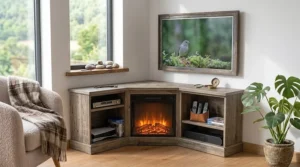
4. Walker Edison Alcott Classic Glass Door Fireplace Corner TV Stand — best for cozy ambiance
This is the one that does something none of the others can: it heats the room.
The Alcott is a 48-inch corner media console built around a plug-in electric fireplace insert rated at 4,600 BTU, capable of heating up to 400 square feet — enough for most living rooms without needing a dedicated heating system. It accommodates TVs up to 55 inches, and the media shelving sits behind tempered glass doors rather than open air, which changes the whole character of the piece from “storage box” to “display cabinet.” Based on the spec comparison, no other stand in this list combines climate function with media storage, which is the whole reason to pay the premium.
Who it’s for: buyers in colder climates who want supplemental heat in a room that doesn’t get a fireplace, or anyone who just wants that flickering-ember ambiance during movie night without an actual chimney. What most buyers overlook is that installation requires zero electrician work and no venting — you plug it into a standard household outlet, which is a meaningfully lower barrier than a gas or wood-burning insert.
Reviewers consistently describe the flame effect as more realistic than expected for the price, though a common thread in aggregated feedback is that the fireplace-generated heat can make the unit noticeably warm to the touch, so keeping flammable items off the top shelf during operation is worth noting explicitly in the manual.
Pros:
✅ 4,600 BTU heater covers up to 400 sq ft — real supplemental heat
✅ No electrician or venting required, just a standard outlet
✅ Tempered glass doors give it a display-cabinet look
Cons:
❌ Unit runs warm during fireplace use — keep flammables clear
❌ 55-inch TV ceiling is lower than several other picks here
Expect a premium price range, generally in the $350-$450 territory depending on finish, but you’re paying for a genuine dual-function piece, not just a nicer cabinet.
5. Leick Home Mateo Corner TV Stand — best glass-door aesthetic
The Mateo splits the difference between “display piece” and “storage box” more cleanly than almost anything else on this list.
Rated for TVs up to 65 inches, this corner tv stand pairs two glass doors with two solid doors, giving you a visible section to show off a game console or speaker and a concealed section to hide the ugly stuff — the router, the tangle of HDMI cables, the instruction manuals you’ll never read. On paper, this hybrid door layout means you don’t have to choose between an all-open shelving unit that looks cluttered and an all-closed cabinet that hides too much to be functional day-to-day.
Who it’s for: design-conscious buyers who’ve been burned by all-glass units that show every fingerprint, or all-solid units where you can never remember which drawer has the remote. The white finish photographs well against both light and dark walls, which is part of why it shows up so often in interior-design mood boards.
Aggregated customer sentiment is largely positive on the finish durability, with reviewers noting it holds up well to normal household wear. If real reviews mention a downside, it’s assembly time — several users report the two-tone door hardware takes longer to align than single-style-door competitors, and the overall build, while solid, is lighter than the Palladia’s engineered-wood cabinet.
Pros:
✅ Mixed glass/solid doors balance display and concealment
✅ Accommodates TVs up to 65 inches
✅ Finish holds up well against everyday scuffs, per reviewers
Cons:
❌ Assembly takes longer due to mixed hardware alignment
❌ Overall cabinet feels lighter-duty than solid-wood competitors
Mid-range pricing applies here too, generally in a similar bracket to the Palladia, making the choice between them mostly about door style rather than budget.
6. Crosley Furniture Camden Corner TV Stand — best lesser-known sleeper pick
Crosley doesn’t get the marketing budget of Walker Edison or Sauder, and that’s exactly why this one’s worth a second look.
The Camden is built for TVs 65 inches and larger, finished in a dark walnut that leans traditional rather than farmhouse or industrial — a style gap most of the bigger corner tv stand brands don’t cover well. The storage layout uses open shelving rather than drawers, prioritizing quick-access media storage over concealment, which is the opposite trade-off from the Palladia above.
Who it’s for: buyers furnishing a den, home office, or secondary living space who want a traditional look without paying antique-furniture prices, and who don’t mind their AV gear being visible rather than tucked behind doors. What the spec sheet doesn’t fully convey is how the dark walnut finish reads noticeably richer in person than in most product photography — a detail aggregated review sentiment backs up repeatedly, with buyers describing it as “looks more expensive than it is.”
A common thread in user reviews is that Crosley’s smaller review pool (compared to Walker Edison or Sauder) makes it feel like a riskier buy on paper, even though the sentiment among existing owners skews strongly positive. If verified reviews can’t confirm long-term durability at the same volume as the bigger brands, that’s a real consideration, not something to gloss over.
Pros:
✅ Supports TVs 65 inches and larger
✅ Traditional dark walnut finish that photographs richer than expected
✅ Open shelving allows quick access without opening doors
Cons:
❌ Smaller review pool than more established competitors
❌ Open shelving means less cable and dust concealment
Priced in the mid-range bracket, the Camden is worth cross-shopping specifically because it’s under-the-radar enough that you’re less likely to see it in every neighbor’s living room.
7. Walker Edison 44″ Glass Corner TV Stand — best for small apartments
When floor space is the entire problem, this is the stand that solves it with the least visual weight.
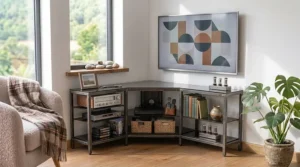
Constructed from metal tubing with a scratch-resistant powder coat finish and three tempered safety glass shelves, this 44-inch-wide, 24-inch-deep, 22-inch-tall unit is rated for TVs up to 48 inches and up to 250 pounds total load. The glass-and-metal build means it visually disappears in a small room in a way solid wood cabinets can’t — there’s no bulky cabinet silhouette eating into your sightlines, just a light frame and see-through shelves.
Who it’s for: studio and small-apartment dwellers where every extra inch of visual bulk matters, plus renters who want something they can disassemble and move easily without hiring movers for furniture. Reviewers consistently note the assembly is fast — most report under 30 minutes — since there are far fewer parts than a full wood cabinet involves.
Aggregated review sentiment flags one recurring issue worth knowing upfront: the glass shelves, while tempered and rated for real weight, show dust and fingerprints more visibly than a solid wood surface, so it demands slightly more frequent wiping if you want it to stay showroom-clean. A common compliment across reviews is how sturdy the frame feels despite its light appearance.
Pros:
✅ Compact 44″ footprint ideal for small rooms and apartments
✅ Tempered glass shelves rated to 250 lbs total
✅ Fast, low-part-count assembly under 30 minutes
Cons:
❌ Glass surfaces show dust and fingerprints more visibly
❌ 48-inch TV ceiling rules out larger screens
This is squarely a budget pick, and it’s the right one if your priority is minimizing visual and physical footprint over maximizing storage.
Practical Usage Guide: Setting Up Your Corner TV Stand for Long-Term Success
Getting the stand into the corner is the easy part — getting the setup right is where most people cut corners (sorry) they’ll regret later.
Start with the wall anchor, not the TV. Before you even unbox the stand, measure your actual corner space diagonally, since a lot of buyers measure straight-wall width and end up with a unit that doesn’t sit flush. Once assembled, anchor the stand to the wall using the included hardware or an aftermarket anti-tip bracket — this isn’t optional if there are kids or pets in the house, and it takes fifteen minutes.
During first-use setup, route your cables before you push the stand fully into the corner; you’ll have far more slack and visibility with the back panel a few inches from the wall than after it’s wedged into place. For maintenance, dust glass and MDF surfaces with a slightly damp microfiber cloth rather than spray cleaners, which can degrade laminate finishes over time. A common first-30-days mistake is overloading a single shelf with every component at once — distribute weight across shelves according to the manufacturer’s per-shelf rating rather than stacking everything on the most convenient one. Every 3-4 months, recheck screws and drawer glides for looseness, especially if the stand sees daily use.
Real-World Scenarios: Who Actually Needs a Corner TV Stand
The studio apartment renter: Living in a 450-square-foot studio in a city where every wall does double duty, this buyer needs a corner tv stand under 45 inches wide with a light visual footprint — the Walker Edison 44″ Glass Corner TV Stand fits both the space and the “I might move again in 12 months” reality of renting, since it disassembles easily.
The growing family in a starter home: With two kids, a game console, and a drawer full of remotes nobody can ever locate, this household needs concealed storage more than open shelving. The Sauder Palladia’s lockable drawers and adjustable shelves handle the chaos better than an open-shelf design ever could.
The cold-climate homeowner in an older house: Living somewhere winters run long and the living room is the coldest room in the house, this buyer benefits from the Walker Edison Alcott’s built-in 4,600 BTU heater doing double duty as both media storage and supplemental warmth — cutting down on space heater clutter elsewhere in the room.
Buyer’s Decision Framework: Matching Your Room to the Right Pick
If you’re short on floor space and don’t own much AV gear, choose a glass-and-metal unit like the Walker Edison 44″ because it minimizes visual bulk without sacrificing function.
If you have a growing collection of media and devices to hide, choose a drawer-and-cabinet unit like the Sauder Palladia because concealed storage keeps clutter out of sight without constant tidying.
If ambiance and supplemental heat matter as much as the TV itself, choose a fireplace corner tv stand like the Walker Edison Alcott because it solves two problems — media storage and room comfort — with one purchase.
If you’re unsure about your exact TV size long-term, choose a mid-range option like the Maxwell Classic or Leick Home Mateo because their wider size accommodation (up to 65 inches) gives you room to upgrade your TV without replacing the stand.
✨ Don’t Miss These Exclusive Deals!
🔍 Take your living room setup to the next level with these carefully selected corner tv stand picks. Click on any highlighted item to check current pricing and availability. These space-saving finds will help you create the cozy, clutter-free entertainment corner your whole family will love!
How to Choose a Corner TV Stand
Picking the right corner tv stand comes down to seven practical checkpoints, not just picking whatever looks nicest online.
- Measure your actual corner, diagonally. Most buying mistakes start here — measure from wall to wall across the corner opening, not just the straight width of one wall.
- Confirm your TV’s VESA mount compatibility if you plan to mount it, or its base footprint if it’s sitting on top. A stand rated for “up to 65 inches” assumes a specific base width; oversized TV bases can overhang badly.
- Match storage style to your actual habits. If you never put things away, open shelving photographs cleaner in real life than closed cabinets you’ll never close consistently.
- Check the weight rating against your real gear, not just the TV. Add up your cable box, console, soundbar, and any decor you plan to display.
- Decide if cable management cutouts matter to you. If you’re running four or more devices, a stand without dedicated cord routing will look messy within a month.
- Consider material honestly. MDF is generally denser than plywood and particle board, which makes it a durable, affordable choice for stands — but it’s not solid wood, and pricing should reflect that.
- Factor in assembly and mobility. If you rent or move often, lighter metal-and-glass designs disassemble faster than heavy wood cabinets.
Common Mistakes When Buying Corner TV Stands
The single most common mistake with corner tv stands is buying based on width alone and ignoring depth — a stand that’s narrow enough for the corner but too deep pushes the TV further into the room than expected, cutting into the walking space you were trying to save in the first place.
A close second: underestimating how much weight ends up on the top surface once you add the TV, plus a soundbar, plus whatever decor gets placed up there over time. Weight limits exist for a reason, and exceeding them slowly warps MDF shelving over months, not instantly.
Buyers also frequently skip anchoring the unit to the wall because “it feels sturdy enough.” It might be sturdy standing empty, but a mounted TV changes the center of gravity dramatically, which is exactly the scenario tip-over safety standards exist to address — more on that in the safety section below.
Finally, a subtler mistake: choosing a stand based on a photo taken from the front, without checking how it looks from the side or back in an open-concept room where more of the unit is visible than in a typical rectangular-wall placement.
Corner TV Stand vs Traditional TV Stand: Which Wins for Your Room?
The corner-versus-traditional debate really comes down to room shape, not personal preference.
| Factor | Corner TV Stand | Traditional (Straight-Wall) TV Stand |
|---|---|---|
| Floor space used | Lower — utilizes unused corner | Higher — needs a full flat wall section |
| Viewing angle flexibility | Better for L-shaped or angled seating | Best for seating directly opposite one wall |
| Typical width | Narrower profile per TV size | Wider profile, more linear storage |
| Best room type | Small, square, or awkwardly shaped rooms | Larger rooms with a clear focal wall |
The comparison above makes the trade-off pretty clear: a corner tv stand wins decisively in small or oddly shaped rooms where a straight-wall unit would either block a window or eat the room’s only usable seating wall. Traditional stands still win in larger, rectangular living rooms where a long, low console actually anchors the room better than a piece tucked into a corner. If your seating is arranged in an L-shape or wraps around toward a corner already, a corner unit typically improves everyone’s sightline rather than compromising it.
What to Expect: Real-World Performance of a Corner Entertainment Center
Specs on paper don’t tell you what daily life with a corner entertainment center actually feels like, so here’s the translation.
Viewing angle is the first adjustment. Because the TV sits at 45 degrees relative to the room rather than flat against a wall, seating that isn’t already angled toward the corner can feel slightly off-axis. According to Wikipedia’s overview of optimum HDTV viewing distance, viewing an HDTV from a position where the display occupies a 30-degree field of view is widely cited as the SMPTE recommendation for comfortable viewing, and that math doesn’t change just because the TV is in a corner — it just means your seating placement matters more with a corner setup than a centered one.
Storage access is the second adjustment. Corner units are triangular or notched at the back, so the deepest point of any shelf is often the hardest to reach — a detail that matters if you’re storing anything larger than DVD cases back there. Reviewers across multiple corner tv stand brands note this as a minor but real annoyance during the first few weeks, before people learn to store daily-use items toward the front of each shelf.
Heat and airflow is the third adjustment, especially relevant for gaming setups. A corner placement naturally has less open air circulating around the back of the unit than a flat-wall placement, which is part of why ventilated designs like the Prepac Vasari matter more here than they would with a straight-wall console.
Space Optimization: How a Corner Media Console Becomes Your Room Corner Solution
Space optimization isn’t just a marketing phrase for corner tv stands — it’s the entire reason the product category exists, and it’s worth understanding why it actually works geometrically, not just anecdotally.
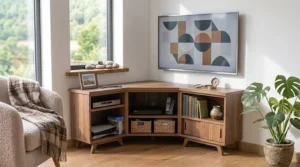
A typical living room corner behind a door or between two windows goes completely unused in a standard furniture layout, because rectangular furniture simply can’t follow the angle of two intersecting walls. A corner media console is built with a triangular or notched back specifically to fill that dead zone, which means the floor space a traditional rectangular stand would occupy along a flat wall gets returned to the room — often enough to fit an extra armchair, a reading nook, or simply more walking room in a tight layout.
This is where the room corner solution angle matters most for apartment dwellers and anyone in an older home with awkward, non-rectangular floor plans. Reviewers consistently mention regaining several feet of usable floor space after switching from a traditional stand to a corner unit, particularly in rooms under 200 square feet. The trade-off, covered in the performance section above, is a slightly less centered viewing angle — but for most small-space households, the square-footage win outweighs that minor adjustment. If you’re weighing a corner media console specifically for its space-saving properties, prioritize models with a narrower front profile (like the Walker Edison 44″ Glass stand) over deeper cabinet-style units, since profile depth is what actually determines how much room you reclaim.
Long-Term Cost & Maintenance: What You’re Really Paying Over Time
The sticker price on a corner tv stand is only part of the real cost, and skipping this math is how buyers end up disappointed two years in.
Budget stands in the $130-$200 range typically use MDF or particleboard construction with laminate veneer. These hold up fine under normal use but are more prone to shelf sag under sustained heavy loads and can’t be easily refinished if scratched — when they wear out, the practical move is replacement, not repair. Mid-range options in the $250-$350 bracket, like the Sauder Palladia or Leick Home Mateo, generally use heavier-gauge hardware (metal drawer glides, safety-stop mechanisms) that extend functional lifespan noticeably, since drawer failure is the most common wear point on any storage-heavy stand. Premium picks like the fireplace-equipped Alcott carry ongoing electricity costs for the heater, though LED-based fireplace inserts are efficient enough that this typically adds only a few dollars a month during regular use.
The maintenance math favors simpler designs. Open-shelf and glass-and-metal stands have essentially zero moving parts to fail — no drawer glides, no door hinges — which is part of why the total cost of ownership on something like the Walker Edison glass stand can end up lower over five years than a cabinet-style unit with drawers, even though the sticker price at purchase might be similar.
Safety, Regulations & Anchoring: What Every Buyer Should Know
This is the section most corner tv stand shopping guides skip entirely, and it shouldn’t be skipped.
The Consumer Product Safety Commission runs a national public education campaign called Anchor It! specifically to prevent furniture and TV tip-overs from injuring or killing children, and the guidance applies directly to corner tv stands: televisions should only be placed on furniture designed to hold a television, and even TVs not wall-mounted should still be anchored to the wall. This isn’t fear-mongering — it’s a documented, ongoing safety issue that every stand in this guide addresses through weight ratings and included anchor hardware, but only if you actually use it.
Practically, this means checking that any stand you buy comes with anti-tip bracket hardware (all seven picks above do), securing it to a wall stud rather than just drywall, and keeping heavier components on lower shelves rather than the top surface to keep the center of gravity low. If you have young children or large pets in the house, this step takes fifteen minutes and meaningfully reduces risk — it’s the cheapest insurance you’ll buy for this purchase. Beyond child safety, anchoring also protects the unit itself from tipping during normal bumps, cleaning, or an overly enthusiastic vacuum session.
Frequently Asked Questions
❓ What size TV fits on a corner tv stand?
❓ Is a corner tv stand better than a wall mount?
❓ How much weight can a corner tv stand hold?
❓ Do corner tv stands need to be anchored to the wall?
❓ Can a corner tv stand fit a 55 inch TV?
Conclusion
A corner tv stand isn’t just a consolation prize for people who couldn’t fit a “real” entertainment center — it’s often the smarter geometric choice, especially in smaller or awkwardly shaped rooms where every square foot along a flat wall actually matters. Across the seven picks in this guide, the right choice really comes down to what you’re optimizing for: the Walker Edison Maxwell Classic and Leick Home Mateo cover the widest range of TV sizes for buyers who aren’t sure what they’ll upgrade to next, the Sauder Palladia and Crosley Camden win on storage for households drowning in remotes and DVDs, the Prepac Vasari and Walker Edison Glass stand minimize footprint and cost for apartment living, and the Walker Edison Alcott earns its premium price by doing double duty as a heater.
None of these are the “best” corner tv stand in some universal sense — the best one is whichever matches your room’s actual dimensions, your storage habits, and how much you’re willing to spend on hardware quality versus a lower sticker price. Measure your corner, be honest about what you’ll actually store, and anchor it to the wall once it’s assembled. That’s really the whole formula.
Recommended for You
- Mid Century Modern TV Stand: 7 Picks That Actually Hold Up (2026)
- Fireplace TV Stand: 7 Best Picks for 2026 (Real Specs)
- TV Stand for 65 Inch TV: 7 Best Picks Ranked for 2026
Disclaimer: This article contains affiliate links. As an Amazon Associate, I earn from qualifying purchases. If you purchase products through these links, we may earn a small commission at no additional cost to you.
✨ Found this helpful? Share it with your friends! 💬🤗
