
In This Article
You finally bought the low, sleek platform bed you’ve been eyeing on Pinterest for a year. Then you got the mattress delivered, unrolled it, and started wondering: is this thing actually going to hold up on slats, or is it going to sag into a hammock by month three? That worry is exactly why mattress for platform bed frame compatibility has become such a common search — the wrong pairing doesn’t just feel bad, it can quietly void your warranty.
Here’s the short version: mattress for platform bed frame compatibility means matching a mattress’s construction and support requirements to a slatted or solid platform base so it lies flat, resists sagging, and stays under warranty without a box spring. Most modern memory foam, hybrid, and even many innerspring mattresses are built for exactly this setup, but the slat spacing, mattress thickness, and center support all have to line up correctly, or you’ll be dealing with premature body impressions and a denied warranty claim.
This guide walks through seven real mattresses that are genuinely built for platform frames, breaks down the slat math nobody explains clearly, and gives you a buyer’s framework so you’re not just guessing based on a product photo. We’ll also dig into thickness, sag prevention, and the box-spring-free setup that’s quietly taken over the mattress industry. Every mattress mentioned here can be found and purchased on Amazon, so you can check today’s price and availability as you go.
Quick Comparison Table
| Mattress | Type | Height | Max Slat Spacing | Price Range (Queen) | Best For |
|---|---|---|---|---|---|
| Zinus 12 Inch Green Tea Memory Foam | All-foam | 12″ | Under 3″ recommended | Under $300 | Tightest budgets |
| Linenspa 12 Inch Gel Memory Foam Hybrid | Hybrid | 12″ | Under 3″ recommended | $230–$300 | Guest rooms, kids |
| Nectar Classic 12″ Memory Foam | All-foam | 12″ | Up to 4″ | $350–$1,300 (varies by sale) | Best value with strong warranty |
| Helix Midnight | Hybrid | 12″ | Up to 5.5″ | $1,000–$1,400 | Balanced medium-firm feel |
| Amerisleep AS3 | All-foam | 12″ | Up to 2.75″ | $1,000–$1,500 | Eco-conscious foam fans |
| Purple RestorePlus Hybrid | Hybrid | 12″ | Under 3.5″ | $2,000–$2,600 | Back pain, pressure relief |
| Saatva Classic | Innerspring hybrid | 11.5″–14.5″ | Under 3″ with center support | $1,700–$2,300 | Luxury hotel feel |
Looking at the table, the split is pretty stark: budget all-foam beds like the Zinus 12 Inch Green Tea Memory Foam and Linenspa 12 Inch Gel Memory Foam Hybrid demand the tightest slat spacing because thin, lower-density foam has nowhere to hide a gap. Mid-tier hybrids like the Helix Midnight get more forgiving because pocketed coils distribute weight across a wider footprint. Premium picks such as the Saatva Classic land somewhere in between on tolerance but add a hard requirement — a center support leg — that budget frames often skip entirely.
💬 Just one click — help others make better buying decisions too!😊
Top 7 Mattresses for Platform Bed Frame Compatibility: Expert Analysis
1. Zinus 12 Inch Green Tea Memory Foam Mattress — best budget pick for a slatted frame
The standout here is simple: this is one of the cheapest mattresses on Amazon that’s genuinely engineered to sit directly on wood slats without a box spring. Zinus ships it compressed in a box, and it fully expands within about 72 hours once unrolled on your frame. The construction is a single 12-inch stack of green tea-infused memory foam over a dense support foam base, with a 10-year limited warranty and a 500-pound weight capacity on queen and larger sizes.
What that spec sheet doesn’t say outright: because there’s no coil layer to bridge gaps, this mattress needs slats spaced close together — ideally under 3 inches — or you’ll feel every gap as a soft spot within weeks. Reviewers on Amazon and in independent lab testing consistently describe the feel as soft with minimal bounce, which makes it a reasonable fit for lighter sleepers, kids’ rooms, or anyone furnishing a rental on a shoestring budget, but less ideal for heavier or combination sleepers who need firmer edge support.
Aggregated customer sentiment is genuinely mixed on this one: buyers frequently praise the price-to-comfort ratio for guest and kids’ rooms, while independent test labs have flagged below-average pressure relief and durability compared to pricier memory foam beds. That’s the honest trade-off you’re making at this price point.
Pros:
- ✅ Among the least expensive CertiPUR-US certified mattresses available
- ✅ 10-year limited warranty despite the low price
- ✅ Compresses small enough for tight stairwells and apartments
Cons:
- ❌ Struggles with pressure relief for heavier or side sleepers
- ❌ Needs closely spaced slats or it will feel unsupportive fast
Prices for the queen size typically land under $300, and it goes on sale often enough that patient shoppers regularly catch it well below that — check current pricing before you buy, since Zinus runs frequent promotions. For the money, it’s hard to argue with as an entry point into a box-spring-free setup.

2. Linenspa 12 Inch Gel Memory Foam Hybrid Mattress — cheapest true hybrid feel for guest rooms
The Linenspa 12 Inch Gel Memory Foam Hybrid earns its spot by doing something the all-foam budget beds can’t: it layers gel memory foam over individually encased steel coils, giving you a bit of springy responsiveness most sub-$300 mattresses skip entirely.
Under the hood, you’re getting roughly 1.5 to 2 inches of gel-infused foam sitting on 8-inch wrapped coils, which explains why this bed sleeps noticeably cooler than the all-foam Zinus. The coil layer also means it tolerates slightly wider slat gaps than pure foam beds, though manufacturer guidance and independent reviewers both still recommend keeping gaps under 3 inches for full support. It’s genuinely compatible with platform frames, box springs, and adjustable bases, which is more flexibility than you’d expect at this price.
Amazon’s review base for this mattress runs well over 100,000 ratings with a strong average, and the pattern in that feedback is consistent: buyers love it for children’s beds, guest rooms, and tight budgets, but a recurring complaint is that the comfort layer compresses and sags faster than expected once a sleeper crosses roughly 200 pounds. That’s a real limitation worth weighing honestly rather than glossing over.
Pros:
- ✅ Sleeps cooler than most budget all-foam alternatives
- ✅ Coils add edge support foam-only beds lack
- ✅ 10-year warranty and works with or without a box spring
Cons:
- ❌ Comfort layer sags faster under sleepers over ~200 lbs
- ❌ Weak edge support compared to pricier hybrids
Expect to pay somewhere in the $230–$300 range for a queen, occasionally dipping lower during flash sales — always check the current price, since Linenspa’s Amazon listings fluctuate weekly. As a secondary bed or a stopgap while you save for something more durable, it’s a legitimately smart buy.
3. Nectar Classic 12″ Memory Foam Mattress — best value with a forever warranty
What most buyers overlook about the Nectar Classic is that its actual advantage isn’t the foam — it’s the company terms wrapped around it. A 365-night home trial and a Forever Warranty are almost unheard of in this price tier, and that alone changes the risk calculus of trying a new mattress on a platform frame you’re not 100% sure about.
Construction-wise, this is a 12-inch all-foam mattress with a cooling top layer over a supportive base foam, landing at a medium-firm feel that suits back and stomach sleepers better than dedicated side sleepers with hip pain. The base has a textured, shift-resistant bottom cover specifically designed to grip a platform surface, so you won’t get the slow mattress-creep toward one side of the bed that plagues slicker-bottomed beds. Nectar explicitly rates it compatible with platform beds, box springs, and slatted foundations as long as slats sit no more than 4 inches apart, which is more forgiving than several premium competitors on this list.
Real customer sentiment, drawn from tens of thousands of verified purchases on Walmart and Amazon, clusters around a strong 4.3-star average, with buyers repeatedly citing reduced motion transfer and stable support atop platform frames. A recurring caveat in the feedback: dedicated side sleepers occasionally find it firmer than expected for their hips and shoulders.
Pros:
- ✅ 365-night trial removes most of the buying risk
- ✅ Shift-resistant base grips slats without sliding
- ✅ Lifetime “Forever Warranty” coverage on most models
Cons:
- ❌ Can feel too firm for strict side sleepers
- ❌ Handles rotating and moving are awkward without a second person
List price sits around $1,299 for a queen, but Nectar discounts aggressively and regularly, so real-world prices in the $350–$650 range for a queen are common — check current pricing at the time you shop, since promotions shift often. Given the warranty terms, this is arguably the least risky mid-tier bed on this list.
4. Helix Midnight — best all-around medium-firm hybrid
Reviewers consistently note that the Helix Midnight threads a needle few mattresses manage: a medium-firm hybrid feel that works for back, side, and combination sleepers without forcing you into a niche category. That versatility is exactly why it shows up on so many best-of-2026 lists across independent testing outlets.
The build is a 12-inch hybrid with layered polyfoam and memory foam over a pocketed coil support core, wrapped in a breathable, stretch-knit cover. Based on the spec comparison against foam-only beds on this list, the pocketed coils give the Midnight a meaningfully more forgiving relationship with slats — Helix’s own guidance allows spacing up to 5.5 inches apart, nearly double what the all-foam picks require, because the coils themselves bridge small gaps instead of relying entirely on foam density. It requires no box spring at all; a solid platform, slatted frame, or adjustable base all work.
Independent lab testing has repeatedly ranked the Midnight highly for cooling and motion isolation relative to its price point, and Helix backs it with a limited lifetime warranty that fully covers manufacturing defects for the first 10 years. The company comparison guides note the trade-off directly: side-by-side against pure memory foam beds like the Nectar, the Midnight trades a bit of contouring “hug” for more responsive bounce and better temperature regulation.
Pros:
- ✅ Forgiving 5.5-inch slat tolerance thanks to pocketed coils
- ✅ Limited lifetime warranty with 10 years of full coverage
- ✅ Balanced medium-firm feel suits most sleep positions
Cons:
- ❌ Not the softest option for dedicated side sleepers with hip pain
- ❌ Coil layer adds weight, making solo setup harder
Queen pricing generally runs in the $1,000–$1,400 range depending on ongoing promotions — Helix runs frequent site-wide sales, so it’s worth checking the current price before assuming full MSRP. For buyers who want one hybrid that reasonably suits an entire household, this is the pick that keeps coming up.
5. Amerisleep AS3 — best eco-conscious foam for tight slat spacing
Here’s what the spec sheet won’t tell you outright: the Amerisleep AS3 has some of the strictest slat requirements on this entire list, needing gaps no wider than 2.75 inches on non-Amerisleep frames to keep the warranty valid. That’s tighter than nearly every hybrid here, and it’s a direct consequence of the mattress being 100% foam with no coil layer to distribute weight across gaps.
In exchange for that pickiness, you get a genuinely well-engineered bed: a 12-inch, medium-feel (about 5 out of 10 firmness) mattress built with a HIVE transition layer that provides zoned support — firmer under the lower back, softer at the shoulders — plus a plant-based Bio-Pur foam top layer that’s noticeably more breathable than traditional memory foam. Amerisleep backs it with an industry-leading 20-year warranty, split into 10 years of full replacement coverage and 10 years of prorated coverage after that.
Independent testers have highlighted the AS3’s motion isolation and above-average cooling as standout traits for an all-foam bed, and it’s routinely ranked among the top memory foam hybrids for side and back sleepers in comparative reviews. The honest caveat, echoed across multiple review sources: edge support is only decent, not exceptional, so sleepers who like to perch on the mattress edge may notice some give.
Pros:
- ✅ 20-year warranty is among the longest in the industry
- ✅ Zoned HIVE layer targets lower back support specifically
- ✅ Plant-based foam sleeps cooler than typical memory foam
Cons:
- ❌ Requires slats no more than 2.75 inches apart
- ❌ Edge support is average, not class-leading
Queen pricing typically falls between $1,000 and $1,500, with Amerisleep running seasonal sales that shift the number regularly — always confirm the current price before ordering. If your platform bed already has tightly spaced slats, this is one of the more thoughtfully engineered foam beds you can put on it.
6. Purple RestorePlus Hybrid Mattress — best pressure relief for back pain
Reviewers repeatedly single out the Purple RestorePlus Hybrid for one specific use case: chronic back pain sufferers who’ve bounced off softer memory foam beds. The reason comes down to Purple’s proprietary GelFlex Grid, a 3-inch hyper-elastic polymer layer that flexes instantly under pressure points while staying firm everywhere else, paired with 3-zone coils that add extra reinforcement under the lower back.
This is a 12-inch hybrid, and Purple is explicit about its platform compatibility: it works on a solid surface base or slats spaced less than 3.5 inches apart, and separately on adjustable bases rated for at least 750 pounds. Purple is equally explicit about what it doesn’t want — a traditional box spring, since the bouncy coil-on-coil interaction can damage the GelFlex layer over time. Based on the spec comparison with other hybrids on this list, the open-grid design also means it sleeps dramatically cooler, with Purple’s own thermal testing claiming up to triple the airflow of leading competitors.
Aggregated review data (roughly 4.7 out of 5 across hundreds of verified purchases at authorized retailers) skews heavily positive for couples and hot sleepers specifically, with the motion isolation and edge support both called out as above-average for a grid-based mattress. What most buyers overlook is that this comfort comes at real cost — it’s the second most expensive bed on this list.
Pros:
- ✅ GelFlex Grid delivers targeted lower-back pressure relief
- ✅ Sleeps significantly cooler than standard memory foam hybrids
- ✅ Strong edge support for a grid-based mattress
Cons:
- ❌ One of the pricier picks on this list
- ❌ Explicitly incompatible with traditional box springs
Queen pricing generally runs $2,000–$2,600, though Purple frequently discounts several hundred dollars during major sale events — check the current price before purchasing, since the swings are substantial. For back pain sufferers specifically, the aggregated review pattern makes a genuinely strong case for the investment.
7. Saatva Classic — best luxury pick, still slat-friendly
The Saatva Classic is the outlier on this list in the best way: it’s a genuine coil-on-coil innerspring hybrid with a plush Euro pillow top, the kind of construction people usually assume needs a box spring, and yet Saatva engineers it to work directly on a platform bed. That’s a meaningful transformation of an old mattress category into something modern bedroom setups can actually use.
Saatva specifies the requirements clearly: the platform needs a solid surface or slats at least 3 inches wide and spaced closer than roughly 3 to 4 inches apart, plus — critically — a center support leg running down the middle of the frame, because this mattress is heavier than the foam and foam-hybrid beds on this list. Skip the center leg and you risk the exact sagging problem a box spring was originally invented to prevent. The dual-coil design uses triple-tempered recycled steel for durability, and Saatva backs it with a 180-night trial plus a lifetime warranty, among the most generous terms in the luxury tier.
Independent testers who’ve slept on it long-term consistently praise the pressure relief and lumbar support, with several naming it a top overall pick for people managing general back and hip aches. The honest trade-off flagged across multiple reviews: the innerspring bounce means noticeably more motion transfer than the foam and grid-based beds here, so light-sleeping couples may feel a partner’s movement more than they would on, say, the Purple RestorePlus.
Pros:
- ✅ Three firmness options accommodate a wide range of sleepers
- ✅ Lifetime warranty and a generous 180-night trial
- ✅ Genuinely engineered for platform beds despite being innerspring
Cons:
- ❌ Requires a center support leg to avoid sagging
- ❌ More motion transfer than foam or grid-based alternatives
Queen pricing generally lands between $1,700 and $2,300, with Saatva running seasonal promotions that regularly knock a few hundred dollars off — check the current price at the time of purchase. If you want a hotel-bed feel without sacrificing platform bed compatibility, this is the clearest option here.
How to Set Up Your Mattress on a Platform Bed the Right Way
Getting the mattress home is only half the job. First, vacuum or wipe down the slats before placing anything on top — dust and debris trapped underneath contribute to odor and mold over time. Next, center the mattress carefully; most box-spring-free setups rely on the mattress’s own weight and a grippy base cover for stability, so an off-center placement can shift during the first few nights of use.
During the first 30 days, resist the urge to judge firmness immediately. Foam and hybrid beds typically need two to four weeks to fully soften into their intended feel as the materials break in, and body impressions under half an inch during this window are normal, not a defect. Rotate the mattress head-to-foot every three months for the first year, which helps prevent uneven wear directly above weaker slat gaps. If you notice any single slat flexing more than its neighbors, reinforce it with a support beam or swap it before it creates a permanent low spot.
One trick most retailers won’t mention: a breathable mattress protector actually improves platform-bed airflow rather than restricting it, because it stops moisture from settling directly onto the mattress base where slats sit closest to the material. Skipping this step is one of the more common first-month mistakes that leads to avoidable warranty disputes down the line.

Common Platform Bed Mattress Problems (And How to Fix Them)
Sagging in the middle: This is almost always a center support issue on queen and larger frames, not a mattress defect. Add a center leg or a horizontal support beam rated for the mattress weight before assuming you need a replacement bed.
Mattress sliding off the slats: Look for a non-slip mattress pad or a frame with raised side rails. Several beds on this list, including the Nectar Classic, already include a textured grip base specifically to solve this.
Creaking or shifting slats: Loose hardware is the more common culprit than worn slats themselves. Tighten every bolt and bracket before replacing anything — this alone resolves a surprising share of noise complaints.
Premature body impressions: Compare the depth against your warranty’s threshold, typically 1 to 1.5 inches, before filing a claim. Anything shallower is generally considered normal settling, not sag.
Voided warranty after a claim gets denied: This usually traces back to either removing the mattress cover, which most brands explicitly prohibit for fire-barrier compliance reasons under federal labeling rules, or using slats spaced wider than the manufacturer allows. Reading the full text of the federal mattress flammability regulation explains why that cover-removal rule exists in the first place — it’s tied to the fire barrier built into the mattress, not just a suggestion.
Buyer’s Decision Framework: Which Setup Fits Your Bedroom?
If you’re furnishing a guest room or kid’s bed on a tight budget, choose an all-foam mattress like the Zinus 12 Inch Green Tea because the low cost outweighs the shorter expected lifespan for occasional use. If you’re a light-to-average-weight solo sleeper who wants the best value-to-risk ratio, choose the Nectar Classic because the 365-night trial all but eliminates buyer’s remorse. If you share a bed and run warm, choose either the Helix Midnight or Purple RestorePlus Hybrid because both prioritize airflow and motion isolation for couples. If you have chronic back pain and a firm budget ceiling isn’t a concern, choose the Saatva Classic or Purple RestorePlus Hybrid, since both consistently show up in aggregated review data as top picks for lumbar support. And if your platform bed already has widely spaced slats you can’t easily replace, prioritize a hybrid with coils — the Helix Midnight tolerates up to 5.5 inches — over any all-foam bed on this list.
How to Choose a Mattress for a Platform Bed Frame Compatibility
- Check your slat spacing first, before shopping for a mattress. Measure the gap between slats with a tape measure; this single number eliminates more options than firmness preference ever will.
- Confirm center support on queen size and larger. Frames without a center leg risk sagging regardless of which mattress you choose.
- Match mattress weight to frame capacity. Heavier innerspring and hybrid beds like the Saatva Classic need a sturdier frame than lightweight all-foam options.
- Read the manufacturer’s foundation requirements, not just the marketing copy. “Works without a box spring” and “works on any slat spacing” are not the same claim.
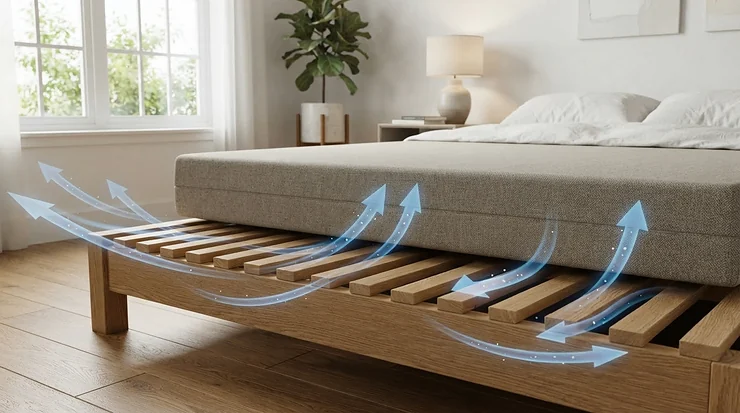
- Consider airflow if you sleep hot. Slatted frames naturally breathe better than solid platforms, which matters most with memory foam.
- Factor in trial length as risk insurance. A 100-night trial gives you far more room to judge fit than a 30-night window.
- Don’t ignore the warranty’s foundation clause. Nearly every brand on this list explicitly voids coverage if the base doesn’t meet their slat-spacing minimum.
Slat Spacing Requirements: The Number That Actually Matters
Every mattress-platform bed compatibility question ultimately comes down to one measurement: the gap between slats. All-foam mattresses without a coil layer generally need slats spaced under 3 inches apart, since foam alone can’t bridge a wider gap without eventually sagging into it. Hybrid mattresses with pocketed coils tolerate more, with some like the Helix line rated for gaps up to 5.5 inches because the coils themselves distribute weight laterally. According to platform bed construction guides, slats should also be flat, sturdy, and at least three-quarters of an inch thick — thin or flexible slats can create soft spots even when the spacing itself technically meets the requirement.
Comparing the two approaches side by side, the practical takeaway is this: if you already own a platform bed with slats wider than 3 inches apart, a hybrid mattress with coils is almost always the safer, warranty-preserving choice over an all-foam bed, unless you’re willing to add a bunkie board to close the gap.

Platform Bed Mattress Thickness: Finding the Right Profile
Mattress thickness for a platform bed isn’t just an aesthetic choice — it directly affects how easy the bed is to get in and out of, since platform frames sit lower to the ground than traditional box-spring setups by design. Most sleep experts recommend a mattress between 10 and 14 inches thick for platform frames: thinner beds can look sparse and make a low platform feel uncomfortably close to the floor, while significantly thicker luxury beds like the Saatva Classic, which can run up to 14.5 inches with its foundation, need a taller platform to avoid an awkwardly high step-up.
If your platform bed sits especially low, lean toward the thicker end of that range — 12 to 14 inches — to bring the total sleep surface height into a more comfortable zone. If your platform already has a tall profile with built-in storage drawers, a slightly thinner 10 to 12-inch mattress like the Zinus or Linenspa options keeps the overall bed height from becoming impractical.
Box-Spring-Free Setup vs Traditional Box Spring: What Changes
Ditching the box spring for a platform bed isn’t just a style choice; it changes several practical things about how your bedroom functions. Independent comparisons of box springs, foundations, and platform beds consistently point out that box springs were originally engineered to flex alongside coil mattresses, absorbing shock in a way that modern foam and hybrid beds don’t actually need — which is exactly why most contemporary mattresses, including every one reviewed here, are rated for box-spring-free use.
| Factor | Box Spring Setup | Box-Spring-Free Platform Setup |
|---|---|---|
| Overall bed height | Taller, often 25″+ total | Lower, typically 14″–20″ total |
| Noise over time | Coils can develop squeaks | Generally silent if hardware is tight |
| Best mattress match | Traditional innerspring | Foam, hybrid, most modern innerspring |
| Upfront cost | Extra $100–$300 for the box spring | Often $0 extra if frame is already owned |
| Under-bed storage | Usually blocked | Frequently available |
The clearest pattern in that comparison is cost and simplicity: skipping the box spring typically saves buyers $100 to $300 outright, while also opening up under-bed storage that a traditional box spring setup blocks entirely. The trade-off worth noting is that a handful of specialty mattresses, particularly some latex beds, still explicitly require a solid surface rather than open slats — always double-check before assuming universal compatibility.
Why Mattresses Sag on Slats (And What Actually Prevents It)
Sag on a slatted frame almost never comes from a single dramatic failure — it’s the slow result of a mattress flexing into gaps that are slightly too wide, night after night, until the foam or fabric loses its ability to spring back. What most buyers overlook is that this is a physics problem as much as a materials one: even a high-quality mattress will eventually telegraph the shape of the slats beneath it if those slats are spaced beyond the manufacturer’s stated limit.
The fix is rarely a mattress upgrade. In most cases, adding a bunkie board or swapping in more closely spaced slats resolves the issue entirely, since it changes the support surface rather than the mattress itself. Reviewers and test labs alike note that hybrids with pocketed coils resist this kind of sag noticeably longer than all-foam beds under identical slat conditions, simply because the coil layer spreads weight across a wider area before it ever reaches the gap.

Frequently Asked Questions
❓ Do I need a box spring for a platform bed?
❓ What slat spacing is safe for a memory foam mattress?
❓ How thick should a mattress be for a platform bed frame?
❓ Will putting a mattress directly on slats void the warranty?
❓ Can a mattress sag between slats over time?
Conclusion
Matching a mattress to a platform bed frame really comes down to three numbers: slat spacing, mattress thickness, and your frame’s weight capacity. Get those right, and nearly every bed on this list — from the budget-friendly Zinus 12 Inch Green Tea Memory Foam to the luxury-tier Saatva Classic — will perform exactly as promised without a box spring anywhere in sight.
If you’re working with a tight budget and closely spaced slats, the Linenspa 12 Inch Gel Memory Foam Hybrid and Zinus 12 Inch Green Tea Memory Foam remain the most forgiving entry points. If you want the safest bet against buyer’s remorse, the Nectar Classic‘s 365-night trial is hard to beat. And if your platform bed already has wider slat gaps you’re not planning to fix, lean toward a coil-based hybrid like the Helix Midnight or Purple RestorePlus Hybrid rather than an all-foam bed.
Whichever mattress you land on, don’t skip the setup basics: measure your slats before you buy, confirm center support on larger sizes, and keep that mattress cover on for warranty compliance. A few minutes of measuring now saves months of warranty headaches later.
Recommended for You
- Mattress Under $500 for a Guest Bedroom: 7 Best 2026 Picks
- 7 Best Adjustable Bed Base for Snoring Relief Picks (2026)
- Innerspring Mattress for Stomach Sleepers: 7 Firm Picks (2026)
Disclaimer: This article contains affiliate links. As an Amazon Associate, I earn from qualifying purchases. If you purchase products through these links, we may earn a small commission at no additional cost to you.
✨ Found this helpful? Share it with your friends! 💬🤗
