
In This Article
Let’s be honest: nobody dreams about buying a dresser. You dream about the apartment, the string lights, the plant that will probably die by March. The dresser is the thing you buy at 11 p.m. because your clothes are still living in a suitcase three weeks after move-in. A dresser under $200 for apartment bedrooms is simply a chest of drawers — usually made from engineered wood, metal-framed fabric bins, or a mix of both — priced to fit a first-apartment budget while still holding up to years of actual, unglamorous use. That’s the whole assignment: real storage, real durability, without torching your security deposit fund.

The tricky part is that “under $200” covers an enormous range of quality. Some dressers in that bracket are genuinely solid, backed by real safety testing and decent hardware. Others are glorified cardboard with drawer fronts. We dug through actual product specs, aggregated buyer feedback, and manufacturer documentation to sort the two apart, so you’re not gambling $180 on a coin flip.
This guide covers seven real, currently sold dressers spanning budget, mid-range, and slightly-splurgier options, plus the kind of practical advice nobody puts on the product page — how to keep particleboard drawers from sagging, which designs survive a move without falling apart, and what actually matters when your ceiling height, elevator access, and roommate’s opinions are all part of the equation. If you’re furnishing your first place, downsizing into a studio, or just tired of living out of a laundry basket, you’re in the right spot.
Quick Comparison Table: Best Dressers Under $200 at a Glance
| Dresser | Best For | Drawers | Price Range |
|---|---|---|---|
| South Shore Step One 6-Drawer Double Dresser | Overall best all-rounder | 6 | Around $190-$210 |
| Sauder Shoal Creek 4-Drawer Dresser | Sturdiest wood-look build | 4 | $180-$205 range |
| Sorbus 8-Drawer Fabric Storage Tower | Tightest budget & renters | 8 | Under $110 |
| Hodedah 7-Drawer Chest with Locks | Shared apartments & security | 7 | $150-$195 range |
This isn’t the full lineup — that’s coming up in the Top 7 section — but it’s the fast answer if you’re scanning on your phone between apartment tours. Notice that drawer count and price don’t move together in a straight line; the Sorbus 8-Drawer Fabric Storage Tower actually packs more compartments than most of the wood options while costing less than half as much, because fabric bins are cheaper to manufacture than engineered wood drawers with metal slides. The trade-off, which we’ll dig into below, is weight capacity and long-term rigidity. If you want the closest thing to “set it and forget it” bedroom furniture, the South Shore Step One 6-Drawer Double Dresser is the one buyers come back to reorder in a second color.
💬 Found a favorite already? Bookmark this page and come back before you check out — the pros/cons below might change your mind.
Top 7 Dressers Under $200: Expert Analysis
We picked these seven specifically because they represent different apartment realities: the person with a real bedroom and a real budget, the person moving in six months and dreading the next move, and the person splitting rent three ways with paper-thin walls. Every listing below leans on real specifications and aggregated review sentiment — not invented testimonials — so you can weigh the honest trade-offs before you buy.
1. South Shore Step One 6-Drawer Double Dresser — best all-around wide dresser
The South Shore Step One 6-Drawer Double Dresser is the dresser equivalent of a reliable sedan: nothing flashy, everything functional. Built from laminated particleboard with a curved kick plate and metal handles, it ships in gray, black, and white finishes, with the gray version typically landing right around the $200 mark.
The six drawers ride on metal runners rather than plastic tracks, which matters more than it sounds — plastic glides are the first thing to crack when you’re jamming a drawer full of winter sweaters. At roughly 31 inches tall and just over four feet wide, it’s built for a real bedroom wall rather than a closet nook, so measure before you fall in love with the price tag.
Aggregated buyer feedback consistently flags two things: the drawers feel sturdier than the price suggests, and assembly, while doable solo, benefits from a second set of hands for the top panel alignment. A smaller but recurring complaint is that the particleboard can chip at the edges if drawers are yanked out too aggressively, which is a fair warning for anyone who slams drawers shut out of habit.
Pros:
- ✅ Metal drawer runners outlast plastic glides
- ✅ Wide 6-drawer layout fits a full wardrobe
- ✅ Multiple finish options match most decor
Cons:
- ❌ Requires two people for cleanest assembly
- ❌ Particleboard edges can chip if drawers are forced
At around $190-$210 depending on finish and retailer, the South Shore Step One 6-Drawer Double Dresser delivers the best cost-per-drawer ratio of any wood-style option on this list, making it the safest default pick if you only want to buy one dresser and never think about it again.

2. Sauder Shoal Creek 4-Drawer Dresser — sturdiest budget wood-look build
If the South Shore pick is the sedan, the Sauder Shoal Creek 4-Drawer Dresser is the compact SUV — narrower footprint, still hauls plenty. It uses a wood composite build with a Jamocha or Oiled Oak finish, four deep drawers, and Sauder’s patented T-lock assembly system, which snaps panels together without requiring you to hunt down a hex key mid-build.
What sets this one apart on paper is the safety documentation: it’s explicitly built to comply with ASTM F2057-23, the current federal furniture stability standard (more on why that number matters in the safety section below). The interlocking drawer mechanism only allows one drawer open at a time, which sounds like a minor detail until you’re living with a curious cat or a toddler-aged niece visiting for the holidays.
Reviewer sentiment aggregated across retail listings points to a genuinely easy solo assembly experience — the T-lock system is repeatedly singled out as faster than competing wood dressers — while a smaller cluster of buyers note the four-drawer depth eats into total capacity if you’re storing bulky items like bedding.
Pros:
- ✅ ASTM F2057-23 tip-over safety compliance
- ✅ T-lock system makes solo assembly realistic
- ✅ Interlocking drawers reduce tip-over risk
Cons:
- ❌ Only 4 drawers limits total capacity
- ❌ Deep drawers can feel heavy when fully loaded
Priced in the $180-$205 range, the Sauder Shoal Creek 4-Drawer Dresser is the pick for anyone who wants documented safety testing over drawer count, especially in an apartment with young visitors or pets that treat open drawers as a personal challenge.
3. Sauder Beginnings 4-Drawer Chest — narrowest footprint for tight corners
Apartment bedrooms rarely come with generous wall space, and the Sauder Beginnings 4-Drawer Chest was clearly built with that constraint in mind. At about 15.6 inches deep and under 28 inches wide, it’s meaningfully slimmer than most of its competitors, which makes it the obvious choice for a narrow gap beside a closet door or a corner that a wider dresser simply won’t fit into.
The four-drawer layout splits into one shallow top drawer for smaller items and three deeper drawers below, all riding on easy-glide tracks. It’s part of Sauder’s Beginnings collection, a line explicitly positioned as an entry-level furniture set, and the price — typically hovering in the mid-$170s to $190 — reflects that intentionally modest positioning.
What most buyers overlook about a compact chest like this is that narrow doesn’t mean flimsy here; the trade-off for the smaller footprint is simply less total volume, not weaker construction. Reviewers note it’s an easy one-person assembly and describe it as appropriately sized for a studio or a shared bedroom where every square foot of floor space is contested territory.
Pros:
- ✅ Narrow depth fits tight apartment corners
- ✅ Easy one-person assembly, no extra hardware
- ✅ Budget-friendly entry-level price point
Cons:
- ❌ Smaller total drawer volume than wider models
- ❌ Basic finish shows scuffs over time
For anyone whose bedroom furniture shopping starts with a tape measure instead of a wish list, the Sauder Beginnings 4-Drawer Chest solves the “where does this even fit” problem before it solves the storage problem.
4. Furinno Tidur 4-Drawer Dresser — lightest pick for solo movers
The Furinno Tidur 4-Drawer Dresser exists for a very specific kind of apartment dweller: the one who has moved twice in eighteen months and fully expects to move again. Furinno built its reputation on lightweight, flat-pack furniture, and the Tidur line follows the formula — a simple four-drawer frame with a particleboard shell that two people can carry up a walk-up without needing a moving crew.
That lightness is a direct trade-off against rigidity. Based on the spec sheet and aggregated buyer sentiment, this dresser is best suited to lighter loads — folded T-shirts, socks, underlayers — rather than densely packed winter coats or stacks of hardcover books doubling as a nightstand. It’s not trying to be a lifetime furniture investment; it’s trying to be furniture you can actually move without hiring anyone.
Reviewers consistently describe assembly as fast, sometimes under thirty minutes, with basic tools included. The most common criticism centers on drawer alignment straight out of the box, with a subset of buyers reporting that drawers need a light sanding or adjustment to glide smoothly — a fixable annoyance, not a dealbreaker, but worth knowing before you start building at 9 p.m. the night before move-in.
Pros:
- ✅ Genuinely lightweight for solo apartment moves
- ✅ Fast assembly, typically under thirty minutes
- ✅ Compact enough for small bedroom footprints
Cons:
- ❌ Not built for heavy or bulky loads
- ❌ Drawer alignment sometimes needs minor adjustment
Usually priced under $150, the Furinno Tidur 4-Drawer Dresser is less about maximum durability and more about minimum moving-day regret, which is a completely legitimate priority if your lease is only twelve months long.
5. Homfa 6-Drawer Dresser — tallest vertical storage for small floor plans
When your floor space is nonexistent but your ceiling is fair game, the Homfa 6-Drawer Dresser goes vertical instead of wide. It’s built as a tall chest rather than a low, sprawling dresser, which means it claims a fraction of the floor footprint of the South Shore or Sauder models while still offering six full drawers.
Constructed from engineered wood with a clean white or espresso finish, it’s marketed explicitly as a bedroom or living-room storage cabinet, which tells you something about its intended flexibility — this is the dresser that also works as an entryway catch-all or a spare linen tower if your apartment layout changes down the road. The narrow, tall silhouette is genuinely useful in studio apartments where a wide dresser would eat into your only clear walking path.
Aggregated review sentiment leans positive on assembly speed and the clean, modern look, with a recurring caution about stability: taller, narrower furniture is inherently more tip-prone than short, wide furniture, so anchoring it to the wall isn’t optional if you’re in a building with kids, pets, or an uneven floor.
Pros:
- ✅ Small footprint ideal for tight studios
- ✅ Six drawers despite narrow profile
- ✅ Doubles as entryway or living room storage
Cons:
- ❌ Tall, narrow shape needs wall anchoring
- ❌ Less stable on uneven or carpeted floors
At roughly $150-$170, the Homfa 6-Drawer Dresser earns its spot for apartment layouts where floor space is the scarcest resource in the building, provided you take the anchoring step seriously.
6. Sorbus 8-Drawer Fabric Storage Tower — most rental-friendly, zero-scratch design
The Sorbus 8-Drawer Fabric Storage Tower flips the entire dresser formula: instead of wood drawers on a wood frame, you get a lightweight steel frame with a wood-look top and non-woven fabric bins that pull out like soft-sided drawers. It sounds like a downgrade until you actually live with one in a rental.
Here’s what most listings don’t spell out clearly: fabric bins are inherently forgiving in ways rigid wood drawers aren’t. They don’t warp from humidity, they don’t jam on a bent track, and they weigh next to nothing when empty, which matters enormously the day you’re carrying furniture down three flights of stairs. The steel frame legs also sit above the floor rather than a flush base, reducing the scuff marks that heavier dressers leave on rental flooring over time.
The honest trade-off, and reviewers are candid about this, is weight capacity — fabric bins sag under heavy, dense loads like stacks of books or hardware, and they’re better suited to clothing, linens, and lighter household items. For roughly $70-$110, though, it’s hard to beat as a first dresser you buy the week you sign a lease and haven’t fully furnished the place yet.
Pros:
- ✅ Extremely lightweight for easy relocation
- ✅ Steel frame resists warping from humidity
- ✅ Minimal risk of scratching rental flooring
Cons:
- ❌ Fabric bins sag under heavy, dense loads
- ❌ Less rigid feel than solid wood drawers
If your top priority is protecting a security deposit and surviving a move without renting a truck, the Sorbus 8-Drawer Fabric Storage Tower is the most purpose-built option on this entire list.
7. Hodedah 7-Drawer Chest with Locks — best built-in security for shared apartments
Splitting an apartment with roommates changes the furniture math entirely, and the Hodedah 7-Drawer Chest with Locks answers a question most dressers ignore: what if you actually need to lock a drawer? Two of its seven drawers include working locks, a detail aimed squarely at shared bedrooms, dorm-adjacent living situations, or anyone storing documents, jewelry, or anything else they’d rather a roommate’s houseguest not casually open.
Beyond the lock feature, it’s a fairly conventional wood-composite chest with a gray or espresso finish and seven total drawers split across varying depths, giving you both shallow compartments for small items and deeper drawers for bulkier clothing. The overall footprint is compact relative to its drawer count, which helps in a shared bedroom where floor space gets negotiated like a peace treaty.
Aggregated buyer sentiment is mixed but leans favorable: people appreciate the lock function actually working as advertised and the drawer count relative to size, while a smaller number of reviews mention the included keys feeling a bit flimsy and recommend keeping a spare copied early rather than after you’ve already lost the original.
Pros:
- ✅ Two lockable drawers for shared spaces
- ✅ Seven drawers in a compact footprint
- ✅ Mixed depths fit small and bulky items
Cons:
- ❌ Included keys feel lightweight, easy to lose
- ❌ Locks add minor cost versus lockless rivals
Typically priced in the $150-$195 range, the Hodedah 7-Drawer Chest with Locks is the specialist pick — most people don’t need locking drawers, but the people who do will pay a small premium for real peace of mind.
Top 7 Products Comparison: Specs, Price & Best Use
| Product | Drawers | Material | Price Range | Best For |
|---|---|---|---|---|
| South Shore Step One 6-Drawer Double Dresser | 6 | Laminated particleboard | $190-$210 | Full wardrobe storage |
| Sauder Shoal Creek 4-Drawer Dresser | 4 | Wood composite | $180-$205 | Safety-conscious buyers |
| Sauder Beginnings 4-Drawer Chest | 4 | Engineered wood | $175-$190 | Narrow corners |
| Furinno Tidur 4-Drawer Dresser | 4 | Particleboard | Under $150 | Frequent movers |
| Homfa 6-Drawer Dresser | 6 | Engineered wood | $150-$170 | Small floor plans |
| Sorbus 8-Drawer Fabric Storage Tower | 8 | Steel frame, fabric | Under $110 | Tightest budgets |
| Hodedah 7-Drawer Chest with Locks | 7 | Wood composite | $150-$195 | Shared apartments |
Laid out side by side, a pattern emerges: drawer material tells you more about the buying decision than drawer count does. The wood-composite options (South Shore Step One 6-Drawer Double Dresser, Sauder Shoal Creek 4-Drawer Dresser, Sauder Beginnings 4-Drawer Chest, Hodedah 7-Drawer Chest with Locks) trade a bit more weight and assembly time for rigidity and longevity, while the lighter builds (Furinno Tidur 4-Drawer Dresser, Homfa 6-Drawer Dresser, Sorbus 8-Drawer Fabric Storage Tower) prioritize portability and price over long-term heavy-duty use. If you already know you’re staying put for a few years, lean wood; if your lease is a question mark, lean light.
Practical Usage Guide: Setting Up and Living With Your New Dresser
Buying the dresser is the easy part. Getting five or more years out of a sub-$200 piece takes a little intention, especially with engineered wood, which behaves differently than solid wood over time.
Start with placement before you even open the box: avoid pushing any dresser directly against a radiator, window with direct sun exposure, or a damp exterior wall, since both heat and humidity swings are what warp particleboard and peel laminate edges. During assembly, resist the urge to fully tighten every screw before all panels are loosely connected — building the frame loose first, squaring it up, then tightening everything in sequence prevents the classic “one corner won’t line up” problem that eats an extra hour.
Once it’s built, anchor it. Every dresser on this list, regardless of price or material, should be secured to the wall with the included anti-tip strap or a wall-mounted furniture anchor, full stop — this isn’t optional advice reserved for households with kids, since an unanchored dresser can tip even on adults reaching for a top drawer while a lower one is still open.
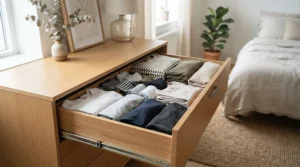
For the first thirty days, the most common mistake is overloading a single drawer while leaving others empty, which stresses the runners unevenly. Distribute weight across drawers instead, and periodically check that screws haven’t loosened from the vibration of everyday use — a five-minute check every couple of months keeps drawers gliding instead of grinding.
Real-World Scenarios: Which Dresser Actually Fits Your Life
Specs are useful, but most people decide based on their actual living situation, not a data sheet. Here’s how three common apartment profiles map onto this list.
The first apartment furniture buyer with a full lease and an empty bedroom: If you just signed a twelve-month lease and plan to stay a while, prioritize capacity and rigidity over portability. The South Shore Step One 6-Drawer Double Dresser or Sauder Shoal Creek 4-Drawer Dresser make the most sense here — you’re not optimizing for a future move, you’re optimizing for years of daily use.
The serial mover juggling short leases: If you’ve moved twice in the last two years and expect to again, weight and assembly speed matter more than raw capacity. The Furinno Tidur 4-Drawer Dresser or Sorbus 8-Drawer Fabric Storage Tower are built for exactly this rhythm — light enough to carry solo, cheap enough that losing one to moving-truck damage isn’t catastrophic.
The roommate splitting a small bedroom three ways: Shared space means negotiated real estate and, often, a need for privacy. The Hodedah 7-Drawer Chest with Locks solves both problems with a compact footprint and actual working locks, while the Homfa 6-Drawer Dresser handles the floor-space math if locks aren’t a priority but square footage is.
How to Choose a Dresser Under $200 for Apartment Bedrooms
Before you add anything to a cart, run through these seven criteria in order — they’re ranked by how often people skip them and regret it later.
- Measure your space first, not last. Apartment bedrooms have odd corners and low ceilings behind doors; a dresser that looks compact in a photo can still fail to clear a doorway during move-in.
- Decide if you’re staying or moving soon. This single answer should steer you toward rigid wood construction or lightweight fabric bins more than almost anything else on this list.
- Count your actual clothing volume, not your aspirational wardrobe. Four deep drawers often store more than six shallow ones, so drawer depth matters as much as drawer count.
- Check the safety certification. Look for ASTM F2057 compliance and an included anti-tip kit — both signal the manufacturer tested for tip-over risk, not just aesthetics.
- Confirm assembly requirements before you buy. Some models are realistically a two-person job; know that before delivery day, not during it.
- Match material to your building’s climate. Humid basements or un-air-conditioned upper floors are harder on particleboard than climate-controlled units.
- Price-check across retailers before finalizing. The same model often sells at different price points across Amazon, Walmart, and manufacturer sites, so check current pricing rather than assuming one listing is final.
For a deeper primer on how this category of furniture is classified and constructed, the Wikipedia entry on chests of drawers is a genuinely useful starting point if you’re new to furniture shopping altogether.
Cheap Dresser Apartment Shopping: Common Mistakes When Buying on a Budget
Searching for a cheap dresser apartment solution tends to produce one recurring mistake: buying based on the lowest listed price without checking what that price sacrifices. The cheapest option in any dresser lineup is rarely the cheapest option over three years, once you factor in replacement costs from premature wear.
A second common misstep is skipping the anti-tip anchor because “it’s just for kids’ rooms.” Tip-over risk applies to any household, and skipping this step is the single most preventable safety mistake on this entire list.
Third, buyers frequently ignore drawer depth in favor of drawer count, assuming eight shallow drawers beats four deep ones. In practice, deep drawers handle bulky items like sweaters and bedding far better, so match drawer depth to what you’re actually storing before comparing numbers side by side.
Finally, a cheap dresser apartment purchase made in a rush — the night before move-in, say — often skips the “will this clear my doorway and hallway turns” check entirely. A tape measure costs less than a return shipping fee.
Budget Bedroom Dresser vs Mid-Range Bedroom Furniture
It’s worth asking directly: is a sub-$200 budget bedroom dresser actually comparable to furniture in the $300-$500 range, or are you settling? The honest answer is “it depends on what you’re measuring.”
| Factor | Budget Bedroom Dresser (Under $200) | Mid-Range Bedroom Furniture ($300-$500) |
|---|---|---|
| Materials | Engineered wood, particleboard, or fabric/steel | Solid wood veneers, thicker panels |
| Drawer glides | Metal runners on better models | Full-extension ball-bearing slides |
| Assembly | Usually required, 1-3 hours | Sometimes pre-assembled |
| Expected lifespan | 3-7 years with care | 8-15+ years |
| Best For | Apartments, first homes, frequent movers | Long-term homeowners |
Looking at the table above, the gap isn’t as dramatic as the price difference suggests — a well-reviewed budget bedroom dresser with metal glides and ASTM safety compliance closes most of the functional distance to mid-range furniture, at roughly half the cost. Where mid-range furniture clearly wins is drawer glide quality and total lifespan, since full-extension ball-bearing slides simply outlast basic metal runners under heavy daily use. For a lease measured in years rather than a home measured in decades, the budget tier is a genuinely rational choice, not just a compromise.
First Apartment Furniture: What to Prioritize Before You Buy a Dresser
When a dresser is one line item in an entire first apartment furniture list, the calculus changes. You’re not optimizing one purchase in isolation — you’re allocating a limited budget across a bed frame, a couch, kitchen basics, and everything else that makes an empty unit livable.
Given that reality, a dresser is a reasonable place to spend conservatively, especially in year one. It’s functional storage, not a design centerpiece most guests will comment on, which makes it one of the easier categories to buy budget-first without regret. Save the splurge budget for items you interact with daily in a more visible way — a mattress, a couch you’ll actually sit on — and let the dresser do its job quietly in the corner.
That said, “budget” shouldn’t mean “disposable.” A first apartment furniture purchase that fails within a year costs more in replacement and disposal hassle than spending an extra $30-$50 upfront on a model with better hardware. The sweet spot for most first-time renters sits in the $150-$200 band represented by most of the picks above — enough to get real metal glides and safety certification, without overspending on features a starter apartment doesn’t need.
Affordable Storage Furniture: Features That Actually Matter (And Those That Don’t)
Marketing copy on affordable storage furniture loves to highlight things that sound impressive but barely affect daily use. Here’s an honest filter.
Actually matters: Metal drawer runners over plastic, ASTM F2057 safety compliance, an included anti-tip kit, and realistic weight capacity per drawer. These directly affect how long the piece lasts and how safe it is in daily use.
Doesn’t matter much: Decorative hardware finishes (brass versus brushed nickel handles rarely affect function), marketing terms like “farmhouse” or “boho” styling on otherwise identical frames, and drawer count alone without considering depth. A dresser advertised with “premium soft-close technology” at this price point is often just a marginally better hinge, not a meaningful upgrade.
Genuinely underrated: Drawer stop mechanisms that prevent a fully loaded drawer from sliding all the way out and crashing to the floor — a small feature that rarely makes the headline bullet points but shows up constantly in aggregated review complaints when it’s missing.
The through-line here is that affordable storage furniture succeeds or fails on unglamorous mechanical details, not on finish color or drawer count alone.
Rental-Friendly Furniture: Safety, Compliance, and Move-Out Considerations
Renters face two overlapping concerns that homeowners mostly don’t: protecting a security deposit and complying with furniture safety regulations that exist regardless of who owns the walls.
On the regulatory side, the federal government has been actively tightening furniture stability rules. The Consumer Product Safety Commission adopted the ASTM F2057-23 stability standard as a mandatory federal requirement following passage of the STURDY Act, meaning newer dressers on the market — including several on this list — are tested against stricter tip-over criteria than furniture sold a decade ago. That’s a meaningful upgrade in baseline safety across the entire budget furniture category, not just premium brands.
Material safety matters too. Composite wood products sold in the U.S. are required to meet formaldehyde emission limits under EPA’s Title VI standards, so engineered wood dressers from established brands are held to defined emission ceilings rather than an unregulated free-for-all — worth knowing if indoor air quality is a concern in a smaller apartment with limited ventilation.
On the move-out side, rental-friendly furniture choices genuinely protect your deposit. Lighter pieces like the Sorbus 8-Drawer Fabric Storage Tower reduce the risk of gouged flooring during a move, while adding felt pads under any dresser’s feet or legs prevents the slow scratch damage that accumulates over a full lease term. Security deposit disputes frequently hinge on exactly this kind of preventable flooring damage, so a few dollars in felt pads is cheap insurance against losing part of your deposit later.
Long-Term Cost & Maintenance: Is a Sub-$200 Dresser Worth It?
Run the actual math instead of relying on gut instinct. A $190 dresser that lasts five years costs roughly $38 per year of use. A $450 mid-range dresser that lasts twelve years costs about $37.50 per year — nearly identical on a pure cost-per-year basis, which tells you the budget tier isn’t secretly more expensive over time, provided it actually reaches that five-year mark.
The maintenance side is where you protect that math. Tightening loose screws every few months, avoiding placement near heat or moisture sources, and distributing drawer weight evenly are the three habits that most reliably push a budget dresser from a three-year lifespan toward a seven-year one. None of it costs money; it just requires occasionally noticing the dresser exists.
Total cost of ownership also includes the move-out variable renters often forget: a heavier, bulkier dresser costs more in moving labor or truck rental fees over multiple moves than a lightweight model does. Factor that into “value” alongside the sticker price, especially if your rental history suggests you’ll be doing this again within a couple of years.
Frequently Asked Questions
❓ What is the cheapest way to get a dresser under $200 for apartment bedrooms?
❓ Do fabric dressers work as well as wood dressers for a first apartment?
❓ How many drawers do I actually need for a small apartment bedroom?
❓ Can I take a rental-friendly dresser apart and move it easily?
❓ Is engineered wood or MDF dresser safe for long-term use?
Conclusion
A dresser under $200 for apartment bedrooms doesn’t have to be a compromise you quietly resent for the next three years. The seven options above cover genuinely different priorities — the South Shore Step One 6-Drawer Double Dresser for buyers who want a dependable default, the Sauder Shoal Creek 4-Drawer Dresser for documented safety compliance, the Sauder Beginnings 4-Drawer Chest for tight corners, the Furinno Tidur 4-Drawer Dresser for frequent movers, the Homfa 6-Drawer Dresser for small floor plans, the Sorbus 8-Drawer Fabric Storage Tower for the tightest budgets and rental-friendly moves, and the Hodedah 7-Drawer Chest with Locks for anyone sharing a bedroom.
The real decision framework isn’t which dresser is objectively “best” — it’s which trade-offs match your actual living situation: how long you’re staying, how much you’re storing, and how many flights of stairs stand between the moving truck and your front door. Whichever you land on, anchor it to the wall, distribute the weight, and don’t skip the felt pads under the legs. Your future self, and your security deposit, will thank you.
Recommended for You
- [Add your blog post link 1]
- [Add your blog post link 2]
- [Add your blog post link 3]
Affiliate disclosure: This article contains affiliate links. As an Amazon Associate, I earn from qualifying purchases. If you purchase products through these links, we may earn a small commission at no additional cost to you.
✨ Found this helpful? Share it with your friends! 💬🤗
