
In This Article
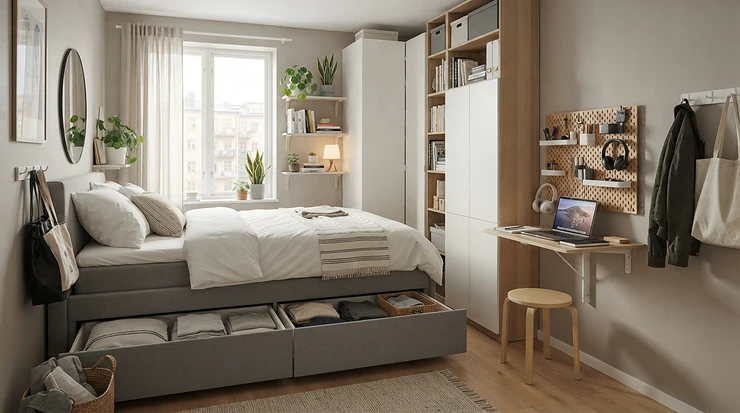
Picture a bedroom eight feet wide, a bed that swallows half the floor, and a wall where a closet should be. Nothing there but paint. That’s the moment the clothing armoire vs closet organizer for small bedrooms debate stops being theoretical and starts deciding whether your mornings feel like getting dressed or like excavating a laundry dig site.
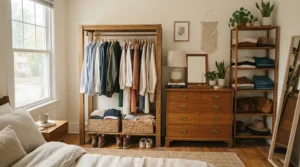
Here’s the quick version. An armoire is a box with doors. It hides the mess, looks like furniture, and keeps dust off your clothes. A closet organizer is a skeleton of rods, shelves, and drawers. It’s cheaper, lighter, and usually holds more per square foot, but everything you own is on display.
Neither is the universal winner, and anyone who tells you otherwise is selling one of them. Home-improvement editors have long pointed renters toward armoires, portable closets, and freestanding systems as the fastest fix when the walls won’t give you a closet. The real question is which one fits your floor plan, your wardrobe, and your tolerance for visual clutter.
This guide covers seven real products, from slim steel cabinets to open rod-and-drawer systems. It also covers the tradeoffs in plain language and a safety rule you shouldn’t skip. Prices appear as ranges only, because they move constantly. Check current price on each listing before you buy.
Quick Comparison: Armoire vs Closet Organizer at a Glance
Start with the cheat sheet, then we’ll earn every row of it.
| Factor | Clothing Armoire | Freestanding Closet Organizer |
|---|---|---|
| Footprint | Often 30-36″ wide, roughly 18-24″ deep | Can go as narrow as ~25″ wide; depth varies |
| Visual impact | Reads as furniture; doors hide everything | Open; clothing is the decor |
| Dust protection | High (enclosed) | Low unless you add covers or curtains |
| Hanging capacity | Moderate; one rod is typical | Often higher; multiple rods common |
| Assembly | Flat-pack, longer build, heavier | Usually faster, lighter to move |
| Typical price tier | Budget to premium | Budget to mid-range |
| Best For | Renters who want a “closed” look and dust protection | Big wardrobes, tight floor space, bargain hunters |
Read that table as a tradeoff, not a scoreboard. The armoire wins on tidiness and protection, while the organizer wins on capacity per square foot and price. If your bedroom is under roughly 10 by 10 feet and you own a lot of hanging clothes, the organizer usually stretches further. If you value a calm, finished-looking room, the armoire earns its extra cost.
💬 Just one click — help others make better buying decisions too!😊
Top 7 Clothing Armoires and Closet Organizers for Small Bedrooms: Expert Analysis
These seven span the enclosed and open worlds. Four are classic armoires and three are open closet systems, so you can compare the two camps with real products rather than abstractions. Every spec below comes with what it means for an actual bedroom.
1. Letaya 71″ Metal Armoire — slimmest footprint in the lineup
The headline is the slim shape: roughly 31.5 inches wide and 17.72 inches deep, per a published roundup of this model. That’s compact enough to tuck along a short wall without hijacking the room. Inside, you get a hanging rod, shelves, and two drawers at the base, a mini reach-in closet in cabinet form.
What does that mean in practice? Shirts, blazers, and jeans hang comfortably. A floor-length coat won’t, and the 18-inch depth means bulky parkas may press against the doors. Based on the spec comparison, this suits a solo renter in a room around 10 by 10 feet who owns more tops than gowns.
Roundups and retailer listings consistently describe it as an easy answer for closet-less bedrooms. I couldn’t verify individual Amazon review text for this model, so treat that as general sentiment, not a rating. Steel flat-pack cabinets usually reward patient assembly, so budget an afternoon.
Pros:
- ✅ Narrow width fits short walls
- ✅ Hanging rod plus two drawers
- ✅ Metal frame suits frequent movers
Cons:
- ❌ Shallow depth squeezes bulky coats
- ❌ Limited length for long dresses
Ballpark tier: budget, think low-to-mid $100s, but check current price. Verdict: strong value if your clothes are mostly short-hang.
2. Sauder Palladia Armoire — most furniture-like look for a bedroom
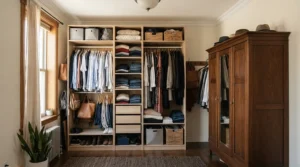
This is the armoire for people who dislike the “I bought a cabinet” vibe. Published roundups describe a single wide hanging rod, a shelf, and a drawer behind doors, in finishes like Vintage Oak. The pitch is that it reads as a bedroom furniture piece rather than a storage unit.
The single wide rod matters more than it sounds. It means one person’s everyday rotation hangs without bunching, and the shelf and drawer take folded basics. For a shared room, one roundup suggests it handles the primary person’s clothes while the other’s off-season items go in the leftover space. That’s an honest ceiling: this isn’t a two-adult wardrobe.
Where it earns its price is appearance and enclosure. Doors hide clutter completely, which keeps a tiny room feeling calm. The tradeoff is a bigger visual presence than a slim steel cabinet, so measure the wall before you fall for the finish.
Pros:
- ✅ Looks like real bedroom furniture
- ✅ Full-width rod for easy hanging
- ✅ Doors hide clutter completely
Cons:
- ❌ Heavier and bulkier to place
- ❌ Not enough for two wardrobes
Ballpark tier: mid-range, think a few hundred dollars, check current price. Verdict: worth it when aesthetics matter as much as storage.
3. VOWNER 71″ Armoire with Mirror and Drawers — mirror, drawers, and rod in one cabinet
The standout is consolidation. A mirror, three drawers, and a hanging rod live in one tall cabinet, which removes the need for a separate full-length mirror eating wall space. In a small bedroom, that’s one fewer object to place.
Here’s what the spec sheet won’t tell you, but roundup reviewers note: the white finish brightens a tight room, and decorative knobs make it look pricier than it is. The flip side is a warning. One published review cautions that the rod may eventually sag if you hang heavy winter coats or several suits. That’s the realistic ceiling for budget engineered-wood construction.
Based on the spec comparison, this fits someone with lighter clothing, a love of drawers for folded items, and no spare wall for a mirror. If your wardrobe leans heavy on wool coats, look at the metal options instead.
Pros:
- ✅ Built-in mirror saves wall space
- ✅ Three drawers for folded basics
- ✅ Bright finish lifts small rooms
Cons:
- ❌ Rod may sag under heavy coats
- ❌ Drawers reduce hanging height
Ballpark tier: budget-to-mid, low-to-mid $100s up to around $250, check current price. Verdict: great value for light-to-medium wardrobes.
4. winiowa Metal Armoire Wardrobe with Mirror Doors — metal frame built to survive moves
The metal frame and mirror doors are the pitch. Roundups recommend it for anyone with a small bedroom and limited closet space who wants a mirror built in and a frame that survives relocations.
Why does the frame matter? Flat-pack wood can loosen with every disassembly. A steel frame generally tolerates being taken apart and rebuilt better, which matters if you rent and move every year or two. Mirror doors also double the sense of space in a narrow room, an old decorator’s trick that works.
Reviewers in published roundups consistently call it a smart pick when you need both a mirror and clothing storage. I couldn’t verify detailed Amazon review text for this exact listing. Confirm door-swing clearance, because mirrored doors that can’t fully open are an annoyance you’ll notice daily.
Pros:
- ✅ Mirror doors enlarge the room visually
- ✅ Metal frame handles repeated moves
- ✅ Enclosed cabinet blocks dust
Cons:
- ❌ Door swing needs floor clearance
- ❌ Fingerprints show on mirrored panels
Ballpark tier: budget-to-mid, check current price. Verdict: a solid pick for renters who relocate.
5. IRONCK Freestanding Closet System with 3 Wood Drawers — open system with real drawer storage
Now we cross to the other camp. This one pairs adjustable shelves and a hanging rod with three wood drawers, in a rustic maple finish. It’s marketed for small closets and no-closet rooms alike.
The drawers are the clever part. Most open systems force you to fold everything onto shelves, which gets messy fast. Drawers hide socks and underwear, so the open section can focus on hanging clothes and a few styled shelves. That makes the open look far more livable.
One roundup reviewer described setting it up in a guest bedroom with zero closet space and having it fully functional within an afternoon. That’s a single anecdote, so don’t treat it as proof. Open frames also need tidy clothes to look good, since nothing hides a pile.
Pros:
- ✅ Three drawers hide small items
- ✅ Adjustable shelves flex with needs
- ✅ Open design is quick to access
Cons:
- ❌ Exposed clothes gather dust
- ❌ Looks messy if overloaded
Ballpark tier: mid-range, check current price. Verdict: best hybrid for open-system fans.
6. Tribesigns Heavy Duty Garment Rack Closet — most storage points for the money
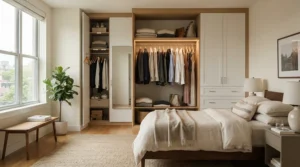
The standout is variety: four drawers, eight hooks, and storage shelves around a heavy-duty rack. The hooks turn bags, belts, and scarves into functional storage rather than clutter.
That’s real-world value. In a closet-less room, accessories are what usually end up draped over the chair. Eight hooks give them a home. Roundups flag the open design as the main drawback because it exposes clothing to dust. A cheap fix: a lightweight garment cover over the least-worn rows.
For a college student, a roommate share, or a first apartment, this is a wardrobe, dresser, and coat rack rolled into one frame. It’s less suited to someone who wants a hidden, tranquil bedroom.
Pros:
- ✅ Four drawers plus eight hooks
- ✅ Heavy-duty rack frame
- ✅ Replaces dresser and coat rack
Cons:
- ❌ Open design collects dust
- ❌ Visual clutter in tiny rooms
Ballpark tier: budget-to-mid, check current price. Verdict: strong for maximalist storage on a budget.
7. Homieasy 25″ Closet System — narrowest tower with two hanging rods
The standout is width: about 25 inches, with two hanging rods and three adjustable shelves. The manufacturer says it holds roughly 150 garments and bears up to 600 pounds. Treat those as marketing claims, not guarantees.
The two-rod layout is the smart trick for small rooms. Short items like shirts and folded pants can hang double-decker, which nearly doubles hanging capacity for short garments. Five levels of shelf adjustment let you reshape it as your wardrobe changes.
Ratings on one retailer listing average around 4.5 out of 5, but the pool is small, so that’s a hint rather than a verdict. For a narrow wall, a hallway, or a studio corner, it’s tough to beat on footprint. It won’t hide clothes, so edit your wardrobe first.
Pros:
- ✅ Slim 25-inch width
- ✅ Two rods double short-hang space
- ✅ Adjustable shelves reconfigure easily
Cons:
- ❌ No doors; everything is visible
- ❌ Small review pool on listings
Price: around the $100-$130 range at the time of research, check current price. Verdict: excellent value for tight spaces.
Here’s how the seven stack up side by side.
| Product | Type | Hanging Setup | Dust Protection | Ballpark Tier | Best For |
|---|---|---|---|---|---|
| Letaya 71″ Metal Armoire | Armoire | Single rod + 2 drawers | High | Budget | Solo renters, short-hang wardrobes |
| Sauder Palladia Armoire | Armoire | Wide rod + shelf + drawer | High | Mid-range | Furniture-look lovers |
| VOWNER 71″ Armoire with Mirror and Drawers | Armoire | Rod + 3 drawers + mirror | High | Budget-mid | Light wardrobes, no mirror wall |
| winiowa Metal Armoire Wardrobe with Mirror Doors | Armoire | Rod + mirror doors | High | Budget-mid | Frequent movers |
| IRONCK Freestanding Closet System with 3 Wood Drawers | Open system | Rod + shelves + 3 drawers | Low | Mid-range | Hybrid open-and-drawer fans |
| Tribesigns Heavy Duty Garment Rack Closet | Open system | Rack + 4 drawers + hooks | Low | Budget-mid | Accessories, roommate shares |
| Homieasy 25″ Closet System | Open tower | Two rods + 3 shelves | Low | Budget | Narrow walls, studios |
Looking at the comparison above, the Letaya 71″ Metal Armoire and Homieasy 25″ Closet System are the budget champions for tight footprints. The first hides everything, the second hides nothing. If you want the furniture look, the Sauder Palladia Armoire justifies its higher tier. Buyers with heavy coats should favor metal frames like the winiowa Metal Armoire Wardrobe with Mirror Doors over lighter engineered-wood builds like the VOWNER 71″ Armoire with Mirror and Drawers.
✨ Don’t Miss These Exclusive Deals!
🔍 Ready to settle the clothing armoire vs closet organizer for small bedrooms question for your own room? Click any highlighted product above to check current pricing and availability. A well-chosen piece will turn that blank wall into the best-organized corner of your home!
What Is a Clothing Armoire vs Closet Organizer for Small Bedrooms?
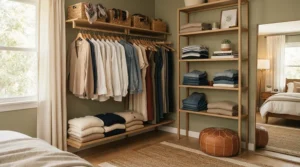
A clothing armoire is a freestanding, enclosed cabinet with doors, a hanging rod, and often drawers. A closet organizer is an open or semi-open freestanding frame of rods, shelves, and drawers. In small bedrooms, the armoire hides clutter and tends to look like furniture, while the organizer packs more hanging and shelf space into less floor area.
Vocabulary muddies this fast. Retailers use “armoire” and “wardrobe” almost interchangeably. One furniture guide notes that an armoire traditionally has furniture-style detailing, while “wardrobe” is the broader term for any freestanding clothing cabinet.
That’s why the phrase wardrobe armoire vs closet system keeps showing up in searches. In practice, it’s the same debate: enclosed cabinet versus open frame.
How to Choose Between a Clothing Armoire and a Closet Organizer
Follow these steps in order. Each one narrows the field.
- Measure the wall, not the room. The usable footprint is wall width plus door-swing clearance. A 31.5-inch cabinet with doors that swing wide needs more than 31.5 inches of floor.
- Check your longest garment. If you own full-length coats or gowns, confirm the hanging height. Bottom drawers eat vertical rod space.
- Count hanging versus folded. Mostly hanging? An organizer with two rods wins. Mostly folded? An armoire with drawers or shelves works.
- Decide on visibility. Open frames look intentional only when clothes are edited. If you hate seeing everything, choose doors.
- Mind the depth. Roughly 18 to 24 inches deep is the common sweet spot, depending on hanger direction and walkway room.
- Plan the delivery path. Tall flat-packs still have to pass your stairwell and door frame.
- Budget for anchoring. Tip-over protection isn’t optional (more on that below).
Use those seven steps like a filter, and most people land on one type before they even open a shopping tab.
Wardrobe Armoire vs Closet System: Which Wins in a Small Room?
Think of it as a trade between control and capacity. A wardrobe armoire controls your environment: doors keep out dust, hide imperfect folding, and let the room look finished. A closet system controls your space: its open design squeezes in more hanging length and shelf area per square foot.
For a bedroom around 10 by 10 feet, I’d lean organizer when the wardrobe is large and the walls are scarce, and armoire when the wardrobe is modest and the look matters. The deciding factor is rarely price. It’s whether you can live with the sight of your own clothes at 7 a.m.
| Alternative | Pros | Cons | Best For |
|---|---|---|---|
| Clothing armoire | Hides clutter, dust-resistant | Heavier, fixed layout | Calm, finished-looking rooms |
| Closet organizer | Cheaper, flexible, high capacity | Open, dust-prone | Big wardrobes, tight floors |
| Built-in closet | Permanent, uses wall space | Not renter-friendly | Owners, long-term homes |
| Garment rack alone | Lowest cost, instant | No drawers, very visible | Temporary setups |
The takeaway: freestanding pieces beat built-ins for renters, because you take them when you leave. A bare garment rack is the cheapest fix but gives up drawers entirely. Armoires and organizers hit the middle ground, which is why this comparison matters.
Freestanding Closet Furniture: What the Category Really Covers
Freestanding closet furniture is a wide umbrella. It includes armoires, wardrobes, open closet towers, garment racks with shelves, and modular systems. What unites them is that none require tools beyond a screwdriver, and none require your landlord’s blessing.
Editors at Reader’s Digest describe a freestanding closet system as essentially a portable closet without the walls, and note that a large freestanding wardrobe can even double as a room divider in a studio. That’s a useful second job. A cabinet with its back to the sleeping area creates a pseudo-wall.
The catch: freestanding means weight and stability matter. A tall, narrow unit loaded unevenly is a tip-over risk. The better pieces include wall anchors and stability features, which is why the safety section below deserves a slow read.
The No-Closet Bedroom Solution: Building a “Closet” Out of Furniture
The no-closet bedroom solution isn’t a single product, it’s a system. In a city where a legal bedroom doesn’t need a closet at all, real estate pros and organizers keep landing on the same answer. StreetEasy calls an armoire or wardrobe the top choice when you can spare a little floor space, thanks to built-in organization and personality.
Here’s the layered approach that works:
- Hanging zone: one armoire or organizer for anything that needs a hanger.
- Folded zone: a dresser or the drawers built into your cabinet.
- Overflow zone: under-bed bins for off-season items.
- Entry zone: wall hooks for the bag and coat you grab daily.
One layout guide for rooms without closets suggests splitting jobs, so one cabinet handles hanging and a separate dresser or rack handles the rest, rather than asking a single piece to carry everything. That’s wise. A cabinet doing three jobs usually does all three badly.
Hanging Rod Storage: What Actually Holds Up
Hanging rod storage is the heart of any closet substitute, and it’s where cheap pieces cut corners. The rod needs to hold weight without bowing, and it needs enough clearance below the shelf above it for your garments to hang straight.
Two realities matter. First, rod material: one published review warns that a particleboard-style rod can sag over time under heavy coats or multiple suits. Metal rods generally tolerate more. Second, drawers: when the bottom foot or so of a cabinet is drawers, your remaining hang height shrinks. Measure your longest garment, then subtract the drawer block.
Open organizers with two rods turn this into a clever puzzle. Short items double-stack, and the saved space goes to a long-hang zone on the side. Spread weight evenly, avoid overloading a single rod, and treat manufacturer capacity numbers as best-case.
Freestanding Wardrobe Features That Actually Matter (And Those That Don’t)
A freestanding wardrobe sells itself on features. Most don’t matter. A few do.
Features that matter:
- Rod strength and material. Sagging is the number one long-term annoyance.
- Interior depth. Around 18 inches is workable; less than that and hangers jam.
- Wall-anchor hardware. It’s a safety feature, not a bonus.
- Door clearance. Mirrors and swing doors need floor room.
- Adjustable shelves. Flexible interiors outlast your changing wardrobe.
Features that mostly don’t:
- Decorative knobs. Nice, but replaceable.
- Built-in LED strips. A novelty unless you’re dressing in the dark.
- Giant weight-capacity claims. Treat them as marketing, not a promise.
- Exotic finishes. A matte white cabinet and a “rustic maple” one hold identical amounts of clothing.
Filter by function first, finish last. A beautiful cabinet with a sagging rod is just an expensive reminder.
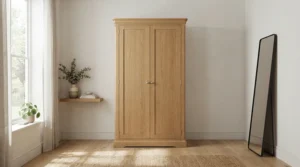
Practical Usage Guide: Your First 30 Days With a Freestanding Wardrobe
Buying is the easy part. Here’s how to make it work.
Day 1: build and anchor. Assemble on a flat floor, then secure it to the wall before you load a single hanger. Use studs where possible.
Days 2–3: edit before you fill. Pull everything out and sort into keep, donate, and off-season. Small-room wardrobes only work with an edited collection.
Days 4–7: load with logic. Put heavy items low and light items high. Hang by category, not by color alone, so mornings stay fast.
Weeks 2–3: standardize hangers. Matching slim hangers can free a surprising amount of rod length, and they stop the “mismatched hanger tangle.”
Week 4: audit. Notice what you never reach for. Move it to under-bed storage.
Maintenance schedule:
- Monthly: wipe surfaces, check for rod bowing.
- Quarterly: tighten screws and recheck the wall anchor.
- Seasonally: rotate off-season items into the hard-to-reach zones.
Common first-month mistakes: overloading one rod, blocking door swing with a hamper, and skipping the anchor. Fix those early, and the piece lasts years longer.
Real-World Scenarios: Which One Fits Your Bedroom?
Three imagined profiles, matched to the options above.
The college renter (9 by 10 room, tight budget). She owns mostly tops, jeans, and a couple of jackets. The Homieasy 25″ Closet System fits a narrow wall, and a garment cover handles dust. If she wants doors, the Letaya 71″ Metal Armoire takes the same footprint with a cleaner look.
The couple in a prewar apartment (10 by 12 room, one closet shared with a hall). They need more than one wardrobe. The IRONCK Freestanding Closet System with 3 Wood Drawers covers hanging plus folded items, and the Tribesigns Heavy Duty Garment Rack Closet takes the overflow and accessories. Together they approximate a real closet.
The remote worker in a studio (one multi-use room). Visual calm matters because the bedroom is also the office. The Sauder Palladia Armoire reads as furniture and hides everything, while its back can help define the sleeping zone. Pair it with under-bed bins for off-season items.
Each profile hinges on the same three questions: how much hanging, how much visibility you can stomach, and how much wall you can spare.
Safety Guide: Tip-Over Rules, Anchoring, and Rental Bedrooms
This is the section that matters most if kids visit. The U.S. Consumer Product Safety Commission adopted a mandatory stability standard under the STURDY Act, based on ASTM F2057-23, covering dressers, armoires, wardrobes, and other clothing storage units. CPSC staff counted 234 deaths from clothing-unit tip-overs between January 2000 and April 2022, including 199 children, plus an estimated 5,300 injuries a year on average.
What the standard tests, in plain terms: stability on carpet, with loaded drawers, with multiple drawers open, and under a simulated weight of a child up to 60 pounds. The rule is aimed at manufacturers, though, and exemptions exist for certain item types. Don’t assume every open rack or shelving tower is covered.
Your job is simple: anchor everything tall to the wall, no matter the label. In a rental, check your lease, since a couple of small screw holes in a stud is usually the safest trade. Load heavy items low, and never let kids climb drawers or shelves.
Common Mistakes When Buying a Closet Substitute
Most regrets come from the same handful of errors.
- Measuring the cabinet, not the swing. Doors that hit the bed are a daily irritation.
- Ignoring depth. A 15-inch-deep cabinet can’t hold standard hangers straight.
- Buying for the wardrobe you wish you had. Size for what you own now.
- Treating the cheapest cabinet as a full closet. A budget cabinet is a partial fix; plan a dresser or rack beside it.
- Overloading the rod. Heavy winter coats need metal and even weight distribution.
- Forgetting delivery access. A tall flat-pack still has to clear your doorway and stairs.
- Skipping the anchor. The one mistake with real consequences.
Print this list or screenshot it. Five minutes of checking beats a return shipment.
Long-Term Cost and Maintenance: Armoire vs Organizer
Think in cost per year, not sticker price. Take an illustrative example: a budget piece in the low-to-mid $100s that lasts five years costs roughly $25–$40 a year. A premium cabinet can run into the thousands. One designer-brand armoire in a published roundup is listed above $5,000, which only makes sense as an heirloom purchase.
For small bedrooms, the budget-to-mid tier is the rational zone. The big hidden costs are moves (steel frames tolerate disassembly better than particle board) and replacement rods. Armoires need occasional hinge and door-alignment tweaks. Open organizers need dust control, so factor in a few garment covers.
If you rent, favor pieces you can take apart and rebuild. If you own and plan to stay, a sturdier mid-range armoire amortizes well. Either way, measure the price against years of use, not the first month’s excitement.
Frequently Asked Questions
❓ How deep should a wardrobe be in a tiny bedroom?
❓ Can a freestanding wardrobe really replace a closet?
❓ Do open closet organizers get dusty?
❓ Do I really need to anchor an armoire in a rental?
❓ Is a closet organizer cheaper than an armoire?
Conclusion: Which Should You Buy?
So, who wins the clothing armoire vs closet organizer for small bedrooms showdown? It depends on you, but the rules are simple. Pick an armoire if you want doors, dust protection, and a room that looks finished. Pick a closet organizer if you own a lot of hanging clothes, have a narrow wall, and don’t mind seeing your wardrobe.
For a quick shortlist: the Letaya 71″ Metal Armoire for slim enclosed storage, the Sauder Palladia Armoire for furniture looks, the IRONCK Freestanding Closet System with 3 Wood Drawers for open-plus-drawers, and the Homieasy 25″ Closet System for the tightest walls. Whatever you choose, anchor it, edit your clothes first, and measure twice.
A closet-less bedroom isn’t a punishment. With the right freestanding piece, it’s a chance to build something better than the closet you never had.
✨ Ready to give your clothes a proper home?
🔍 Click any highlighted product above to check current pricing and availability, and turn that bare wall into the best-organized spot in your bedroom today!
Recommended for You
- TV Armoire For Hiding A Flat Screen In the Bedroom: 7 Best Picks 2026
- Nightstand For Storage In Studio Apartments: 7 Proven Picks (2026)
- Round Nightstand For Small Apartment Bedrooms: 7 Best Picks 2026
Disclaimer: This article contains affiliate links. As an Amazon Associate, I earn from qualifying purchases. If you purchase products through these links, we may earn a small commission at no additional cost to you.
✨ Found this helpful? Share it with your friends! 💬🤗
