
In This Article
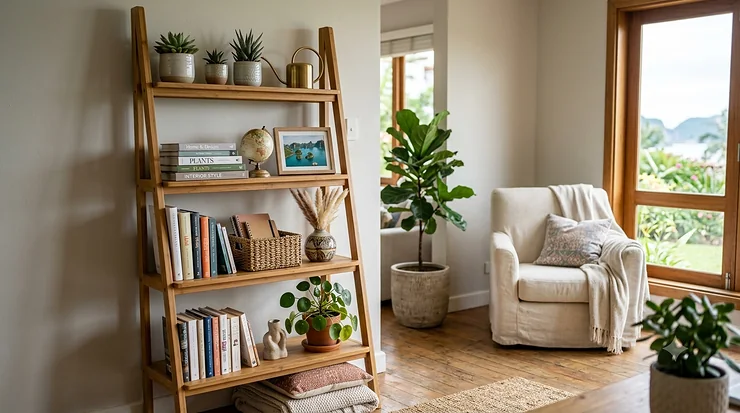
A ladder shelf is a slanted, open-shelving unit shaped like a leaning ladder — narrower at the top, wider at the base — used for books, plants, or decor. That’s the textbook version anyway. In practice, it’s the piece of furniture that quietly solves the “I have books and nowhere to put them” problem without eating up your entire wall. If you’ve spent an evening scrolling through a hundred nearly-identical listings trying to find the best ladder shelf for your actual living room (not some staged photo with a fiddle-leaf fig in the corner), you already know the real challenge isn’t finding a ladder shelf. It’s finding one that won’t wobble the second you set a stack of hardcovers on it.
This guide skips the fluff and gets into the specifics: steel versus rubberwood frames, what “213 lb static load” actually means for your paperback collection, and why some 5-tier designs feel sturdier than 4-tier ones that cost more. We researched real listings, real specs, and real aggregated buyer sentiment — not invented reviews — to land on seven models spanning budget, mid-range, and premium builds. According to basic engineering principles behind shelving units, weight capacity and vertical spacing between tiers matter more than the finish, and that’s exactly where we started our comparison.
Whether you’re after a compact ladder bookshelf for a studio apartment, a leaning ladder shelf for a reading nook, or a tiered stand for a decorative display of plants and framed photos, there’s a real, currently-available option below matched to your space and budget.
Quick Comparison: Best Ladder Shelf at a Glance
| Product | Tiers | Frame Material | Best For | Price Range |
|---|---|---|---|---|
| VASAGLE BARNET | 4-tier | Steel + particleboard | Heaviest static load | Mid $60s–$90s |
| Amazon Basics Rubberwood | 5-tier | Solid rubberwood | Best all-around value | Mid $70s–$100s |
| HOOBRO with Storage Boxes | 5-tier | Metal + particleboard | Hiding small clutter | Mid $80s–$110s |
| Furinno Ladder Bookcase | 5-tier | Particleboard | Lightest, most budget-friendly | Under $60 |
| AQIMUELE Walnut | 5-tier | Solid wood w/ edges | Decorative styling | Mid $90s–$130s |
| Casual Home Solid Wood | 5-tier | 100% solid wood | Premium, heirloom build | $150s–$200s |
| HOOBRO Wall Leaning | 5-tier | Wood + metal frame | Narrow bathrooms & small spaces | Mid $50s–$80s |
Looking at the table, the clearest split is between engineered-wood budget picks and solid-wood premium builds — and that split predicts almost everything else about how each shelf will hold up. If your books are mostly paperbacks and decor knick-knacks, the lighter, cheaper options genuinely hold up fine; if you’re storing hardcovers, vinyl records, or heavier planters, the steel-reinforced or solid-wood options are worth the jump in price. Note that Amazon rotates pricing constantly, so treat every figure here as a snapshot rather than gospel — always check the current price before buying.
💬 Just one click — help others make better buying decisions too!😊
💬 Found a pick you like already? Scroll down for direct specs on each one below!
Top 7 Best Ladder Shelves: Expert Analysis
1. VASAGLE BARNET Collection 4-Tier Ladder Shelf — sturdiest frame for heavy loads
The BARNET’s steel frame paired with two X-shaped reinforcement bars in the back is what separates it from most particleboard-and-hope competitors. At 13.6″D x 22″W x 54.1″H, it’s compact enough for a home office corner but rated for a genuinely impressive 213 lb total static load across all four tiers — more than double what many entry-level ladder shelves claim.
What that spec means in practice: you can load the bottom two shelves with actual hardcover encyclopedias or a small printer without feeling like the whole unit is one bump away from collapse. The 13-inch gap between shelves also fits oversized art books and tall vases, something a lot of tighter-spaced competitors can’t handle. Based on the spec comparison, this is the pick for anyone who’s outgrown flimsier units and wants something that reads as furniture, not a temporary fix.
Reviewers consistently note that assembly takes 15–30 minutes solo thanks to labeled parts, and that the anti-tip kit genuinely gets used rather than tossed in a drawer — a detail that matters given how top-heavy loaded ladder shelves can get. A recurring theme in aggregated feedback is that the rustic-brown-and-black finish reads more “intentional industrial” than “flat-pack generic” once assembled.
Pros:
- ✅ 213 lb total static load beats most competitors by a wide margin
- ✅ X-bar reinforcement noticeably reduces wobble under weight
- ✅ Solo assembly in under 30 minutes with labeled hardware
Cons:
- ❌ 4 tiers only, so less vertical display space than 5-tier rivals
- ❌ Particleboard panels shouldn’t sit in direct sun or rain exposure
At a price generally landing in the mid $60s to $90s range, the value case is strong if load-bearing capacity is your top priority. Check current pricing directly, since VASAGLE frequently rotates finish-specific listings.
2. Amazon Basics 5-Tier Ladder Bookshelf — best all-around solid wood value
This one earns its “best all-around” tag by doing the unglamorous thing well: solid rubberwood construction at a price point where most competitors cut corners with particleboard. At 14″D x 24.8″W x 70.1″H, it’s taller than most picks on this list, which translates to real extra shelf-inches for a growing book collection.
Each shelf supports up to 44 lbs — meaningfully more than the entry-level particleboard units nearby on this list — and the solid rubberwood frame resists the sagging that thinner composite shelves develop over a year or two of heavy use. What most buyers overlook about this model is that “Amazon Basics” doesn’t mean stripped-down here; the frame quality rivals shelves costing 40% more.
Aggregated buyer sentiment points to straightforward assembly with included hardware and clear instructions as a consistent strength, alongside praise for how the espresso, walnut, and white finish options blend into different room styles without looking like obvious flat-pack furniture.
Pros:
- ✅ Solid rubberwood frame instead of particleboard at this price
- ✅ 44 lb per-shelf capacity, well above typical budget competitors
- ✅ Tallest option on this list at 70.1″, maximizing vertical storage
Cons:
- ❌ 70.1″ height needs a room with adequate ceiling clearance
- ❌ Narrower depth (14″) limits how far books can protrude
Typically priced in the mid $70s to low $100s depending on finish, this is the shelf we’d point most first-time buyers toward — it rarely disappoints and rarely overspends.
3. HOOBRO 5-Tier Ladder Bookshelf with 2 Storage Boxes — best for hiding small clutter
The defining feature here isn’t the ladder shape — it’s the two enclosed storage boxes built into the lower tiers, which solve a problem open shelving can’t: where to put the stuff you don’t want on display. The stable metal frame with adjustable feet handles uneven flooring, a detail apartment dwellers with older hardwood will appreciate.
Here’s what to weigh: an all-open ladder shelf looks great in photos but becomes a catch-all for remote controls, chargers, and mail within a month. HOOBRO’s boxed lower tiers give you two dedicated “hide it” zones while keeping the upper shelves open for books and decor — a hybrid approach that’s more practical for daily living than pure open shelving.
Reviewers consistently report that the rustic brown finish resists visible scuffing better than expected for the price tier, and that the metal legs feel noticeably sturdier than the particleboard-only competitors nearby in the same price bracket.
Pros:
- ✅ Two enclosed storage boxes for out-of-sight clutter
- ✅ Metal frame legs with adjustable feet for uneven floors
- ✅ Retro-modern finish that hides everyday scuffs well
Cons:
- ❌ Storage boxes reduce usable open-shelf space by two tiers
- ❌ Slightly heavier overall, making repositioning more of a chore
Generally priced in the mid $80s to $110s range, this is the practical pick for anyone who wants a ladder shelf that also functions as a catch-all organizer.
4. Furinno 5-Tier Ladder Bookcase Display Shelf — lightest and most budget-friendly
Furinno built its reputation on furniture that’s cheap without being flimsy in the ways that actually matter, and this ladder bookcase follows the formula. At 23.6″W x 53.5″H x 13″D, the tiered weight ratings are refreshingly specific: 35 lbs on the bottom shelf, 20 lbs in the middle, and 15 lbs up top — a distribution that mirrors how people actually load a ladder shelf in real life (heavy stuff low, light decor high).
The spec sheet won’t tell you this, but user reports suggest the biggest advantage here isn’t strength — it’s how genuinely painless assembly is compared to steel-frame competitors, often finishing in well under 20 minutes without a second pair of hands. That matters enormously for renters, students, or anyone who moves apartments more than once every few years.
Aggregated reviews commonly mention the lightweight profile as a double-edged trait: easy to reposition on a whim, but noticeably less rigid than metal-reinforced options when fully loaded on the top tier.
Pros:
- ✅ Tiered weight ratings matched to realistic real-world loading
- ✅ Fastest, easiest assembly of any pick on this list
- ✅ Lightweight enough to reposition without help
Cons:
- ❌ Top tier feels less rigid than steel-reinforced competitors
- ❌ Particleboard construction is less forgiving of moisture
Usually available under $60, this is the pick for dorms, first apartments, or anyone who just needs functional shelving without a long-term commitment.
5. AQIMUELE Walnut Wooden 5-Tier Ladder Shelf with Edges — best for decorative styling
AQIMUELE’s standout feature is genuinely simple but underrated: raised edges (lips) along each shelf that keep smaller decor items — votive candles, small plants, framed photos — from sliding off during everyday bumps. The walnut finish also reads noticeably more furniture-grade than most particleboard-and-veneer competitors in a similar price bracket.
Based on the spec comparison, the leaning, open-tier design widens progressively from top to bottom, which is a deliberate choice that gives smaller decorative objects more breathing room up top while reserving the sturdier bottom shelves for heavier items like books or baskets. This is the model we’d point toward anyone building a curated shelf display rather than a working bookcase.
A common thread in aggregated review sentiment is appreciation for how the walnut tone photographs well for home-styling content, alongside occasional notes that the narrower top shelf limits what larger decor pieces can fit up there.
Pros:
- ✅ Raised shelf edges prevent small decor items sliding off
- ✅ Walnut finish looks and photographs like real furniture
- ✅ Widening tier design suits layered decorative styling
Cons:
- ❌ Narrower top shelf restricts larger decorative objects
- ❌ Not the top pick if heavy book storage is the main goal
Typically priced in the mid $90s to $130s, this is worth the premium if the shelf is meant to be seen as much as used.
6. Casual Home 100% Solid Wood 5-Shelf Ladder Bookcase — best premium heirloom build
Where most of this list uses particleboard, engineered composite, or veneer, Casual Home’s 72″ ladder bookcase is built from genuinely solid wood throughout — a meaningful upgrade for anyone who’s watched a cheaper bookcase sag or delaminate after a couple of humid summers. The warm brown finish leans traditional rather than industrial, which fits homes that don’t want the exposed-steel aesthetic several other picks lean into.
What most buyers overlook about solid-wood construction is that the value shows up years down the line, not on day one: no sagging mid-shelf under a row of hardcovers, no swelling at exposed edges, and screws that hold their grip through multiple reassemblies if you move. On paper this means a higher upfront cost but a genuinely longer usable lifespan than composite alternatives.
Reviewers consistently describe the finish as living up to photos rather than looking cheaper in person, a common complaint with budget composite shelves, and note that the extra weight of solid wood construction translates to noticeably less wobble even without wall anchoring.
Pros:
- ✅ 100% solid wood resists sagging and swelling long-term
- ✅ Traditional warm brown finish suits non-industrial decor
- ✅ Heavier build means less wobble even before anchoring
Cons:
- ❌ Highest price point of any pick on this list
- ❌ Solid wood adds significant weight for moving day
Generally priced from the $150s to $200s, this is the buy-it-once option for anyone furnishing a permanent home rather than a short-term rental.
7. HOOBRO 5-Tier Wall Leaning Ladder Shelf — best for narrow bathrooms and small spaces
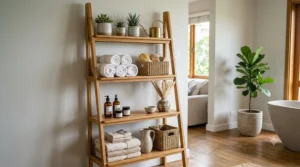
This natural-finish HOOBRO model leans into (literally) the narrowest footprint on this list, standing 58.3″ tall while staying slim enough to slide into a bathroom corner, a hallway nook, or beside a toilet without crowding the room. It’s marketed as a “multifunctional plant stand,” and the shallow depth backs that up — this is built for narrow zones, not deep book storage.
Here’s what to weigh: the trapezoidal, wall-leaning silhouette genuinely maximizes vertical storage in spaces where floor footprint is the scarce resource, which is exactly the scenario most rectangular bookcases handle poorly. Reviewers consistently note it works well for towels, toiletries, and small plants in bathrooms — a use case most of the taller, book-focused picks on this list weren’t designed for.
A recurring theme in aggregated feedback is appreciation for how unobtrusive the natural wood tone is in small rooms, paired with occasional notes that the shallow shelf depth isn’t ideal for oversized hardcovers or wide storage bins.
Pros:
- ✅ Slim, narrow footprint built for tight bathroom corners
- ✅ Wall-leaning design maximizes vertical space, not floor space
- ✅ Natural finish blends into small rooms without dominating
Cons:
- ❌ Shallow shelf depth limits large book or bin storage
- ❌ Requires wall attachment to achieve its rated stability
Commonly priced in the mid $50s to $80s, this is the pick for anyone solving a small-space storage problem rather than building a full home library.
Practical Usage Guide: Setup, Maintenance & Optimization
Getting a ladder shelf from box to functional furniture goes smoother with a few tricks the instruction manual won’t mention. First, assemble the unit in the room it’ll actually live in, not the hallway — ladder shelves are awkward to carry fully built, and repeated flexing during a move can loosen joints before you’ve even loaded a single book. Second, always install the included anti-tip kit before you load anything, not after; it takes five extra minutes and it’s the single most-skipped step according to aggregated review complaints about wobbling.
For the first 30 days, resist the urge to max out every shelf immediately. Load the bottom two tiers first and live with it for a week — this lets you gauge real-world stability before committing your full book collection to the top-heavy upper shelves. A common mistake is loading the top shelf with your heaviest items because “it’s out of the way,” when the opposite distribution (heavy low, light high) is what actually keeps a leaning ladder shelf stable long-term.
Maintenance is minimal but not zero: wipe particleboard or veneer finishes with a barely-damp cloth, never a wet one, since standing moisture is the number one cause of swelling and delamination in engineered-wood shelves. Solid wood picks like the Casual Home bookcase tolerate an occasional light wood polish, but check adjustable feet every few months — uneven flooring gradually loosens them, and a five-second twist prevents the slow lean that eventually strains the anti-tip anchor.
Real-World Scenarios: Which Ladder Shelf Fits Your Life
Consider a grad student in a 400-square-foot studio who moves every August. Budget is tight, and the shelf needs to survive at least two moves without falling apart. The Furinno 5-Tier or the HOOBRO Wall Leaning model both make sense here — lightweight, inexpensive enough that a scratch during moving day isn’t a tragedy, and simple enough to reassemble solo in a new apartment without tools left behind in a packed box.
Now picture a couple furnishing a first home they plan to stay in for a decade, with a growing hardcover collection and a home office corner that needs real storage. The VASAGLE BARNET or the Casual Home Solid Wood bookcase fit better — both are built to hold serious weight without sagging, and the higher upfront cost amortizes over years rather than a single lease term.
Finally, think about someone styling a reading nook or a plant corner for the aesthetic as much as the function — someone who wants the shelf itself to be a design statement, not just storage. The AQIMUELE Walnut model, with its raised edges and progressively widening tiers, is built exactly for that kind of curated decorative display rather than dense book storage.
✨ Don’t Miss These Exclusive Deals!
🔍 Ready to upgrade your space? Click on any highlighted pick above to check current pricing and availability, and turn that empty corner into the storage-meets-style solution your room’s been missing!
Buyer’s Decision Framework
If your top priority is maximum weight capacity, choose a steel-framed model like the VASAGLE BARNET, because the X-bar reinforcement and 200+ lb rating handle hardcovers and heavier decor without stress. If you’re furnishing a long-term home and want furniture that lasts a decade, choose 100% solid wood like the Casual Home bookcase, because composite materials degrade under repeated humidity cycles that solid wood resists.
If you move frequently or live in a small rental, choose the lightest option that still meets your load needs, since repeated disassembly stresses composite joints more than solid frames — the Furinno or HOOBRO Wall Leaning models minimize that risk through simpler builds. If the shelf’s job is mostly to look good — plants, framed photos, curated objects — prioritize models with raised shelf edges and a finish that photographs well, like the AQIMUELE Walnut, over raw weight capacity.
A simple priority checklist: weight capacity first if you’re storing books or heavy decor, footprint first if space is tight, finish and edge design first if the shelf is primarily decorative, and total cost of ownership first if you plan to keep the piece for years rather than one lease cycle.

How to Choose the Best Ladder Shelf
Picking the right ladder shelf comes down to matching seven practical factors to how you’ll actually use it, rather than chasing whichever listing has the most five-star reviews.
- Check the per-shelf and total static load rating, not just the overall dimensions — a shelf rated for 20 lbs per tier won’t survive a stack of hardcovers no matter how sturdy it looks in photos.
- Measure your ceiling clearance and depth, since ladder shelves range from 50″ to over 70″ tall and 11″ to 15″ deep, and a too-tall unit in a low room reads as cramped rather than striking.
- Match frame material to your load type — steel and solid wood for books and heavier decor, lighter particleboard or bamboo for plants and lightweight display objects.
- Confirm an anti-tip kit is included, since federal safety guidance on furniture tip-overs specifically recommends anchoring tall, top-heavy furniture like ladder shelves to the wall.
- Consider tier count versus tier spacing — a 5-tier shelf with cramped 9″ gaps holds less usable book height than a 4-tier shelf with 13″ spacing, despite the lower number.
- Decide between open shelving and enclosed storage, since fully open designs look cleaner but offer nowhere to hide daily clutter, unlike hybrid models with built-in boxes.
- Factor in assembly difficulty and your moving timeline, since composite, tool-light assemblies suit renters while steel or solid-wood builds suit long-term homeowners.
Ladder Bookshelf vs Traditional Bookcase: The Real Differences
A ladder bookshelf and a traditional rectangular bookcase solve the same core problem — vertical book storage — but they trade off differently on footprint, capacity, and style. A traditional bookcase is a straight-sided box with uniform shelf widths stacked evenly, maximizing storage density for a given footprint. A ladder bookshelf angles back from base to top, trading some of that density for a smaller visual footprint and a more open, airy feel in the room.
| Factor | Ladder Bookshelf | Traditional Bookcase |
|---|---|---|
| Floor footprint | Smaller at eye level | Uniform, larger overall |
| Total capacity | Lower per square foot | Higher per square foot |
| Visual weight | Light, open | Heavier, boxier |
| Best for | Small rooms, styling | Large libraries, dense storage |
The analysis here favors ladder shelves for anyone prioritizing visual openness over raw storage density — a real consideration in smaller apartments where a traditional bookcase can make a room feel boxed in. Reviewers migrating from bulky bookcases consistently report that a ladder shelf “opens up” a room simply by exposing more wall and floor space around and behind it, even holding a comparable number of books.
The Angled Design Advantage: Leaning Ladder Shelf Geometry Explained
The angled design isn’t just aesthetic — it’s structural. A leaning ladder shelf’s backward tilt distributes weight toward the wall it rests against, which is precisely why nearly every model on this list ships with an anti-tip kit rather than relying on the angle alone for stability. What the spec sheet won’t tell you is that this tilt also changes how weight should be loaded: because the top tier sits further back and higher, overloading it creates more leverage against the anchor point than an equivalent load on a straight-sided bookcase would.
Practically, this means the angled, leaning silhouette rewards a specific loading pattern — heaviest items on the wide bottom shelf, progressively lighter items as you move up the narrowing tiers. Reviewers consistently note that shelves loaded “top-heavy” against this logic feel noticeably less stable, even when the total weight stays within the rated capacity. The angled design also creates the visual effect buyers usually want from a leaning ladder shelf in the first place: shelves that appear to float outward from the wall rather than stacking as a flat, boxy silhouette.
Is a 5 Tier Ladder Shelf Actually Better? Tier Count Explained
More tiers sound like more value, but a 5 tier ladder shelf isn’t automatically superior to a well-built 4-tier unit — it depends entirely on shelf spacing and total load rating, not the number printed on the listing. Compare the VASAGLE BARNET’s 4 tiers with 13″ of spacing against a 5-tier competitor squeezing five shelves into the same overall height: the 5-tier version often ends up with tighter 9–10″ gaps that can’t fit oversized books or taller decor objects.
What most buyers overlook is that a 5 tier ladder shelf genuinely shines for smaller, uniformly-sized items — paperbacks, framed photos, small plants — where more, shorter shelves beat fewer, taller ones for organizing and separating categories of objects. For oversized art books, file folders, or bulkier decor, a 4-tier shelf with generous spacing often performs better despite the seemingly smaller number. The honest takeaway: count the inches between shelves before counting the tiers themselves.
Common Mistakes When Buying an Open Shelving Ladder Rack
The single most common mistake with open shelving is treating the display shelf like closed storage — piling loose cables, mail, and miscellaneous clutter onto open tiers because there’s available space, then wondering why the “clean, minimalist” look from the product photos never materializes at home. Open shelving rewards curation; it punishes accumulation, since everything placed on it is visible by design.
A second frequent misstep is ignoring weight distribution across an open shelving unit — loading the most-used, heaviest items on a convenient middle shelf rather than the sturdier, wider bottom tier, which stresses the frame unevenly over time. A third: skipping the anti-tip anchor because the unit “seems sturdy enough” on delivery day, only to have a growing collection of books or decor gradually shift the shelf’s center of gravity over months of use. Reviewers who report wobbling issues almost always mention skipping this step in the same breath.
Styling Your Ladder Shelf for Decorative Display
A ladder shelf built for decorative display benefits from a loading logic that’s almost the opposite of a working bookshelf: rather than maximizing storage, the goal is intentional negative space. Design writers covering ladder shelf styling trends consistently point to leaving roughly a third of each tier empty, letting individual objects breathe rather than crowding a shelf edge to edge.
Group objects in odd numbers — threes work especially well — and vary height within each grouping using a tall item, a medium item, and something low and wide, rather than lining up matching-height objects like a row of soldiers. Models with raised shelf edges, like the AQIMUELE Walnut pick, genuinely help here since they let you push smaller objects (candles, small frames) closer to the front edge for a layered look without risking them sliding off during everyday bumps. Rotate a couple of items seasonally — swap in different plants, photos, or textiles — and the same physical shelf reads as a refreshed display several times a year without buying anything new.
Long-Term Cost & Maintenance: What Ladder Shelves Really Cost Over Time
The sticker price is only part of the real cost of a ladder shelf. Particleboard and composite units, while cheaper upfront, typically show sagging or edge-swelling within two to four years of regular use, especially in humid climates or rooms without climate control — at which point replacement, not repair, is usually the only option. Solid wood picks like the Casual Home bookcase cost roughly two to three times more upfront but commonly last well over a decade with nothing more than occasional feet adjustments and the occasional polish.
| Build Type | Typical Upfront Cost | Typical Lifespan | Cost Per Year (rough) |
|---|---|---|---|
| Particleboard / composite | Under $60–$90 | 2–4 years | ~$20–$30/year |
| Steel-reinforced composite | $60–$110 | 4–7 years | ~$12–$20/year |
| 100% solid wood | $150–$200+ | 10+ years | Under $20/year |
Interpreting the table, solid wood’s cost-per-year actually rivals or beats the cheapest composite options once you account for replacement cycles — the premium price buys durability, not just aesthetics. If sustainability matters to your purchase, look for wood sourced under responsible forest management certification, which several solid-wood furniture makers now disclose in their listings, since it signals both material quality and a lower long-term environmental footprint than fast-replaced composite alternatives.
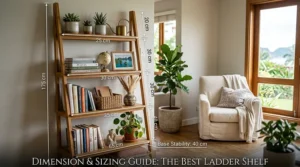
Safety, Regulations & Anti-Tip Compliance Guide
Ladder shelves are exactly the kind of top-heavy, freestanding furniture that federal safety agencies specifically warn about. The Consumer Product Safety Commission’s ongoing tip-over prevention campaign has tracked hundreds of furniture-related fatalities over the past two decades, the large majority involving unanchored furniture with drawers, doors, or shelves — precisely the category a leaning ladder shelf falls into once loaded with books or decor. Every model on this list ships with some form of anti-tip hardware, and installing it isn’t optional busywork; it’s the difference between a decorative accent and a genuine household hazard, especially in homes with young children or pets prone to climbing.
Beyond anchoring, a few practical habits reduce risk further: keep the heaviest items on the bottom shelf regardless of how the unit is styled, avoid placing anything a child might be tempted to climb toward on upper tiers, and re-check anchor tension every few months since drywall anchors can loosen gradually with repeated furniture flexing. None of this requires special tools or expertise — most anti-tip kits install with a screwdriver in under ten minutes, which is a small time investment against a real, well-documented risk.
Frequently Asked Questions
❓ Is a ladder shelf sturdy enough for heavy books?
❓ Do ladder shelves need to be attached to the wall?
❓ What's the difference between a 4-tier and 5-tier ladder shelf?
❓ Can a ladder shelf work in a small bathroom?
❓ How long does a ladder shelf typically last?
Conclusion
The best ladder shelf for you depends less on star ratings and more on how honestly you assess your own load, space, and lifestyle. Renters and frequent movers do better with lightweight, budget-friendly builds like the Furinno or HOOBRO Wall Leaning shelf. Long-term homeowners with growing book collections get more value from steel-reinforced or solid-wood picks like the VASAGLE BARNET or Casual Home bookcase, even at a higher upfront cost. And if the shelf’s real job is styling a room rather than storing a library, the AQIMUELE Walnut’s raised edges and photogenic finish earn their premium.
Whichever model you land on, the two habits that matter most cost nothing extra: install the anti-tip anchor before loading anything, and put your heaviest items on the bottom tier regardless of how you style the rest. Get those two things right, and any of the seven picks above will serve you well for years.
Recommended for You
- 7 Best Floating TV Stand Picks for 2026 (Wall-Mounted & Modern)
- Corner TV Stand: 7 Best Picks for 2026
- Mid Century Modern TV Stand: 7 Picks That Actually Hold Up (2026)
Disclaimer: This article contains affiliate links. As an Amazon Associate, I earn from qualifying purchases. If you purchase products through these links, we may earn a small commission at no additional cost to you.
✨ Found this helpful? Share it with your friends! 💬🤗
